
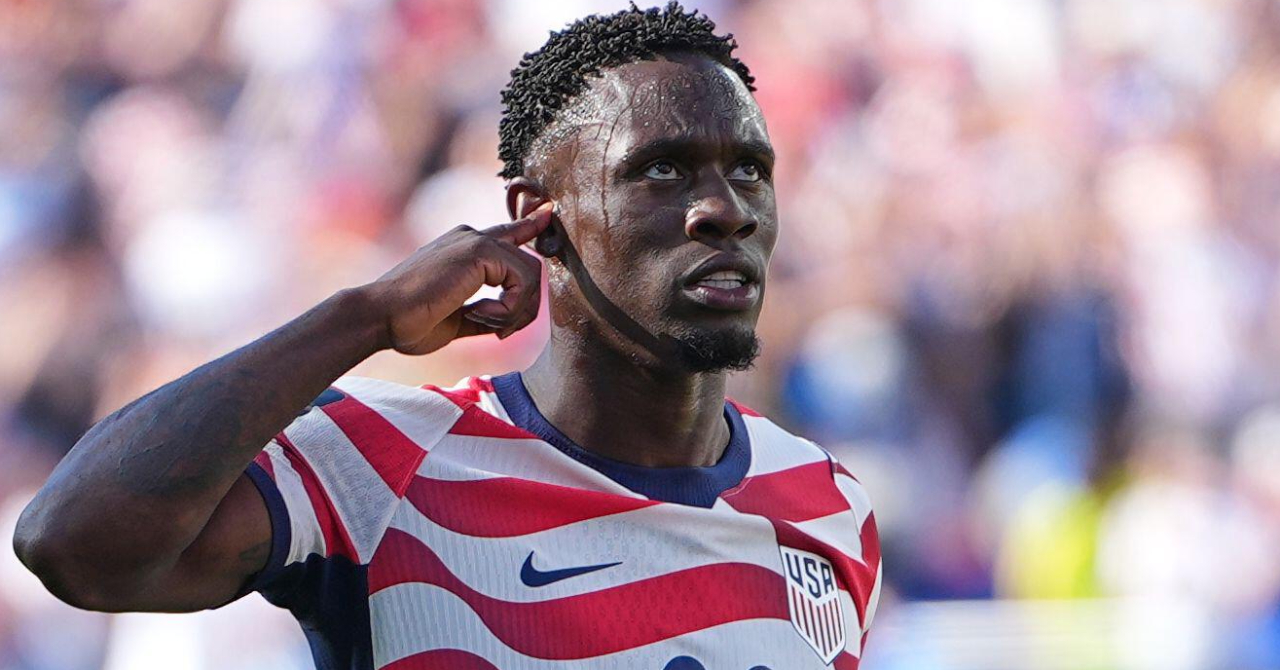
Controversy Erupts: Balogun Ban Blunder Rocks World Cup Integrity!
The beautiful game, often lauded for its unyielding commitment to fair play and transparent governance, finds itself embroiled in a scandal that threatens to cast a long, dark shadow over the 2026 World Cup. At the heart of this storm is Folarin Balogun, the prodigious striker, whose controversial clearance to play for the United States against Belgium in the Round of 16 has ignited a fiery debate, with Belgium’s Football Association now demanding an urgent explanation from FIFA.
This wasn’t just a minor administrative hiccup; it was a seismic jolt to the very foundations of FIFA’s disciplinary process. Balogun, having already showcased his electrifying talent with three crucial goals in the tournament, had earned a straight red card – an undeniable, unequivocal infraction that should have triggered a one-match suspension. Yet, in a move that defied precedent and logic, FIFA mysteriously suspended his ban for a full year. The decision was not only baffling but utterly unprecedented, prompting a global outcry and leaving football federations across the globe scratching their heads in disbelief.
The uproar reached fever pitch when whispers turned to shouts, revealing an astonishing layer of alleged political interference. Reports surfaced, suggesting that none other than US President Donald Trump and high-ranking White House officials had actively lobbied FIFA over Balogun’s situation. If true, this transcends mere controversy; it is a direct assault on the independence and integrity of world football’s governing body, opening a Pandora’s Box of questions about who truly holds sway in critical decisions.
UEFA, the powerful European football governing body, and the Royal Belgian Football Association (RBFA) were among the first to voice their profound concerns, articulating a collective bewilderment that resonated with fans and pundits alike. Two months have passed since that contentious Round of 16 clash, and yet, the RBFA confirms they are still awaiting a “satisfactory response” from FIFA. The silence is deafening, and it speaks volumes about the discomfort and potential complicity within FIFA’s inner sanctum.

Pascale van Damme, the president of the RBFA, minced no words in her recent statement, embodying the frustration of a nation and a continent. “Two months after the events, our questions remain unanswered,” she declared, her voice echoing the demand for accountability. “Given the importance of transparency and clarity for all parties involved, we request the necessary explanations and, at the same time, wish to explore where improvements to the current processes are possible, so that similar cases can be handled in a clear, consistent and efficient manner in the future.” Her words are not just a call for clarity; they are a battle cry for systemic reform, for a restoration of faith in a system that appears to have buckled under external pressure.
Van Damme’s commitment goes beyond this single incident. “Together with UEFA, the other confederations and the national associations, we remain committed to transparency in decision-making, strong governance and clear processes. We remain open to constructive cooperation, in the interest of the trust, integrity and future of football.” This isn’t just about Balogun; it’s about setting a dangerous precedent, about the erosion of trust, and about ensuring that the beautiful game remains untainted by political machinations or preferential treatment. The stakes could not be higher.
Game Highlights: A Match Under a Cloud of Doubt
The match itself, a Round of 16 encounter between the United States and Belgium, was meant to be a showcase of footballing prowess, a true test of wills on the biggest stage. Instead, it became a footnote to a burgeoning scandal. The air in the stadium was thick with anticipation, but beneath it, a palpable sense of unease lingered, especially around the US camp.
From the opening whistle, Belgium, arguably one of the most potent attacking forces in the tournament, pressed with relentless intent. Their golden generation, playing with a point to prove, capitalized on what seemed to be a distracted US defense. Early in the first half, a magnificent through ball from Kevin De Bruyne split the US backline, finding Romelu Lukaku, who slotted home with his customary power and precision, giving Belgium the lead. The goal was a masterpiece, but one couldn’t help but wonder if the controversy had already unnerved the American squad.
Balogun, restored to the starting XI, looked a shadow of the player who had lit up the group stages. His runs lacked the usual incisiveness, his touches seemed heavy, perhaps burdened by the immense pressure and the ethical cloud hanging over his inclusion. Belgium, sensing vulnerability, doubled their lead before halftime through a well-worked Eden Hazard goal, exploiting space down the flank and finishing with clinical accuracy. The US battled, showing flashes of individual brilliance, but the cohesion that marked their earlier performances was conspicuously absent.
The second half saw more Belgian dominance. Another expertly taken goal, this time a header from a corner, pushed the score to 3-0, effectively sealing the US’s fate. While the Americans fought valiantly, managing a late consolation goal through a spirited solo effort from an attacking midfielder, the 4-1 scoreline felt almost secondary to the lingering questions. Belgium deserved their win, advancing to the quarter-finals before their eventual elimination by Spain. But for many, the victory felt tainted, achieved against an opponent whose preparations were undoubtedly compromised by an external storm of FIFA’s making.
Prediction: A Reckoning on the Horizon?
The FIFA Council meeting, where Belgium intends to table this explosive issue, looms as a critical juncture for the integrity of global football. Will FIFA finally provide the “clear justification” and “transparency” that the RBFA, UEFA, and indeed the entire footballing world demands? My prediction, based on FIFA’s historical patterns of crisis management, is one of cautious skepticism.
While the pressure from powerful federations like Belgium and UEFA cannot be ignored, FIFA is likely to offer a carefully worded, somewhat evasive response. They might commission an “independent review” or promise “future improvements to processes” – a classic bureaucratic sidestep designed to diffuse immediate outrage without truly addressing the core issue of accountability for past decisions, especially those allegedly influenced by political figures. A genuine admission of wrongdoing or the imposition of severe sanctions on those responsible for bending the rules seems improbable, given FIFA’s inherent resistance to public self-flagellation.
However, the sheer audacity of this particular incident, coupled with the unwavering stance of the Belgian FA, suggests that this cannot simply be swept under the rug. This controversy will undoubtedly force FIFA to at least *appear* to tighten its disciplinary protocols. The long-term prediction is that while this specific incident might eventually fade from the immediate headlines, it will forever serve as a stark reminder of the ever-present threat of external influence on the sport. The trust, integrity, and future of football will remain under scrutiny, forever challenged by the shadow of the Balogun Ban Blunder, forcing federations and fans alike to remain eternally vigilant in their fight for a truly fair game.