
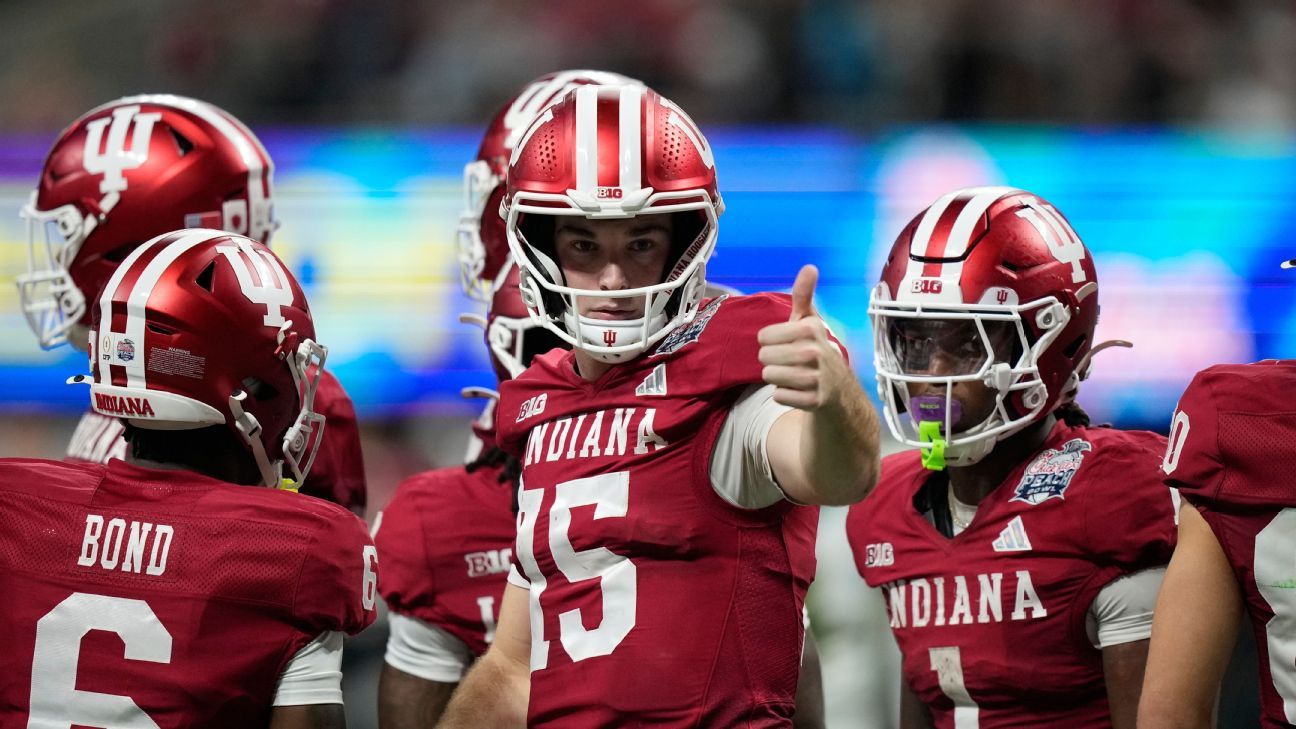
The 2027 cohort of NFL draft-eligible signal-callers is destined to be among the most extensively discussed ever. (That is a noteworthy assertion, of course, given the frequent conversations surrounding every class.) Yet, encompassing talents such as Arch Manning, Julian Sayin, Dante Moore, LaNorris Sellers, Jayden Maiava, Trinidad Chambliss, and others, next year’s assembly will be replete with both immense potential and captivating narrative possibilities.
However, preceding that, comes 2026. This year’s draft group might only feature a single first-round selection and, indeed, merely two quarterbacks within the top 50. Fernando Mendoza of Indiana is, naturally, expected to be the No. 1 pick for the Las Vegas Raiders. Beyond him, however, are quarterbacks who display either limited ceiling, primarily functioning as short-pass specialists, or individuals possessing extraordinary upside alongside significant bust potential. No player is ever a certainty, but it is fair to say this particular crop offers less assurance than others.
Nevertheless, the quarterback position remains paramount in team sports. Teams will recruit numerous QBs fueled by optimism alone (or, perhaps, the necessity for a backup), and such hope could genuinely materialize for a couple of them. Therefore, for the top 10 quarterback prospects, let us examine the reasons each might succeed and why each could (likely) fall short.
(Note: Unless otherwise specified, all rankings presented below are derived from a sample of 83 quarterbacks with a minimum of 15 FBS starts during 2024-25.)
Navigate to a QB:
Mendoza | Simpson | Beck | Nussmeier | Green
Allar | Payton | Klubnik | Altmyer | Robertson


Unfiltered 2024-25 statistics: 27 starts, 538-of-765 passing, 6,539 yards, 70.3% completion rate, 57 touchdowns, 1.6% interception rate, 7.9% sack rate, 52% success rate, 7.5 yards per dropback, 111 non-sack carries for 784 yards and nine TDs
Total QBR position (out of 84): seventh (79.4)
Reasons for potential success: His continuous progress is notable. I find the strategy of utilizing two years of data for an analysis like this valuable because it provides a more expansive sample and mitigates the influence of a brief period of exceptional (or poor) performance. However, concerning Mendoza, it wasn’t merely a temporary surge in 2025; rather, it reflected a sustained escalation in his performance throughout the season.
If we categorize Mendoza’s 35 collegiate starts – 19 over two years at California, followed by 16 in one season at Indiana – into distinct segments, we uncover the profile of an individual whose maximum capability had not yet been reached when he departed college.
Starts 1-15: 60.4 Total QBR, 65.2% completion rate, 6.3 yards per dropback
Starts 16-20: 70.9 Total QBR, 68.4% completion rate, 7.0 yards per dropback
Starts 21-25: 88.1 Total QBR, 74.6% completion rate, 9.0 yards per dropback
Starts 26-30: 91.8 Total QBR, 75.2% completion rate, 8.8 yards per dropback
Starts 31-35: 92.4 Total QBR, 69.3% completion rate, 7.6 yards per dropback
Among his most recent five games were Indiana’s Big Ten championship game triumph over top-ranked Ohio State and College Football Playoff victories against Alabama, Oregon, and Miami. A slight decline in his raw statistics would be anticipated when facing such formidable opponents, and this indeed occurred, yet his Total QBR, adjusted for opposition, continued its upward trajectory.
Frankly, observing Mendoza’s play in 2025 evoked the impression of someone mastering a complex video game. He would commit an error, absorb the lesson, and avoid repetition. Even an otherwise subpar showing transformed into one of his finest moments when he orchestrated an extraordinary, 80-yard two-minute drive, featuring four impeccably executed passes, to secure a narrow victory against Penn State.
By the season’s conclusion, Mendoza was demonstrating nearly mechanical precision in timing and throwing, delivering almost every pass precisely where only his targets could retrieve it, frequently hitting their back shoulder with perfection. And across his final six collegiate games, he completed 74% of his throws with 15 touchdowns and only one interception. He even exhibited an eagerness to gain yardage personally: in contests where his passing was not flawless, he was content to scramble. He ran five times for 35 yards during a closely contested win against Iowa, and seven times for 74 yards in College Football Playoff victories over Alabama and Oregon, and his most renowned maneuver in Indiana’s title game triumph over Miami was also executed using his legs:
His performance was so exceptional that although his two-year numbers were undeniably strong, it became simple to conclude that a complete two-year data set was not truly indicative of his abilities – only his final form truly mattered.
Reasons for potential failure: He is likely to absorb numerous impacts. Mendoza possessed an extraordinary aptitude for learning from errors, however, when opposing teams successfully pressured him, he sometimes appeared somewhat unsettled.
The nationwide mean for the proportion of sacks relative to pressures stood at 17.2% during 2024-25 – implying that, on average, approximately one out of every six pressure situations resulted in a sack – but Mendoza significantly surpassed that metric (negatively) in both years. His proportion was 25.3% as he sustained 41 sacks at Cal in 2024, and despite receiving considerably better protection at Indiana in 2025 (his rate of facing pressure decreased from 38.4% to 28.3%), he nonetheless sustained 25 sacks, maintaining a 22.5% sacks-to-pressures proportion.
And despite improvements in numerous statistics during the latter part of the season, this particular metric remained unchanged: in his final seven games of 2025, he was sacked 18 times (a substantial 10.4% sack incidence) with a 30.5% sacks-to-pressures proportion. This is a critical point, as while collegiate statistics do not invariably translate identically to the NFL – it can generally be asserted that you are unlikely to exceed your college rate statistics, yet the degree of proximity is uncertain – the sacks-to-pressures ratio tends to be quite persistent, adhering to a player more consistently than many other metrics.
Granted, a couple of other recent No. 1 selections diverged somewhat from this pattern. Among top picks, Mendoza’s proportion is not significantly disparate from those of Caleb Williams and Kyler Murray, and they have not endured excessively poor sack rates in professional play. They are considerably more evasive, though: top draft selections who primarily operate from the pocket, like Joe Burrow and Cam Ward, have undeniably faced numerous impacts.
With Mendoza joining a Raiders squad that concluded the previous season with a 3-14 record and witnessed Geno Smith taking 55 sacks, it is reasonable to anticipate he might absorb an inordinate amount of impacts in 2026, and potentially in subsequent years. While there is no assurance he won’t learn and adjust, as he has demonstrated with all other challenges – this being his most formidable attribute – accumulating an excessive number of hits can devastatingly impede a quarterback’s progression more than almost any other factor, and it represents an obstacle Mendoza must demonstrate he can surmount.

Unfiltered 2024-25 statistics: 15 starts, 319-of-498 passing, 3,734 yards, 64.1% completion rate, 28 touchdowns, 1% interception rate, 5.5% sack rate, 44.6% success rate, 6.6 yards per dropback, 69 non-sack carries
accruing 348 yards and three touchdowns
Overall QBR standing (from 84): 18th (76.0)
Reasons for potential triumph: Composure in the pocket. This selection pool features numerous quarterbacks adept at executing concise, secure throws and sustaining offensive momentum, though many have yet to demonstrate proficiency in the high-stakes, narrowly-targeted, deep throws sought by NFL talent evaluators. Within this particular player profile, Simpson presents the most secure option. He performs effectively amidst a congested pocket, and his interception percentage (1%) stood out as demonstrably superior among all individuals in this 84-quarterback group. (His touchdown-to-interception proportion of 5.6 ranked second.) He skillfully prolongs plays — ranking 66th in average throwing time (2.90) — while largely avoiding significant impacts. Such an attribute clearly holds worth, which is precisely why he retains a possibility of being chosen in the initial round.
Reasons for potential setback: Limited NFL-caliber throws. Even though he was a fourth-year junior in 2025, his experience in terms of repetitions trails that of the majority of athletes on this roster. Over the preceding two seasons, he made merely 562 dropback attempts (placing 67th out of 83) and just 142 against man-to-man coverage. (He achieved an average of only 6.3 yards per dropback when facing man coverage, positioning him 59th.) Furthermore, while he rarely committed turnovers, he frequently opted for simpler solutions: He positioned 54th in yards per completion (11.7) and 55th in yards per dropback (6.6), delivering only 12.7% of his throws 20 or more yards downfield (54th).
Additionally, despite cinematic evidence suggesting sound pocket mechanics, Simpson still registered 44th in sack percentage (5.5%) — notwithstanding protection from projected top-15 selection Kadyn Proctor at left tackle — and 48th in the proportion of sacks relative to pressures (17.2%). It is conceivable that we are overestimating this particular aspect of his performance, and should he endure frequent hits without ever attempting significant deep throws, what precisely is the potential benefit?
1:35
The reasons Ty Simpson brings Shedeur Sanders to Matt Miller’s mind
Matt Miller articulates his reasoning for not projecting Ty Simpson as a first-round draftee.

Unadjusted 2024-25 statistics: 29 appearances, 628 completions from 915 attempts, 7,298 accrued yards, 68.6% passing accuracy, 58 touchdowns, 2.6% interception frequency, 3.8% sack frequency, 47.4% effective play rate, 7.3 yards per dropback, 81 rushing attempts not resulting in sacks for 380 yards and three touchdowns
Overall QBR standing (from 84): fifth (81.3)
Reasons for potential triumph: Quick release and reception. Across the last two campaigns, no player initiated more contests than Beck, with only incoming Indiana signal-caller Josh Hoover accumulating more passing yardage. Beck will reach 24 years of age during his inaugural season this autumn; by prospect benchmarks, he is a seasoned campaigner.
This observation is logical upon viewing his play: He essentially embodied the collegiate equivalent of a late-career Tom Brady or Aaron Rodgers. The football departed his grasp instantaneously upon its reception. He placed second in average release time (2.51 seconds), first in pressure susceptibility (19.2%), and third in both sack susceptibility (3.8%) and contact frequency (17.6%). His passes did not travel great distances — he ranked 61st in average air yards per attempt (7.7), and 30.5% of his throws aimed at players at or behind the line of scrimmage (11th highest) — yet he skillfully fulfilled the role of a facilitator.
Reasons for potential setback: For sheer undeveloped potential, seek alternatives. At Miami, Beck performed under the guidance of the identical offensive coordinator (Shannon Dawson) who was instrumental in Cam Ward becoming the top selection last year, but while Ward was a prolific big-play producer (14.1 yards per completion), Beck demonstrated a distinctly divergent style of play and ranked merely 56th in yards per completion (11.6).
Beck’s visual distribution of passes quite conclusively illustrates his typical throwing destinations.
Beck was a rapid throw-and-receive specialist, with both positive and negative implications, and if the intended target wasn’t open, adverse outcomes frequently ensued. He consistently refrained from extending plays — a mere 7.1% of his throws originated outside the pocket (second lowest within the observed group), and although he seldom faced pressure, such pressures often resulted in sacks (21.7%, 64th). Furthermore, notwithstanding his infrequent deep attempts, he nevertheless positioned 54th in interception frequency (2.6%).
Provide Beck with a skilled tight end and several rapid options, and he will utilize them. However, when adversaries adapt to this strategy (as they invariably will), his capacity for further growth remains uncertain.

Unadjusted 2024-25 statistics: 22 starts, 531 completions from 813 attempts, 5,979 gained yards, 65.3% passing accuracy, 41 touchdowns, 2.1% interception frequency, 3.7% sack frequency, 46.2% effective play rate, 6.8 yards per dropback, 32 rushing attempts not resulting in sacks for 178 yards and four touchdowns
Overall QBR standing (from 84): 13th (77.0)
Reasons for potential triumph: The year 2025 served as a developmental chance. Should one perceive Nussmeier’s aforementioned figures as remarkably unremarkable, that assessment is correct. His performance metrics suffered due to a tumultuous, ailment-ridden 2025 campaign during which whispers circulated of him contending with various (unspecified) physical maladies, and his accompanying roster provided insufficient assistance.
Subsequent to foreshadowing respectable potential in 2024, Nussmeier largely dedicated 2025 to an exceedingly cautious style of play. He reduced his average throwing duration by a quarter of a second (from 2.84 to 2.58), and while he elevated his completion percentage from 64.2% to 67.4% and lowered his interception frequency from 2.3% to 1.7%, he essentially sacrificed all potential for doing so: His yards per completion diminished from 12.0 to a mere 9.9, and his yards per dropback decreased from 7.2 to 6.0.
Why was the preceding passage situated within the “reasons for potential triumph” segment? Because such an alteration in mindset might prove beneficial if he becomes entirely healthy yet confronts NFL defensive schemes in the ensuing months or years. He capably executed by maximizing available opportunities, and if he can integrate that approach with intermittent menacing deep throws, the challenges of 2025 could ultimately yield a degree of enhanced potential.
Reasons for potential setback: The inherent potential remains
theoretical. It’s important to observe that, even with a considerably more formidable pass-catching unit (and robust physical condition) in 2024, his statistics for that season were rather ordinary. Among signal-callers from 2024 in particular, he was positioned 35th in yards per dropback (7.2), 42nd in his completion percentage (64.2%), 46th in his interception percentage (2.3%), and 70th in yards per completion (12.0). Moreover, he is of lesser stature compared to many other quarterbacks on this roster — standing at 6-foot-2 and weighing 203 pounds — making it challenging to discern the necessary potential, even when observing his strongest campaign.

Unaltered 2024-25 statistics: 24 appearances, 428-of-707 passing, 5,868 aerial yards, 60.5% completion percentage, 34 touchdowns, 2.8% interception percentage, 7.7% sack frequency, 48% achievement rate, 7.4 yards per dropback, 236 carries not resulting in a sack for 1,837 yards and 16 touchdowns
Overall QBR position (from a pool of 84): 15th (76.7)
Reasons for potential achievement: Boundless potential and physical prowess. Amidst a multitude of hopefuls possessing simple passing accuracy and virtually devoid of further potential, Green emerges as a sanctuary. Delight in his readiness to simplyexperiment. Among the FBS signal-callers featured here, none achieved a higher average gain per rush than Green, and scarcely anyone else secured greater yardage per completed pass.
Green secured the fifth position among the 84 signal-callers in yards per completion (13.7) and blended dynamic playmaking with reliable effectiveness: Furthermore, he ranked 13th in achievement rate (48%). He seldom delivered throws either at or behind the line of scrimmage — he truly epitomized a Bobby Petrino-style quarterback, after all — and when he sighted an unobstructed path in front of him, he seized the opportunity. He was 19th in his scrambling frequency (9.7%) and foremost in yards gained per scramble (10.8). Within this dataset, just a single quarterback recorded a higher average of total yards per non-sack rush, and that was UTSA’s Owen McCown who does not typically run. Green was similarly proficient when facing man-to-man and zone schemes, and I am nearly certain no other individual in this draft cohort possesses the ability to execute such a maneuver.
0:36
Touchdown! Taylen Green achieves a 64-yard ground score
Touchdown! Taylen Green achieves a 64-yard ground score
Alternatively, consider this play from his inaugural year at Boise State.
0:38
Taylen Green converts a play-action for a 91-yard score
Taylen Green surpasses the Aggies’ defense on a 91-yard touchdown run, clinching victory for the Broncos.
Reasons for potential setbacks: An abundance of errors. Following the commendation I just provided, it might be perplexing as to why Green is not considered a top-tier draft candidate. This is attributable to his subpar performances being both more severe and more common than those of any other individual featured here. This presents a considerable impediment.
Green was 59th in completion percentage (60.5%) and 63rd in interception frequency (2.8%), and he absorbed all the expected impacts from a quarterback who spent an average of 3.15 seconds before releasing the ball (the second-highest duration): He was 71st in sack frequency (7.7%), 66th in contact percentage (38.5%) and 65th in the ratio of sacks to pressures (21.7%). Arkansas concluded last season with a 2-10 record, notwithstanding a top-25 offensive unit, and while that fully illuminates the Razorbacks’ dismal defensive performance, Green’s propensity for committing ruinous errors at precisely inopportune moments played a role in the squad’s 1-9 standing in games decided by a single score across the preceding two campaigns. He is tremendously entertaining yet utterly unreliable.

Unaltered 2024-25 figures: 22 appearances, 365-of-553 aerial yardage, 4,427 yards, 66% completion percentage, 32 touchdowns, 2% interception percentage, 4.3% sack frequency, 50.1% achievement rate, 7.4 yards per dropback, 107 carries not resulting in a sack for 638 yards and seven touchdowns
Overall QBR position (from a pool of 84): 24th (73.0)
Factors favoring his success: Powerful throwing ability, grand aspirations. He was a highly touted five-star talent, and at 6-foot-5, 230 pounds, he’s an archetype for the NFL. He patiently awaited his opportunity at Penn State, guided the Nittany Lions to the CFP semifinals in 2024, and came back to academia intending to propel them to greater heights in 2025. The outcome was, to put it mildly, unfavorable: Penn State’s performance deteriorated after a loss to Oregon, and Allar was sidelined for the remainder of the season due to injury after a third consecutive defeat.
Nevertheless, Allar mastered a consistent, effective playing style — he was sixth among 83 in achievement rate (50.1%) and 16th in completion percentage (66%) — while gaining unearned yardage via his mobility: He was 18th in scrambling frequency (9.8%) and maintained a robust average of 7.5 yards per scramble. That’s an advantageous blend.
Reasons for potential setbacks: He fails to adequately leverage his powerful throwing arm. Occasionally, there is merit in taking chances that could result in interceptions, and Allar indeed experienced a pair of erratic performances concerning this — he registered a total of five interceptions against USC and Oregon during 2024 — and regrettably for him, perhaps his two most notable throws resulted in turnovers: the one that positioned Notre Dame for victory in the 2024 semifinals and the one that terminated PSU’s rally endeavor against Oregon in 2025.
However, those errors did not constitute his most significant issues. Predominantly, he performed as though he possessed considerably greater physical constraints. He was positioned 42nd in yards per completion (12.1) across these two campaigns, and he delivered merely 8% of his throws 20 or more yards deep, the smallest proportion within the 83-player cohort. Such an occurrence is atypical. His foremost anticipated asset paradoxically emerged as his most significant shortcoming.

Unaltered 2024-25 figures: 13 appearances, 171-of-240 aerial yardage, 2,842 yards, 71.3% completion percentage, 18 touchdowns, 2.1% interception percentage, 8.4% sack frequency, 10.4 yards per throw, 135 carries not resulting in a sack for 1,069 yards and 14 touchdowns
Reasons for potential achievement: He excelled at the preceding tiers. Within a draft class brimming with secure, yet limited-potential, prospects, why not consider taking a chance on a hopeful with an impressive physical build (6-foot-3, 233 pounds) and statistics that significantly overshadow those of Carson Wentz (the 2nd overall selection in 2016) and Trey Lance (the 3rd overall selection in 2021)?
Wentz in 2015: 7.4 gain per throw, 62.5% completion percentage, 6.2 gain per rush*
Lance in 2019: 9.1 gain per throw, 66.9% completion percentage, 7.4 gain per rush*
Payton in 2025: 10.6 gain per throw, 71.9% completion percentage, 7.8 gain per rush*
(* I
counted quarterback takedowns as aerial attempts, not ground rushes, because that’s the correct methodology.)
Indeed, few things highlight a “versatile talent” better than a nearly flawless HudlIQ radar diagram.
Notwithstanding a surprising defeat by Illinois State in the FCS playoffs’ Sweet Sixteen, NDSU presented its strongest squad last autumn subsequent to Lance’s 2019 group. Payton effectively leveraged his substantial physique during ground attacks, and he pursued significant gains in a manner rarely witnessed from NDSU signal-callers. Immense promise resides within this player.
Potential Pitfall: His style of play diverged significantly. Payton exhibited another Mendoza-esque characteristic: his excessive comfort occasionally led him into difficulties. The singular, substantial flaw in the aforementioned radar diagram was prominent: his quarterback takedown percentage stood at8.6%in 2025, surpassing all other quarterbacks in this cohort, even considering the benefits derived from competing at a lesser tier. Payton frequently opted to scramble, consumed considerable time before releasing the ball, and sought out deep passing chances.
Perhaps Payton’s most indicative performance was his final one: During the astounding defeat to Illinois State, he launched a 78-yard scoring throw on the Bison’s initial play but connected on merely three additional throws, enduring four sacks throughout the remainder of the contest. ISU had faced NDSU earlier in the campaign, and upon their subsequent encounter with Payton, the Redbirds devised a strategy to exploit him, compel him to prolong plays, and generate substantial yardage losses. Payton’s fundamental abilities are remarkably promising, yet ISU demonstrated the considerable development he still requires.

Raw 2024-25 statistics: 26 starts, 565-for-878 aerials, 6,582 total yards, 64.4% completion accuracy, 52 scoring throws, 1.4% interception frequency, 4.4% sack incidence, 44.9% success ratio, 6.9 yards per snap from scrimmage, 162 non-sack ground carries for 851 yards and 11 touchdowns
Total QBR ranking (out of 84): 31st (70.6)
Reason for potential triumph: Another dependable passing specialist. Much like Allar, Klubnik is a former highly-touted recruit possessing a powerful arm and a commendable knack for gaining ground with his legs. He evades pressure effectively—he ranked 17th in the ratio of sacks to pressures (13.1%)—and boasts extensive experience, with 40 career starts and over 10,000 career passing yards. Furthermore, similar to Simpson, he demonstrates caution regarding turnovers: He was sixth in interception rate (1.4%) and fifth in touchdown-to-interception ratio (4.3). Throughout his tenure in collegiate football, many quarterbacks performed significantly worse than Klubnik.
Reason for potential failure: He won’t elevate his supporting cast. With the finest receiving unit at his disposal at Clemson, Klubnik reached a high performance standard in 2024: He registered six games with a Total QBR of 88.0 or greater and nine contests with at least three scoring passes. His 262 yards and four touchdowns in the ACC championship match aided the Tigers in securing a CFP spot.
However, with his pass-catchers sidelined by injuries in 2025, he reverted to his prior form. Across his four seasons at Clemson, his Total QBR by year was 57.1 (as a backup), 55.0, 78.7, and 60.1, respectively. This makes 2024 appear to be a significant deviation. Over the past two seasons, he was a respectable 28th in completion percentage (64.4%) but a middling 42nd in success rate (44.9%) and 55th in yards per completion (11.7%). He also didn’t utilize his athletic prowess as frequently as he could have: He stood at just 63rd in scramble rate (4.7%) and 35th in planned runs (10.8%). Competent? Yes. But he never fulfilled the high expectations of a blue-chip prospect.

Raw 2024-25 statistics: 26 starts, 457-for-712 aerials, 5,724 total yards, 64.2% completion accuracy, 44 scoring throws, 1.5% interception frequency, 8.2% sack incidence, 47% success ratio, 6.9 yards per snap from scrimmage, 135 non-sack ground carries for 890 yards and nine touchdowns
Total QBR ranking (out of 84): 22nd (74.1)
Reason for potential triumph: He didn’t operate in an easy environment. Across 12 seasons from 2012 to 2023, Illinois garnered an average of 4.3 victories per season with an average offensive SP+ ranking of 88.9. That average stood at 90.0 during Bret Bielema’s initial three campaigns. However, with Altmyer healthy and leading the charge, the Illini surged to 55th in 2024, then 27th last autumn despite a lackluster ground game. Over the past two seasons, they secured 19 wins, notwithstanding competing in the conference boasting the highest average defensive SP+ rating in FBS.
Throughout this impressive stretch, Altmyer consistently made prudent, sound decisions and advanced the ball with above-average effectiveness. He was 10th in interception rate (1.5%), 21st in success rate (47%), and 33rd in completion rate (64.2%). He produced figures comparable to Klubnik’s at minimum, despite a less formidable supporting cast. (He did have third-round receiver Pat Bryant in 2024, for whatever that’s worth.)
Reason for potential failure: When prolonging plays goes awry. While his efficiency metrics were decent, he ranked merely 44th in yards per dropback (6.9), partly due to a scarcity of explosive plays and partly because he endured numerous hits. He was 59th in average time to throw (2.85 seconds), and there weren’t enough big passes to offset rankings of 50th in contact rate (33.9%), 76th in sack rate (8.2%), and 73rd in sacks-to-pressures ratio (23.1%).

Raw 2024-25 statistics: 23 starts, 533-for-872 aerials, 6,752 total yards, 61.1% completion accuracy, 59 scoring throws, 2.3% interception frequency, 4.1% sack incidence, 46.2% success ratio, 7.1 yards per snap from scrimmage, 82 non-sack ground carries for 500 yards and seven touchdowns
Total QBR ranking (out of 84): 17th (76.4)
Reason for potential triumph: He possesses considerable experience. In two seasons as Baylor’s primary signal-caller, Robertson secured victories with final scores of 48-45, 59-35, 49-35, 37-34, and 35-34. He faced defeats with scores of 55-28, 42-36, 44-31, and 34-28. A substantial portion of his work occurred in very close contests, and he threw more touchdown passes than any other player in this assessment group. He also displayed proficiency in releasing the ball swiftly and effectively: He was 13th in average time to throw (2.58 seconds) and consequently ranked fourth in pressure rate encountered (25.8%) and ninth in contact rate (21.3%). Despite this, he still maintained a respectable average of 12.7 yards per completion (27th). He also boasts solid physical attributes—6-foot-4, 216 pounds—and as a sentimental bonus, he was Mike Leach’s final quarterback.
Reason for potential failure: Where does he distinguish himself?Robertson’s overall statistics were good, but he was 56th in completion rate (61.1%), 39th in interception rate (2.1%), 55th in catchable ball rate (76.1%), and 56th in QBR against man coverage (56.9%). Furthermore, he doesn’t excel in any notable way outside the pocket—he’s 66th in scramble rate (4.4%) and 82nd in the percentage of passes thrown outside the pocket (8.7%). Many individuals in this cohort deliver passes quickly and minimize turnover risk. He is not the most secure option among the group.