
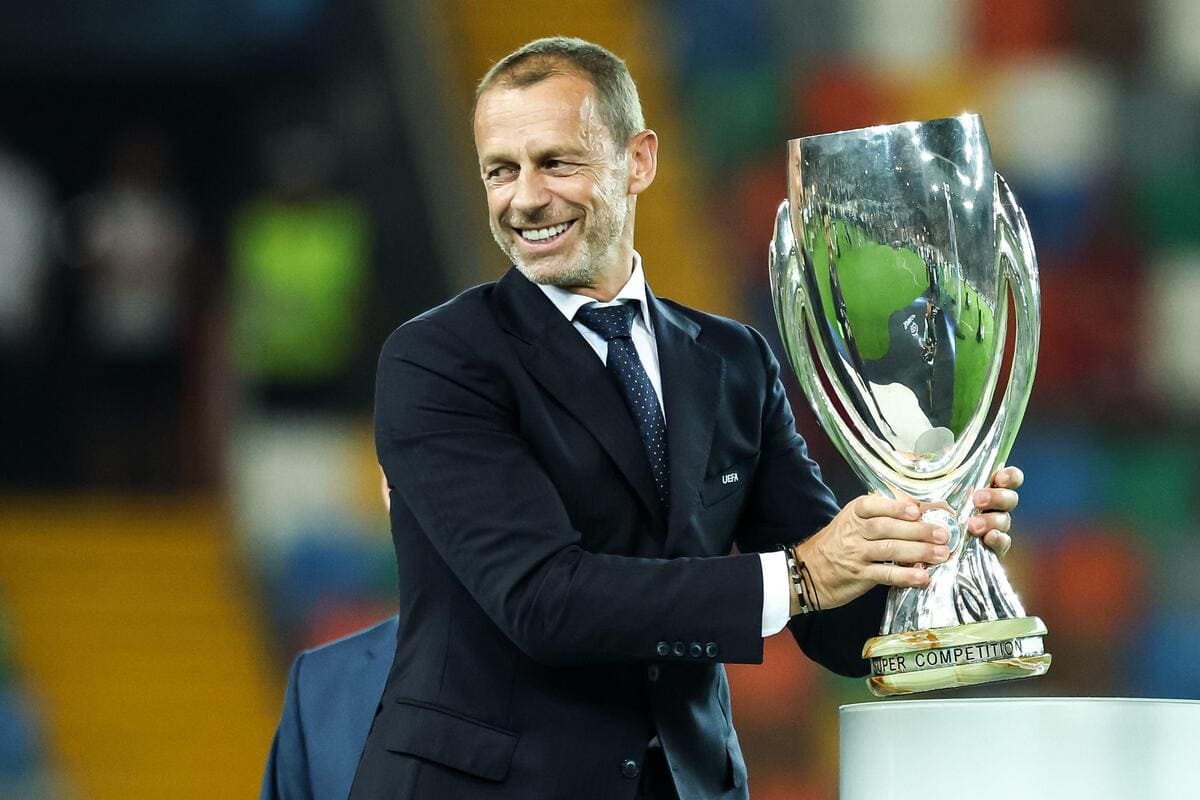
NEW JERSEY – The electric atmosphere of a World Cup final, traditionally the zenith of global football, was undeniably palpable at the MetLife Stadium. Yet, amidst the roar of the crowd and the glitter of a star-studded half-time spectacle, a seismic absence loomed large. UEFA President Aleksander Ceferin, the most powerful figure in European football, pointedly boycotted Sunday’s World Cup final between Argentina and Spain, a stark and unprecedented protest against FIFA’s increasingly controversial direction.
Ceferin’s non-attendance, a silent but thunderous rebuke, sent shockwaves through the footballing world. Having graced the opening match in Mexico City, his decision to skip the grand finale in New Jersey was no mere oversight, but a meticulously calculated statement following a series of escalating disagreements with FIFA President Gianni Infantino and his administration. The chasm between football’s two most influential bodies has never felt wider, threatening to fracture the very foundations of the global game.
At the heart of Ceferin’s outrage, and indeed the final straw that triggered his boycott, was FIFA’s astonishing reversal of Folarin Balogun’s suspension. This extraordinary intervention, reportedly at the behest of none other than United States President Donald Trump, shattered conventional legal and sporting protocols. UEFA’s condemnation was swift and scathing, branding the decision “unprecedented, incomprehensible and unjustifiable.” Their subsequent statement resonated with the gravity of the situation: “When the certainty of rules is no longer guaranteed by its guardians, the integrity of the game is at stake and the credibility of a competition is undermined.” This wasn’t just about a single player; it was about the sanctity of due process, the independence of sporting tribunals, and the insidious creep of political influence into what should be an autonomous sporting arena.
UEFA Rejects Half-Time Spectacle: A Clash of Visions
Beyond the Balogun affair, Ceferin’s protest encapsulates a deeper philosophical divergence regarding the very soul of football. Infantino’s tenure has seen a relentless push towards transforming the sport into an all-encompassing entertainment spectacle, blurring the lines between sport and show business. The World Cup final itself was a testament to this vision, featuring a bombastic half-time show with performances from global superstars Madonna, BTS, Shakira, and Justin Bieber. This extravaganza extended the traditional 15-minute interval to a staggering 27 minutes, leaving players lingering in the tunnels and fans waiting impatiently for the resumption of play.
UEFA, staunch defenders of football’s traditional purity, have emphatically rejected any plans to introduce similar, elongated spectacles at their flagship competitions, the Champions League or the European Championship. For Ceferin, the game itself, its drama, its skill, and its inherent narrative, should be the primary attraction. The integrity of the match, the welfare of the players who need an optimal interval for rest and tactical adjustments, and the fan’s desire for continuous football are paramount. This isn’t just a preference; it’s a foundational belief system – a stark contrast between FIFA’s ‘entertainment-first’ model and UEFA’s unwavering ‘football-first’ mantra.
The disagreements don’t end there. UEFA remains firmly against FIFA’s proposals to expand the World Cup to a mammoth 64 teams, an idea Infantino casually floated during the tournament. Such an expansion, critics argue, would dilute the quality of the competition, place unbearable logistical strain on host nations, and risk oversaturating the global football calendar. Furthermore, UEFA took a proactive stand on the issue of human rights and fairness after Somali referee Omar Artan was denied entry to the United States before the World Cup. In a deliberate act of defiance and solidarity, UEFA swiftly appointed Artan to officiate the prestigious UEFA Super Cup between Paris Saint-Germain and Aston Villa on August 12th, sending a clear message about inclusivity and opportunity within their jurisdiction.
Even the fundamental issue of fan access has become a battleground. While World Cup attendees in the US faced exorbitant ticket prices, with some parking spaces costing more than several match tickets in other regions, UEFA has committed to broadly freezing prices for Euro 2028. Their stated aim is to allow supporters to buy five match tickets for roughly the cost of a single parking space at a World Cup venue in the United States. This difference in approach highlights a philosophical divide: is football a premium product exclusively for the affluent, or a universal game accessible to the masses?
Game Highlights: Argentina vs. Spain – A Thrilling Showdown
Despite the off-field political drama, the World Cup final itself delivered an enthralling spectacle worthy of the occasion. Argentina, driven by the enduring brilliance of Lionel Messi (who, at 39, still dictated play with sublime vision), faced a youthful and dynamic Spanish side brimming with the likes of Pedri and Gavi. The first half was a tense tactical battle, with Spain dominating possession but struggling to break down Argentina’s resolute defence marshalled by Emiliano Martinez in goal and the towering presence of Cristian Romero. Argentina, however, always posed a threat on the counter, with Julian Alvarez’s blistering pace causing problems.
The breakthrough finally came in the 67th minute. A moment of pure magic saw Messi, dancing past two Spanish defenders on the edge of the box, thread an exquisite through ball for Lautaro Martinez, who coolly slotted past Unai Simon. The stadium erupted in a cacophony of blue and white. Spain, refusing to wilt, pushed forward relentlessly. Their persistence paid off in the 88th minute when a surging run from Alejandro Balde down the left flank led to a pinpoint cross, met by a diving header from substitute Nico Williams to level the scores. Just as extra time loomed, a defensive lapse from Aymeric Laporte in the 92nd minute allowed Enzo Fernandez to snatch possession, unleash a powerful, curling shot from 20 yards that nestled in the top corner. MetLife Stadium exploded once more as Argentina sealed a dramatic 2-1 victory, cementing their legacy and offering a pure footballing antidote to the controversies swirling around the tournament.
Prediction: A Widening Gulf and an Uncertain Future
The World Cup final, for all its on-field glory, will be remembered as much for Ceferin’s absence as for Argentina’s triumph. This boycott is not merely a symbolic gesture; it signifies a dangerous inflection point for global football governance. The ideological chasm between FIFA’s commercial-first, expansionist vision and UEFA’s tradition-bound, integrity-focused approach appears set to widen even further. Expect UEFA to continue fortifying its own competitions, potentially seeking to distance itself from FIFA’s more radical proposals, particularly regarding the club World Cup and further international calendar changes. We may see a future where UEFA’s Champions League and European Championship increasingly operate as a distinct, premium footballing ecosystem, while FIFA pursues its global expansion with more diverse, potentially less established markets. The immediate consequence will be continued friction and power struggles, with both bodies vying for influence and control over the sport’s direction and lucrative revenue streams. The greatest risk, however, is a fragmented football landscape, where the sport’s unity is sacrificed on the altar of conflicting ambitions and where the fan, ultimately, is left navigating a confusing and increasingly politicized terrain.