
Unlock the White House Watch newsletter for free
Your guide to what Trump’s second term means for Washington, business and the world
### Key Takeaways:
1. **Geopolitical Risk Remains Elevated:** Despite high-level peace talks involving US envoys, the lack of significant breakthroughs and ongoing hostilities in Ukraine, compounded by the broader US war with Iran, signals continued geopolitical uncertainty. This sustains a substantial risk premium across global asset classes, particularly in energy and defense sectors.
2. **Commodity Markets Under Pressure:** The protracted conflict in Ukraine and heightened tensions in the Middle East due to the US-Iran war place upward pressure on energy prices (oil, natural gas) and critical agricultural commodities. Investors should anticipate sustained volatility and potential supply chain disruptions through the upcoming winter season.
3. **Cautious Investor Sentiment:** The ambiguous nature of the peace proposals, coupled with both Kyiv and Moscow’s firm stances on territorial integrity, suggests a prolonged stalemate. This reinforces a cautious stance among investors, who are likely to favor safe-haven assets and sectors resilient to geopolitical shocks over growth-oriented plays.
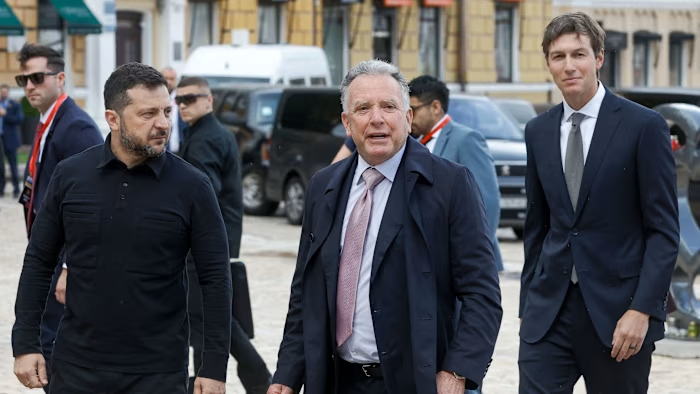
Global markets held their breath this weekend as Donald Trump’s envoys, Steve Witkoff and Jared Kushner, embarked on a high-stakes diplomatic mission, engaging separately with President Volodymyr Zelenskyy in Kyiv and Russian leader Vladimir Putin in Moscow. The delicate dance underscores persistent geopolitical volatility, with financial analysts closely scrutinizing every development for implications on energy prices, defense spending, and broader market stability, especially in the shadow of an escalating US war with Iran.
The duo’s first official visit to the Ukrainian capital came a day after their meeting with Putin. Notably, both Kyiv and Moscow reportedly agreed to a temporary pause in air strikes during the visit, a small but significant gesture that briefly tempered the geopolitical risk premium, albeit marginally. The envoys arrived armed with what the US president has termed “a proposal to end the war,” a phrase that typically sends ripples through futures markets anticipating potential de-escalation.
However, initial reports from Kyiv poured cold water on prospects of an immediate breakthrough. Sources familiar with the discussions indicated that the American delegation brought largely updated iterations of prior peace frameworks, rather than revolutionary new concepts. These revisions aimed to acknowledge the dramatically altered geopolitical landscape since peace negotiations collapsed in February, primarily at the outset of the US war with Iran. The introduction of a major conflict involving the United States in the Middle East has profoundly reshaped global risk calculations, diverting attention and resources, and placing immense pressure on global oil and gas markets already strained by the Ukrainian conflict.
The central sticking point remains the Donbas region – a critical industrial and resource-rich territory. Russia’s annexation claims over 75 percent of the region, despite its failure to fully capture the remaining Ukrainian-held territory, presents an intractable dilemma. For President Zelenskyy, relinquishing any sovereign territory, particularly Donbas, is a “red line.” This unyielding stance by both parties signals a prolonged period of negotiation and, likely, continued military friction, dampening hopes for a swift resolution that would otherwise spark a relief rally in global equities and stabilize commodity prices.
Discussions in Kyiv acknowledged the grim reality that a definitive end to the four-year-long war is improbable before winter. This acknowledgment has immediate market implications, particularly for European natural gas futures and energy security stocks. With Russia expected to escalate attacks on critical infrastructure as temperatures drop, the prospect of an even more challenging winter for Ukraine, and by extension, for European energy markets, is a significant concern for investors. While the envoys expressed optimism about progress before winter, their rhetoric offers little concrete reassurance to market participants bracing for potential energy supply shocks and increased humanitarian crises.
Steve Witkoff characterized the talks as “substantive and important,” preceding further engagements with German, British, and French national security advisers. Such multilateral discussions are crucial for coordinating international financial aid and sanctions regimes, which continue to shape the economic trajectories of all involved nations and influence investor sentiment toward European assets.
The choice of St Sophia Cathedral complex in central Kyiv for the talks, a symbol of Ukrainian heritage, was overshadowed by recent aggression. Just a day prior, a Russian jet-powered drone struck Ukraine’s security service headquarters directly across the street. This unprecedented daytime drone strike in Kyiv’s historic center serves as a stark reminder of the persistent and escalating threat environment. For insurers, this escalates the cost of war risk premiums, while for international businesses, it underscores the prohibitive operational risks in the region.
Ahead of the envoys’ arrival, Zelenskyy articulated Ukraine’s readiness for talks, emphasizing “Peace is needed. Security guarantees are needed. A dignified character of the postwar peace is needed. Our proposals are ready.” His comments, relayed via social media platform X, aim to project a constructive image, yet the underlying market sentiment remains skeptical given the deeply entrenched positions.
From the Russian side, Putin’s aide Yuri Ushakov described the Moscow talks as “timely and useful” but remained tight-lipped on specifics. Putin’s consistent insistence on recognizing “realities on the ground” – a euphemism for Russia’s territorial gains – and his opposition to a ceasefire as a prerequisite for peace talks, starkly contrast with Ukrainian demands. This fundamental divergence creates a wide chasm, making any near-term resolution appear increasingly remote and thus maintaining a high geopolitical risk premium in asset valuations.
Prior to Witkoff and Kushner’s arrival, expectations in Ukraine for a significant breakthrough were notably low. Oleksandr Merezhko, a prominent MP and chair of the parliament’s foreign policy committee, voiced concerns that the envoys’ initial stop in Moscow signaled a potential bias, raising fears of a “pro-Putin” plan being imposed on Ukraine. Such perceptions of uneven diplomacy can erode investor confidence and trigger adverse reactions in currency markets, particularly for the Ukrainian Hryvnia and other emerging market currencies sensitive to geopolitical alignment.
The sustained barrage of daytime drone attacks on Kyiv over the past week, including five alerts on Saturday and one on Sunday, severely disrupted the lives of its 3.5 million residents and served as a tangible manifestation of ongoing hostilities. Zelenskyy’s accusation that Russian forces deliberately bombed Kyiv’s main civilian airports to prevent the envoys’ landing, while unconfirmed, highlights the deep mistrust and the challenges of creating a conducive environment for peace. The Kremlin’s reported lack of response to a Ukrainian proposal for a ceasefire during the envoys’ travel further underscores the difficulty in even achieving temporary de-escalation, let alone a comprehensive peace agreement.
The broader prospects of a lasting ceasefire have diminished significantly as both sides have intensified long-range strikes, targeting Black Sea shipping lanes, military installations, and critical energy infrastructure. This escalation directly impacts global trade routes, maritime insurance costs, and the stability of global energy supply chains – all critical variables for market participants.
Market Impact:
The outcome of these peace talks, or the lack thereof, reinforces an environment of elevated geopolitical risk, maintaining upward pressure on defense contractor stocks and volatility in energy commodity futures, notably Brent crude and European natural gas. The ongoing US war with Iran further exacerbates these pressures, adding a significant layer of uncertainty to global oil supplies and driving investors towards safe-haven assets like the U.S. dollar and gold. Equity markets, particularly those in Europe, will likely continue to trade with a geopolitical discount, while sectors tied to global trade and supply chains face sustained headwinds. Investors should brace for continued market choppiness, with any substantial relief rally contingent on concrete, verifiable de-escalation or a definitive peace agreement that appears increasingly distant given the entrenched positions of the belligerents and the overshadowing Middle Eastern conflict.