
Upon the sounding of the final whistle, marking their 3-1 defeat against the Netherlands in the 2022 World Cup’s round of 16, the U.S. men’s national team entered a remarkably peculiar 3.5-year stretch. As joint host of the enlarged 2026 World Cup, they had already secured qualification, thus obviating the need to compete in another truly consequential match until the World Cup itself commenced.
Certainly, numerous significant developments would unfold – including parting ways with Gregg Berhalter, subsequently re-employing him, then dismissing him after a disastrous exit from the Copa America group stage, clinching victory in two Nations Leagues, suffering defeat in two Gold Cups, and ultimately enlisting Mauricio Pochettino – all carrying their own importance. However, the singular aspect that truly held import was the prospective form of the squad in the summer of 2026.
Subsequent to Saturday’s loss to Belgium in Atlanta, the U.S. squad has three fixtures remaining before their World Cup campaign initiates: They are set to host Portugal in Atlanta on Tuesday, followed by a match against Senegal in Charlotte (May 31) and Germany in Chicago (June 6), after which it will be game time. With the ultimate preparatory phase now in motion, let’s pause to examine Pochettino’s starting XI choices and observe how the available player pool has transformed since the conclusion of the events in Qatar. Many of the 2022 mainstays have retained their involvement, and while squad depth has seen a commendable increase in numerous positions, a shortage of options in central defense could present complications.
Similarly, a deficit of team cohesion could pose a challenge: Jeff Carlisle’s most current predicted U.S. starters (all of whom are highlighted in bold within the subsequent sections) have, in fact, never collectively appeared on the field.
Let’s proceed by position.
– Carlisle: USMNT received a reality check from Belgium
– O’Hanlon: Does the U.S. finally possess sufficient depth to contend?
– What is the experience like playing for Pochettino? U.S. players share their insights
Goalkeepers
Average age adjusted for minutes played under Pochettino: 28.4
Incumbents who maintained their involvement:
1. Matt Turner (31): 810 minutes under Pochettino
2. Zack Steffen (30): 90 minutes
New talents who emerged:
1. Matt Freese (27): 1,170 minutes under Pochettino
2. Patrick Schulte (25): 90 minutes
Following his commendable showing in Qatar, it seemed straightforward to designate Turner as the probable starting goalkeeper for 2026. Nevertheless, his difficulties at the club level – he saw minimal playing time after his transfer to Arsenal in 2022-23, performed poorly during a loan spell with Nottingham Forest, barely featured while on loan with Crystal Palace, and is currently once again on loan (from Lyon) with the New England Revolution – created an opportunity for a challenger. Freese capitalized on this chance.
Freese has accumulated more minutes than Turner under Pochettino’s tenure, and in Turner’s most recent two appearances for the U.S., he has conceded nine goals with a save percentage below 50%. Freese’s metrics for shot prevention and defensive build-up play have both demonstrated a slight superiority, and while there doesn’t appear to be a vast disparity between the two, Freese certainly seems to be in the lead.
The outlook for this position appears favorable, provided that younger players persist in challenging Freese. Schulte from Columbus, Roman Celentano of FC Cincinnati, and CJ dos Santos from San Diego FC (all aged 25) could continue to enhance their standings, and while no youth player has solidified a reputation as a definite future star, viable candidates exist. Gaga Slonina (22) was regarded as one of the most promising teenage prospects in the player pool four years prior, having already established a solid level of performance for the Chicago Fire; however, he has been somewhat sidelined within the Chelsea loan system for a period and requires stability. Yet, he is still young. The same applies to Barcelona B goalkeeper Diego Kochen (20). Chris Brady (22) is also carving out a specialized role with the Chicago Fire.
Significant competition for positions on the squad hierarchy could unfold in the coming years, particularly if Freese does not unequivocally secure the primary goalkeeper spot.
Central Defenders
Average age adjusted for minutes played under Pochettino: 30.6
Incumbents who maintained their involvement:
1. Tim Ream (38): 1,558 minutes under Pochettino
2. Chris Richards (25): 1,094 minutes
3. Mark McKenzie (27): 899 minutes
4. Miles Robinson (29): 532 minutes
5. Walker Zimmerman (32): 187 minutes
6. Cameron Carter-Vickers (28): 90 minutes
New talents who emerged:
1. Tristan Blackmon (29): 174 minutes under Pochettino
2. Auston Trusty (27): 100 minutes
3. George Campbell (24): 88 minutes
3:03
Is the USMNT prepared for the World Cup?
The ‘FC TV’ panel offers their reactions to USMNT’s 5-2 defeat against Belgium.
No positional grouping has undergone less alteration over the preceding four years than this one. At times, this feels like a positive development. On Saturday, it did not.
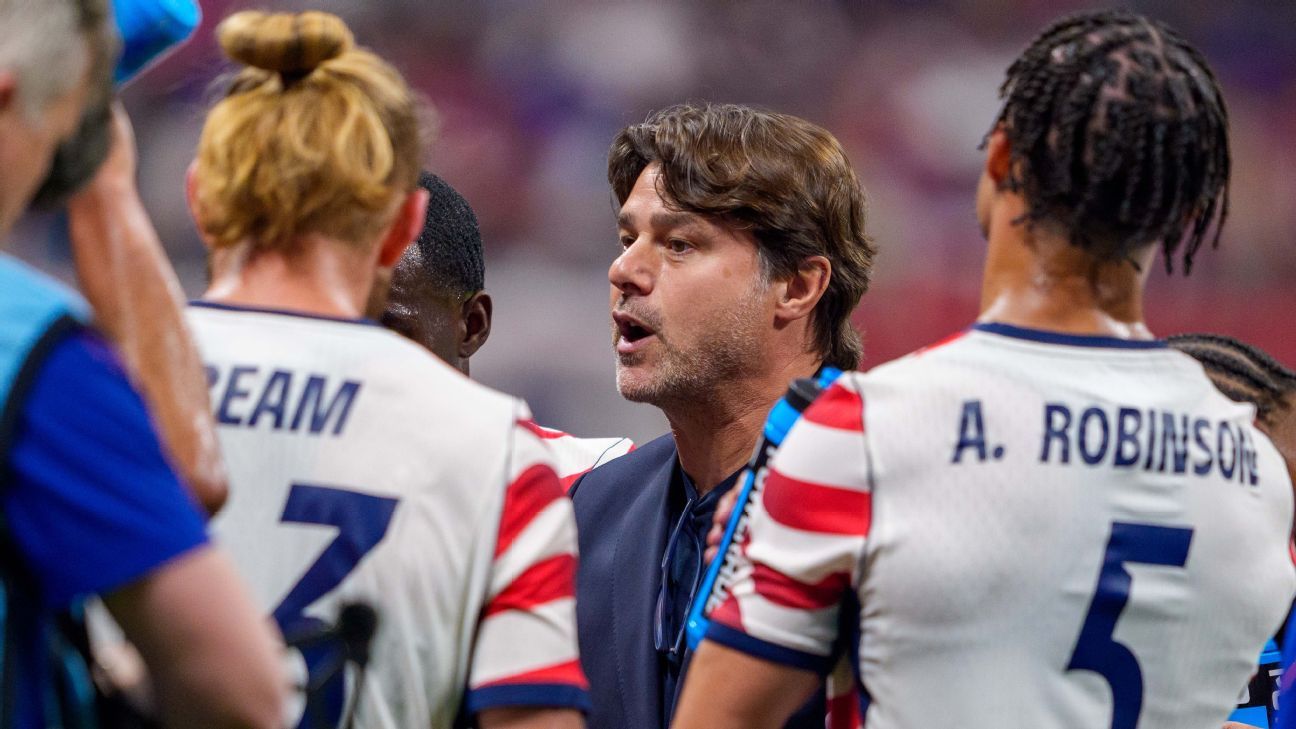
Players such as Zimmerman, Aaron Long, Matt Miazga, and Erik Palmer-Brown seem to have been gradually excluded from the player pool, but Ream featured for every minute of the 2022 World Cup for the U.S., and Richards might have done the same had he not sustained an injury. They have unequivocally been the top two names during Pochettino’s tenure, and while Richards’ continuous progression at Crystal Palace stands as one of the most encouraging narratives for the U.S. in recent years, Ream has rapidly begun to show his age. His performance on Saturday against Belgium was subpar, and his struggles were intensified by the absence of both Richards and Miles Robinson due to minor ailments. Lacking other apparent choices, Ream and McKenzie still played the entire 90 minutes.
Perhaps the most intriguing inquiry regarding this contingent, as it pertains to the World Cup, is whether two or three individuals will ultimately comprise the starting lineup. Until Saturday, Pochettino had typically employed either a 3-4-3 or 3-4-2-1 formation over the prior six U.S. matches, with the team remaining undefeated during that period; without Richards and Robinson against Belgium, Pochettino reverted to a 4-2-3-1, but what (and who) might he select if all his options are available in June? And should he lose confidence in Ream or McKenzie in the approaching weeks, could former fullbacks like Joe Scally or Alex Freeman become viable selections in a three-man defensive unit?
Of the seven central defenders who have played a minimum of 90 minutes under Pochettino (excluding Scally or Freeman), six will be at least 31 years of age by 2030. Admittedly, this position generally tends to feature older players as a whole, but considering the minutes-adjusted age here is already over 30, and given the scarcity of dependable depth, new talents will urgently need to emerge.
Perhaps this implies that someone like West Brom’s Campbell or the L.A. Galaxy’s Justin Haak (24) will assume greater responsibility. Alternatively, anticipated young prospects such as New York Red Bulls’ Justin Che (22) or Bayern loan system member Grayson Dettoni (20) might begin to make their breakthrough. Or perhaps the ongoing recruitment efforts aimed at bi-national Noahkai Banks will finally prove successful. The Hawaii-born 19-year-old has already developed into a stellar Bundesliga defender for Augsburg and would ascend rapidly to the pinnacle of the hypothetical 2030 U.S. squad hierarchy if he opts to represent this nation instead of Germany. He has not yet reached a conclusive decision.
Full-back / Wing-back
Average age adjusted for minutes played under Pochettino:
Mean age under Pochettino: 23.7
Established players who continued their participation:
1. Joe Scally (23): 581 minutes with Pochettino
2. Tim Weah (26): 521 minutes
3. Antonee Robinson (28): 356 minutes
4. Sergiño Dest (25): 214 minutes
5. Shaq Moore (29): 121 minutes
Fresh faces appearing:
1. Max Arfsten (24): 1,112 periods of play under Pochettino
2. Alex Freeman (21): 1,002 minutes
3. John Tolkin (23): 233 minutes
4. Marlon Fossey (27): 135 minutes
5. Kristoffer Lund (23): 134 minutes
6. Nathan Harriel (24): 121 minutes
7. DeJuan Jones (28): 115 minutes
8. Caleb Wiley (21): 24 minutes
In an ideal scenario — or a world with flawless athlete well-being, at least — Robinson and Dest would be unquestionable, dependable, primary selections on the flanks as either defensive wingers or advanced full-backs. They’re nimble, they’re potent in offensive positions, and in his prime in recent years, Robinson has been among the top defensive wingers in the Premier League. However, Dest was absent for the majority of the 2024-25 season due to an ACL injury, and Robinson has spent 2025-26 contending with both physical ailments and performance dips: He’s accumulated merely 1,339 minutes of action in all competitions, and after registering 10 goal setups last season, he has only a single one this campaign. Neither has logged even 300 minutes for Pochettino yet, and Dest was sidelined once more due to a slight ailment on Saturday. Without him present, Weah fared poorly against Belgium’s formidable Jérémy Doku.
Weah appears better suited for a wing-back position rather than a traditional full-back, but there are alternative choices on the flanks. Scally has been satisfactory for both his team (Borussia Monchengladbach) and national squad, while Arfsten and Freeman have both asserted their presence in discussions for the World Cup. Just Ream, Freese, and Richards have accumulated greater playing time for Pochettino, and while Arfsten’s weaknesses in defense pose an issue, his five goal contributions for the U.S. national team are the highest tally among any player during Pochettino’s leadership.
Freeman’s physical prowess — he traverses the field like he’s the son of a celebrated American football player (because he is) — recently captured the attention of LaLiga’s Villarreal. He has seen limited action since transferring to the Spanish club, but while he might not be in the starting lineup for the World Cup, it would be unexpected if either Freeman or Arfsten weren’t included in the team.
Irrespective of the summer’s outcomes, it feels the US is better equipped than ever on the wings. Robinson will admittedly reach the age of 32 during the 2030 World Cup, but even if he becomes too old for selection, Dest will merely be 29, Arfsten will be 28, Scally and John Tolkin will be 27 and Freeman will be 25. Furthermore, other individuals, such as Chelsea loan army member Caleb Wiley (currently 21), recent Manchester City signee Christian McFarlane (19), Vancouver Whitecaps’ Tate Johnson (20), or even Wolfsburg’s Kevin Paredes (23) could yet discover an enhanced level of performance. Paredes made a significant impact for Wolfsburg in 2023-24, but has contended with injuries thereafter.
Midfield core
Playing time-weighted mean age under Pochettino: 25.1
Established figures who maintained their participation:
1. Tyler Adams (27): 697 minutes with Pochettino
2. Luca De La Torre (27): 590 minutes
3. Yunus Musah (23): 461 minutes
5. Cristian Roldan (30): 332 minutes
6. Johnny Cardoso (24): 216 minutes
7. Gianluca Busio (23): 169 minutes
8. James Sands (25): 64 minutes
Emerging talents:
1. Sebastian Berhalter (24): 730 minutes with Pochettino
2. Tanner Tessmann (24): 615 minutes
3. Aidan Morris (24): 450 minutes
4. Quinn Sullivan (22): 140 minutes
5. Alex Zendejas (28): 139 minutes
6. Emeka Eneli (26): 115 minutes
7. Benjamin Cremaschi (21): 110 minutes
3:14
Should the USMNT be concerned with Christian Pulisic’s form?
The ‘FC TV’ crew react to the USMNT’s 5-2 defeat to Belgium.
Here’s a further domain where physical setbacks have hindered primary selections from gaining extensive playing time under Pochettino. Tyler Adams has been crucial to the U.S. national team’s achievements at times, but he was sidelined for the majority of the 2023-24 season due to injury, commenced only 21 out of 38 top-tier league fixtures with Bournemouth last season and has commenced only 18 out of 31 this season. He was unavailable for this crucial international period due to a slight physical setback, too.
Adams’ intermittent unavailability has enabled Pochettino to conduct considerable experimentation, and he appears to have developed a special fondness for Roldan (who provided two goal setups against Australia), Tessmann (who netted a goal against Uruguay) and Morris (who’s prevailed in a team-leading 18 ground challenges in this six-game stretch). And in a pleasing development, he also appears to hold a considerable liking for Sebastian Berhalter, the offspring of the previous USMNT manager.
Considering the individuals employed by prominent clubs (Adams, Lyon’s Tessmann, Atletico Madrid’s Cardoso, Atalanta’s-via-AC-Milan Musah) and Pochettino’s rather unexpected recent preferences, numerous choices exist in this position. And with Pochettino apparently favoring McKennie in a more offensive capacity, a fair number of them could secure a spot on the squad this summer.
In four years’ time, Roldan will be 34, and Adams and McKennie will be 31, but a significant portion of the aforementioned players will be either 27 or 28, still within their prime physical capabilities. And others, like Venezia’s Busio, Houston’s Jack McGlynn (listed as an offensive playmaker below), Philadelphia’s Quinn Sullivan and Parma’s-via-Inter-Miami Cremaschi, still possess ample opportunity to advance their skills further and establish themselves as clear contenders.
1:55
Pochettino acknowledges Belgium defeat serves as a ‘wake-up call’ for the USMNT
Mauricio Pochettino responds to the USMNT’s 5-2 defeat by Belgium.
Flank players and offensive playmakers
Playing time-weighted mean age under Pochettino: 24.1
Established figures who maintained their participation:
1. Malik Tillman (23): 1,004 minutes with Pochettino
2. Christian Pulisic (27): 692 minutes
3. Brendan Aaronson (25): 557 minutes
4. Weston McKennie (27): 509 minutes
5. Gio Reyna (23): 145 minutes
Emerging talents:
1. Diego Luna (22): 953 minutes with Pochettino
2. Jack McGlynn (22): 441 minutes
3. Caden Clark (23): 135 minutes
4. Brian Gutiérrez (22): 118 minutes
5. Matko Miljevic (24): 110 minutes
6. Timothy Tillman (27): 90 minutes
7. Indiana Vassilev (25): 86 minutes
8. Paxten Aaronson (22): 54 minutes
Halt me if this sounds familiar: Given
With a pivotal player sidelined due to ailments or the necessity for recuperation, Pochettino has had the opportunity to try out concepts within this segment. Pulisic has shown satisfactory performance under Pochettino’s guidance, registering two goals and three assists from 19 goal-scoring opportunities. However, his playing time has been restricted to merely 692 minutes across incomplete segments of 11 games. Furthermore, he is currently experiencing a notable dip in his offensive output. McKennie, conversely, has participated for 509 minutes across seven fixtures.
Nevertheless, during their individual unavailability, Pochettino has extensively evaluated both Malik Tillman of Bayer Leverkusen and Real Salt Lake’s Diego Luna (who is not participating in this international period, having only recently recovered from an ailment). These two have also delivered notable results, collectively contributing seven goals and eight assists from 46 generated scoring opportunities.
McGlynn (with two goals and two assists from 13 created opportunities) has likewise maximized his chances, and even in brief appearances, both Reyna and Miljevic have performed effectively. Miljevic, who presently features for Racing Club in Argentina, performed excellently against Venezuela last January, but he has yet to receive another call-up; Reyna, conversely, clearly captivated Pochettino significantly during last November’s international period – he found the net against Paraguay, then provided an assist in 29 minutes versus Uruguay – leading him to secure a crucial selection this month, even though he had received virtually no recent game time with his club team (Borussia Monchengladbach). He accomplished little in his 20-minute appearance against Belgium.
The future outlook appears promising. Pulisic, McKennie, and even Weah could continue to be superb choices for an additional World Cup cycle. Given their youth, Tillman, Luna, McGlynn, Reyna, and most of the other aforementioned individuals can aspire to further develop for several more years.
StrikersAverage age adjusted for minutes played under Pochettino: 25.2
Average age adjusted for minutes played under Pochettino: 25.2
Current players who maintained participation
1. Ricardo Pepi (23): 292 minutes under Pochettino
2. Haji Wright (27): 282 minutes
3. Josh Sargent (26): 260 minutes
Fresh talents to surface
1. Patrick Agyemang (25): 825 minutes under Pochettino
2. Folarin Balogun (24): 480 minutes
3. Brian White (30) 182 minutes
4. Damion Downs (21): 92 minutes
5. Brandon Vázquez (28): 58 minutes
6. Cade Cowell (23): 16 minutes
2:54
Which host country will advance furthest in the World Cup?
The ‘FC TV’ panel discusses which host country will advance furthest in the 2026 FIFA World Cup?
No positional segment has developed and progressed more significantly for the U.S. during this World Cup period than that of the striker.
In Qatar in 2022, Haji Wright, Josh Sargent, Jordan Morris, and Jesús Ferreira collectively participated for 341 of 360 minutes but managed only 10 shots (2.6 per 90 minutes) and registered a solitary goal – Wright netted a goal late when the U.S. was trailing 2-0 to the Netherlands in the knockout rounds. There was simply little cause for enthusiasm in this area.
However, Wright has matured into a much improved choice at Coventry, and Ricardo Pepi is ever more menacing when fit (a state that seldom occurs recently). More crucially, Patrick Agyemang has demonstrated increasing capability, and Folarin Balogun has revealed the full potential anticipated from him when he pledged his allegiance to represent the U.S. in 2023.
During 1,879 minutes under Pochettino, the foursome of Balogun, Agyemang, Pepi, and Wright have collectively found the net 15 times from 64 attempts (3.1 per 90). They’ve also collectively provided three assists from 25 generated opportunities, and all four seem eager in their pressing efforts.
This is by no stretch a top-tier group, and one would desire additional progress regarding the sheer quantity of shots. Nevertheless, Pochettino will command a much more competent contingent at this World Cup than Gregg Berhalter benefited from four years prior. Balogun, Pepi, and Agyemang will likewise all be under 30 in 2030; however, the number of clear youthful alternatives following Downs remains uncertain.