
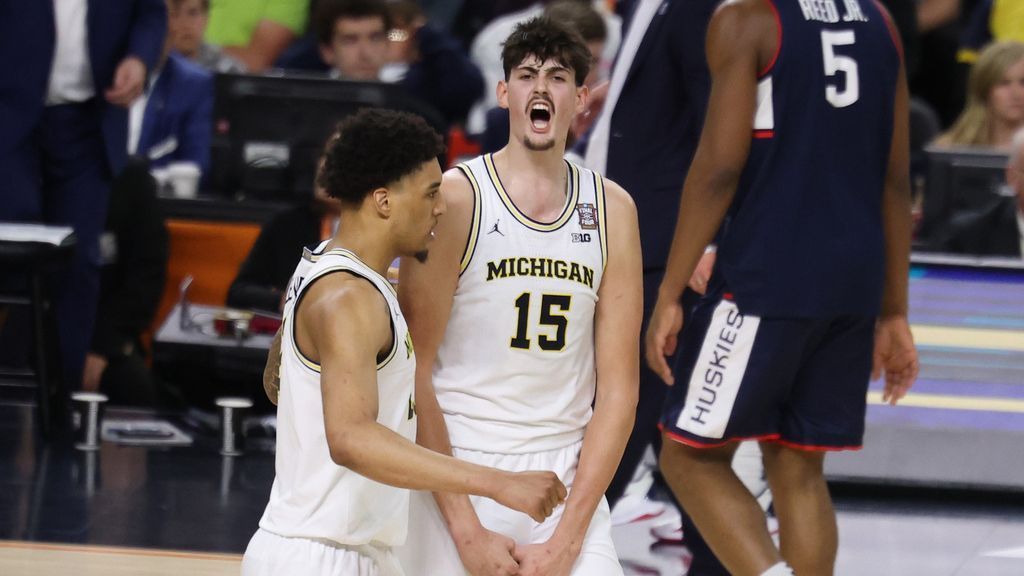
INDIANAPOLIS — Prior to Michigan stepping onto the court to compete against Gonzaga in the championship match of the Players Era Championship last November, Elliot Cadeau shared an observation with his teammates.
“We are the most formidable group ever put together,” Cadeau declared at that moment.
Michigan then went on to defeat Gonzaga by 40 points.
From that juncture, the Wolverines emerged as the preeminent squad in the nation — and they concluded their journey on Monday appearing just as they had on Thanksgiving Eve: as the top collegiate basketball team.
Michigan marked a resounding conclusion to a memorable campaign in Monday’s national championship game, overcoming UConn, 69-63.
The Wolverines secured the institution’s initial national title since 1989 — and became the first squad to overcome UConn in the Sweet 16 round or beyond dating back to Michigan State’s victory over the Huskies in the 2009 Final Four.
UConn’s strategy initially closely resembled that of the initial rounds of the NCAA tournament: Deliver the ball to Tarris Reed. He attempted three of the Huskies’ first four shots, but found it difficult to complete plays versus the reach and stature of Michigan’s Aday Mara. The Wolverines’ advantage in that aspect also proved significant at the opposite end, with three offensive boards and six points in the paint before the first media timeout.
The initial 15 minutes of the contest, however, primarily favored UConn. The Huskies prevented Michigan from executing fast breaks, with the Wolverines registering no fast-break scores in the first half — and only one genuine chance to initiate a quick offensive drive. Michigan sought to apply defensive pressure and accelerate the pace, yet UConn managed to handle the ball carefully. A significant portion of that praise belonged to Malachi Smith, who provided Hurley with valuable playing time with Silas Demary Jr. sidelined due to fouls. Smith quickly tallied four points and competed effectively against Michigan’s backcourt.
UConn was dictating the pace, maintaining parity in rebounding and receiving an advantage due to Michigan’s inaccurate shooting; the Wolverines recorded an 0-for-8 performance from 3-point range in the opening period.
While Solo Ball was exhibiting no adverse consequences of his foot sprain, accumulating 12 first-half points despite also accruing two personal fouls, Michigan’s Yaxel Lendeborg appeared a mere shadow of the athlete that had garnered All-American and Big Ten Player of the Year accolades. He participated in all 20 first-half minutes, but converted only one of five field-goal attempts and was unproductive on offense and defense.
“I feel terrible, I feel exceptionally feeble right now,” Lendeborg stated during the halftime commentary. “I can’t sink any shots … I performed quite passively in that first half.”
The Wolverines were compensating for their scoring difficulties by excelling in two accustomed domains: the restricted area and the charity stripe. They had a total of 33 points in the initial half from those areas, in contrast to UConn’s 12. With two first-half fouls each for Ball, Demary and Reed, one of UConn’s vulnerabilities was surfacing at an inopportune moment.
Michigan’s first crucial turn of events occurred on a hook-and-hold call against Alex Karaban with 3:16 remaining in the first half. It initiated a 6-0 run for the Wolverines in 46 seconds, and incited a 10-4 outburst to conclude the half, granting Michigan a 33-29 advantage at intermission.
Persistent foul issues remained a recurring pattern for UConn in the second half. Ball accrued his third and fourth personal fouls and Demary committed his third infraction prior to the initial media stoppage post-intermission.
A Cadeau and-one sequence on Ball’s fourth foul extended Michigan’s advantage to seven points with 16:20 remaining — Michigan’s most substantial lead of the contest up to that juncture.
The Huskies had experienced an offensive drought and Michigan, predictably, began to operate with greater effectiveness on the offensive end. Cadeau sank the Wolverines’ initial triple of the game at the 12:56 mark of the second half, increasing their lead to 11 — on the same play Lendeborg secured his inaugural rebound and tallied his initial assist.
UConn was on the brink and appeared devoid of solutions. The Huskies failed on 13 successive attempts from beyond the arc during a particular segment of the match.
As the last four minutes commenced, UConn was 5-for-21 on its initial offensive attempts in the second half, according to ESPN’s data analysis, and the Huskies were 1-for-9 on attempts challenged by Mara. Michigan’s stature and reach near the basket — four blocks after halftime — were a significant impediment.
The Huskies were incapable of assembling continuous drive and exerting meaningful contest pressure on Michigan in the closing stages. The Wolverines were providing opportunities for them to narrow the gap, but UConn could not execute three or four consecutive sequences of defensive stops and successful scores. A Karaban defensive effort and board acquisition provided UConn possession while trailing by five points, but he committed a turnover on the subsequent possession, which culminated in a Mara alley-oop completion, extending Michigan’s lead once more to seven.
UConn had a further chance to reduce the deficit to four points with two minutes left, but was unsuccessful in capitalizing on a fast-break chance. Michigan proceeded to the opposite court and Trey McKenney sank a pivotal three-pointer to provide the Wolverines with a nine-point advantage.