
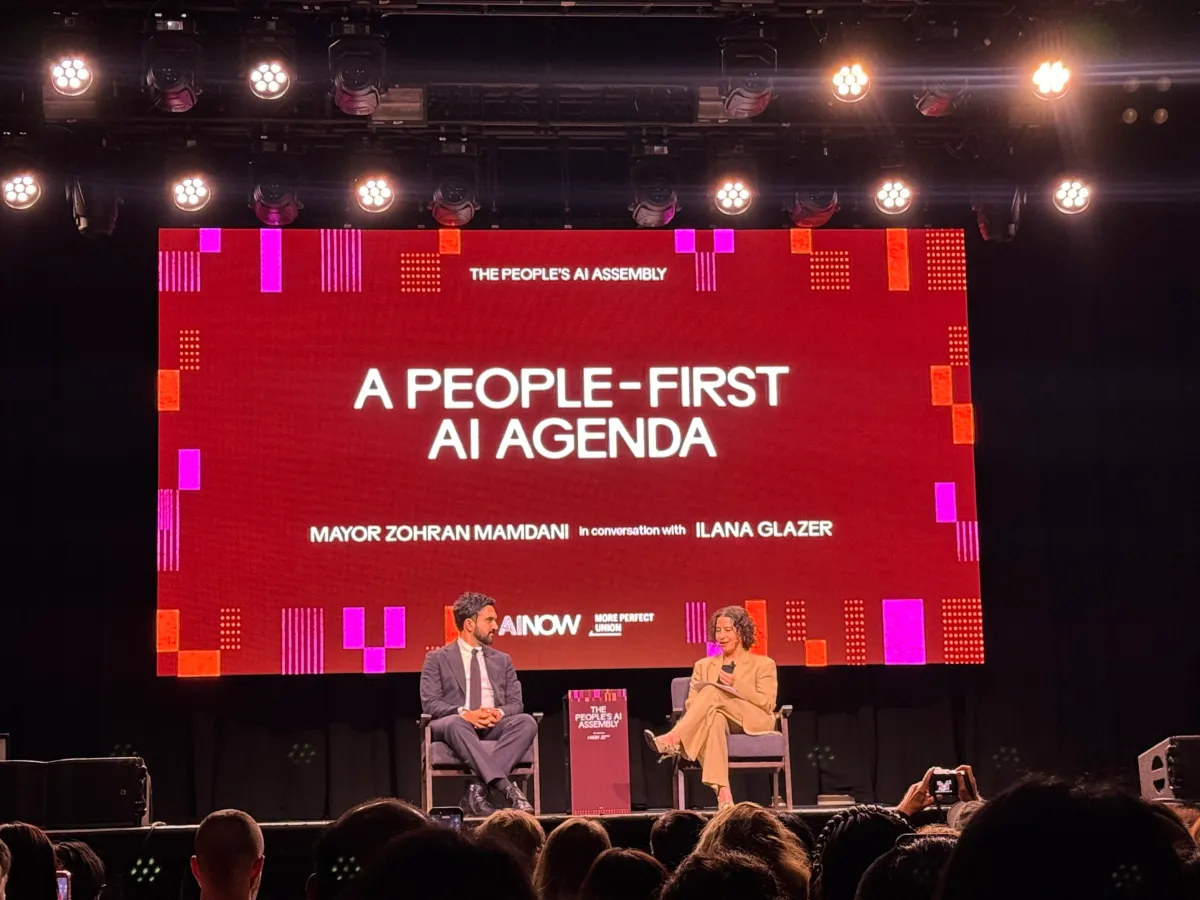
New York City, a vibrant hub of innovation and activism, recently played host to a crucial dialogue on the future of Artificial Intelligence. At Webster Hall, in an event aptly titled ‘The People’s AI Assembly,’ Mayor Zohran Mamdani, a prominent voice in local governance, engaged in a thought-provoking conversation with activist, comedian, and “Broad City” star Ilana Glazer. Their discussion, hosted by the AI Now Institute, a leading think tank dedicated to exploring the societal implications of AI, centered on a powerful message: the rapid integration of AI into our lives is not an unchallengeable inevitability, but a malleable future that can and must be shaped by public will and proactive policy.
Key Takeaways:
- **Local Resistance, Global Impact:** Mayor Mamdani advocates for active resistance against the pervasive notion of AI’s inevitability, urging New Yorkers to reclaim control over technology’s role in their lives, especially as federal regulation lags.
- **NYC Leads the Way:** In the absence of comprehensive federal AI policies, New York City is taking tangible steps, banning AI in elementary schools and mandating disclosure for AI-generated real estate listings, setting a precedent for municipal oversight.
- **Accountability Over Aspiration:** The discussion highlighted the critical need to prioritize humanistic concerns and accountability over the tech industry’s pursuit of market valuation and the nationalistic “AI arms race” narrative, drawing parallels to past unregulated tech booms.
The Monday night event saw Glazer, renowned for her sharp wit and social commentary, skillfully probe the mayor on the profound implications of AI for society. Mamdani’s central thesis was clear: New Yorkers, and indeed all citizens, should actively push back against the overwhelming sense that AI is an unstoppable force poised to disrupt jobs, influence children’s development, and diminish human dignity. Instead, he championed a vision of collective agency, asserting that communities have the power to define the terms of AI’s integration.
This call to action resonates deeply in an era where the federal government has largely adopted a hands-off approach to AI regulation, leaving cities and states to grapple with the technology’s rapid advancements on their own. Mamdani’s stance at The People’s AI Assembly underscored his belief that the technology’s swift rollout is not a predetermined course. Rather, it is a human-driven process, and therefore, public officials bear the responsibility to hold AI companies accountable for their creations and their impact.
Mayor Mamdani has already translated this philosophy into concrete policy within New York City. Just last month, he issued an order banning the use of AI in elementary and middle schools. This move directly addresses concerns like those voiced by Glazer, a parent herself, who expressed palpable unease about AI’s unsolicited entry into classrooms. “It just makes me nervous. It feels so non-consensual,” Glazer reflected, questioning the sudden imperative for AI in educational settings when it was absent just a few years prior. Her sentiment reflects a broader public anxiety about the pace and necessity of AI integration into foundational aspects of life.
Beyond the classroom, Mamdani’s administration tackled AI’s impact on another critical sector: real estate. Over the summer, the mayor introduced a pioneering policy requiring landlords, brokers, and real estate platforms to explicitly disclose when property listings feature photos or videos generated by AI. This proactive measure aims to protect New Yorkers from “house-phishing” – a deceptive practice where misleading AI-fabricated visuals could trick prospective tenants or buyers, ensuring transparency and consumer protection in a digitally evolving market.
Both the school ban and the real estate disclosure policy stand as powerful challenges to the widespread assumption that society must passively accept AI as it arrives. They embody Mamdani’s core belief, articulated forcefully at Monday’s event: “Nothing *has* to be.” He warned against a subtle, insidious “creep” associated with AI’s rollout, describing it as an intentional strategy “to overwhelm that leaves people feeling as if there is simply no option.”
The mayor further elaborated on what he perceives as a “reckless adoption of technology without any kind of a reckoning with the limitations of that technology.” He cited a sobering example: the U.S. military’s February strike on a school in Iran, which tragically resulted in over 150 fatalities, including at least 123 children. Reports from officials involved in the Pentagon’s internal investigation, shared with Bloomberg, indicated that an overreliance on AI in targeting systems was a significant contributing factor to the devastating outcome. This incident, Mamdani argued, starkly illustrates the perils of unquestioning faith in AI’s infallibility.
“There is this desire to speak about [AI] as if it is infallible, as if it cannot be questioned, as if the only people who can regulate it are the ones who are currently developing it,” Mamdani observed, drawing a historical parallel to arguments made by Facebook in 2008 about its own burgeoning influence. He posited that this rhetoric is, at its heart, “an attempt to escape any kind of accountability at any level, without also jeopardizing the potential valuation from an IPO.” This critique comes at a time when major AI players like Anthropic and OpenAI are gearing up for public market debuts, with Anthropic expected to go public this year and OpenAI by 2027, highlighting the immense financial stakes involved in the push for minimal regulation.
Mamdani did not shy away from criticizing the “complete abdication of federal law” concerning AI. He lamented how, at a national level, discussions about artificial intelligence are frequently framed through the lens of an “arms race with China.” This dominant narrative, he argued, tends to marginalize “any of the humanistic concern,” pushing it aside in favor of a competitive geopolitical discourse. This approach, he suggested, dangerously overlooks the profound ethical and societal implications of unchecked AI development.
The recent announcement of President Donald Trump’s Superintelligence Task Force earlier this month appears to reinforce this trend, largely prioritizing the self-regulation of powerful AI companies over the implementation of new federal restrictions. This policy direction persists despite escalating fears about AI’s far-reaching effects on every facet of human existence, including dire warnings from whistleblowers at prominent firms like Anthropic, Google DeepMind, and OpenAI, who have controversially suggested that advanced AI could even pose an existential threat to humanity.
“As we are looking at what comes after this federal administration, there has to be a very different kind of framework in how we think about AI, talk about AI, the accountability we’re willing to bring forward when it comes to that,” Mamdani concluded, emphasizing the urgent need for a paradigm shift in how the nation approaches AI governance. His message is a clarion call for a future where public interest and ethical considerations, rather than corporate profits or geopolitical competition, guide the development and deployment of artificial intelligence.
The Bottom Line:The dialogue between Mayor Mamdani and Ilana Glazer at Webster Hall served as a vital reminder that the trajectory of AI is not sealed. In a landscape marked by federal inertia, cities like New York are stepping up, demonstrating that proactive, human-centered governance can effectively challenge the tech industry’s unchecked power. Their message is clear: the future of AI is a collective construct, and by demanding accountability, fostering transparency, and prioritizing human well-being over technological hype, communities can actively shape a more equitable and responsible digital future, proving that resistance to technological determinism is not only possible but essential.
When you purchase through links in our articles, we may earn a small commission. This doesn’t affect our editorial independence.
{content}
Source:{feed_title}