
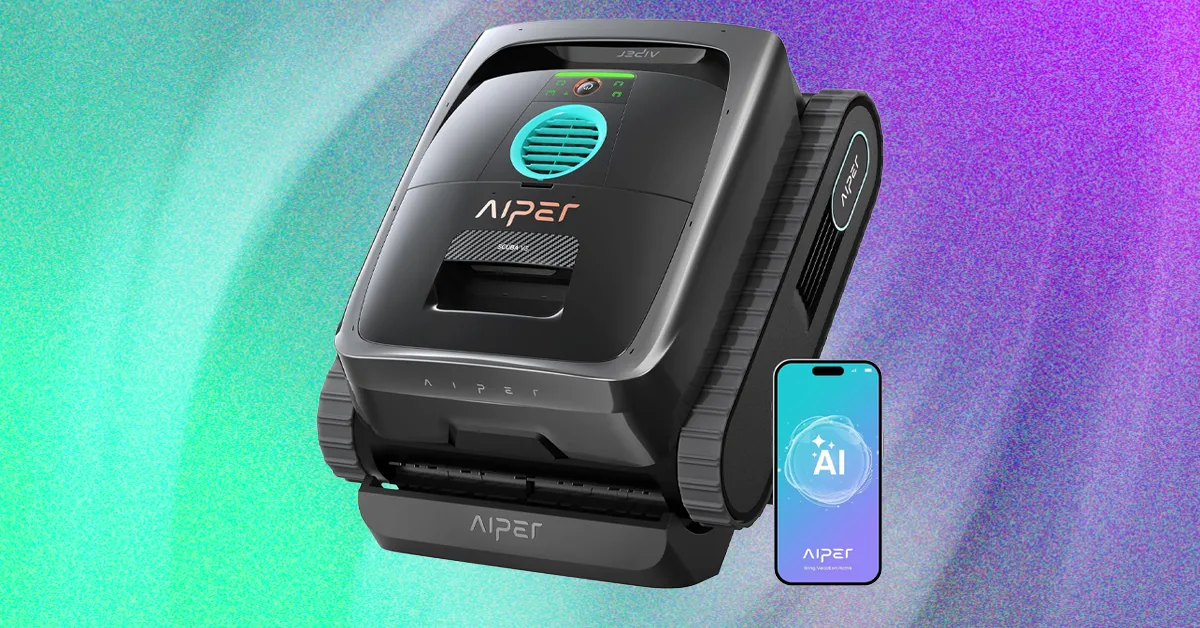
The application also offers access to two pre-programmed operating options for users intending to leave the device within the pool. These include a time-based setting with three distinct cycle options—90 minutes x 2, 60 minutes x 3, or 45 minutes x 4. The alternate mode is somewhat disappointing: the feature dubbed AI Navium *gives the impression* of utilizing the AI camera to regularly inspect the pool throughout the week and undertaking a standard cleaning solely when necessary. However, in practice, this mode merely conducts a rapid assessment of your prior operations and then employs artificial intelligence to devise a timetable for the subsequent few days, informed by your past interactions with the device.
Adept at Grime Removal
Video: Chris Null
The Scuba V3 efficiently cleared refuse in my pool throughout trials, seldom requiring beyond a couple of hours to gather all discernible detritus from the pool’s base, concurrently scouring the perimeter and water level. The AI camera system appears to function as promoted, detecting even minor stones I introduced into the water and meticulously navigating to retrieve them. Regarding natural refuse, the pool appeared entirely pristine following every cycle (concluding between 170 and 190 minutes per instance). For artificial waste, the Scuba V3 attained a 96 percent purity score, with only a handful of trial leaves persisting in challenging nooks. This represents particularly strong efficacy, considering three hours is not an extensive operational period. It’s important to note that the operational duration cannot be altered apart from the pre-set modes; immediate-start modes invariably deplete the battery until it’s almost exhausted. Happily, Aiper appears to optimize this period, officially designating an extensive maximum coverage zone of 1,600 square feet.
Regrettably, I encountered limited favorable outcomes using the AI timetable function. Subsequent to executing the analysis tool, the application proposed a perplexing five-day program, consisting of two bottom-only cycles, two bottom-and-waterline cycles, and one concluding bottom cycle. The device subsequently disregarded the plan and swiftly initiated a three-hour bottom cleaning, consequently fully depleting its power source. The following day, I attempted once more, yet the cleaner failed to adhere to its timetable, subsequently operating erratically late at night. I wasn’t particularly fond of in-pool programming prior to evaluating the Scuba V3, and this demonstration did not enhance that viewpoint.
Video: Chris Null
Upon concluding a cycle, the Scuba ascends to the water’s surface, transmitting an alert to the application, informing you of its readiness for retrieval and sanitation. Be aware that you possess merely 10 minutes to access it: The Scuba lacks buoyancy, thus, it must utilize its remaining power to operate a motor for treading water and maintaining its position. Once that 10-minute interval elapses, the depleted Scuba descends to the pool’s bottom, necessitating recovery with a pool pole and hook. My optimal recommendation is to activate a 175-minute countdown every time you initiate an operation to prompt you to observe for the termination alert.
The cleaning process can prove rather intricate. The filter receptacle’s configuration includes a sizable cover, which facilitates effortless access to the internal filter, and rinsing both filters to cleanse them is uncomplicated. However, the detachable netting within the inner basket presents a different challenge. Although highly efficient at entrapping grime and other minute particles, its cleaning proves considerably arduous. Furthermore, if it’s not extracted from the receptacle, a substantial amount of detritus becomes lodged between the mesh and the basket. Extracting and reinserting the netting is challenging, particularly in its moistened state. Consequently, I typically left it undisturbed and cleaned it to the best of my ability after each operation, acknowledging that absolute perfection was unattainable. I anticipate the majority of users will follow a similar approach.
{content}
Source:{feed_title}