
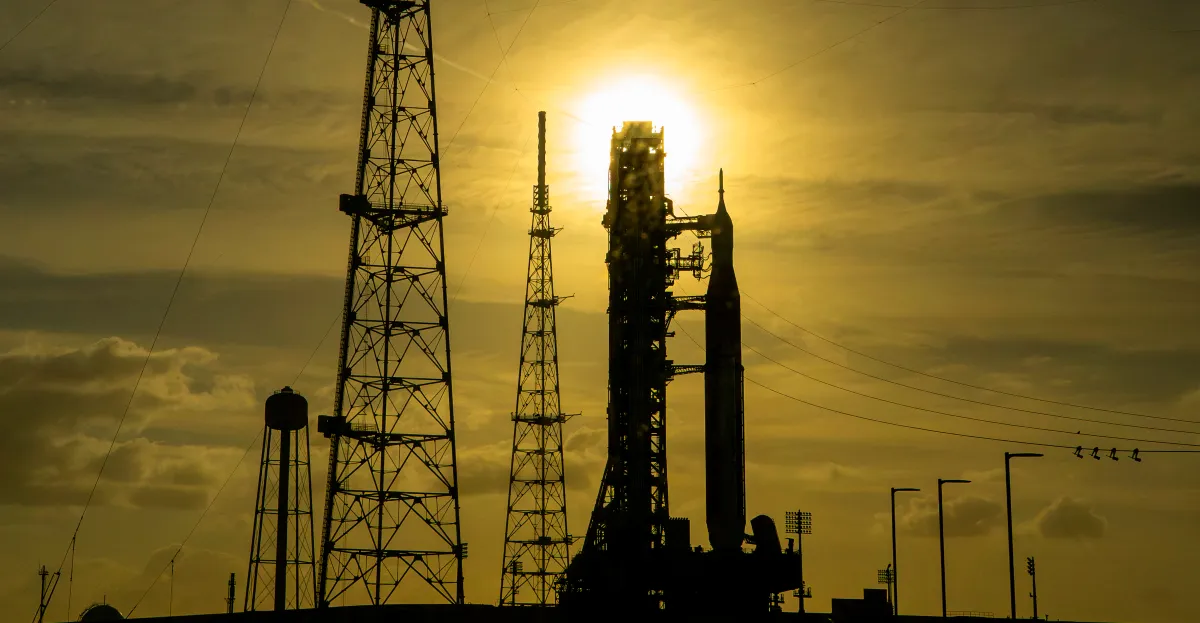
The quest to journey back to the Moon has been rekindled, with NASA scheduled to send four space explorers on its Artemis II expedition this Wednesday. This forthcoming venture will involve cosmonauts aboard the Orion spacecraft orbiting the Moon prior to their 10-day return trip to Earth. They will be evaluating the apparatus and operational frameworks that could imminently enable Americans to set foot on the Moon for the first time in over five decades, as part of the Artemis IV mission slated for 2028. While NASA is not yet prepared for a crewed lunar landing, this is the objective for the ensuing five years: not only to transport individuals to the Moon but also to establish a prolonged human presence on its surface.
This distinguishes Artemis as NASA’s principal advantage compared to the Apollo programs of the 1960s and ’70s—our intention is not merely a brief visit to the Moon for a few days, but rather to permanently settle there for an extended duration. The precise length remains undefined, but the concept is to construct a lunar outpost that enables space travelers to reside on the celestial body’s surface for several weeks or even months consecutively.
Such an undertaking significantly complicates logistical arrangements, as space explorers will be unable to transport all necessary provisions and assets from Earth. Instead, they would be required to leverage the finite resources available on the Moon through a method known as in-situ resource utilization. For instance, instead of hauling a massive volume of water for the journey from Earth, we would simply locate and melt lunar ice for use. Sounds straightforward, doesn’t it?
This forms the fundamental rationale for much of the Artemis program: Resources are essential for sustaining a lunar outpost, so an outpost must be constructed to facilitate their discovery.
In reality, it is far from simple. There are scientific complexities. And there are legal impediments.
The lunar environment is severe and unforgiving, characterized by hazardous space radiation, abrasive regolith that damages equipment, and a distinct gravitational pull to contend with. While less fanciful than the audacious Mars colonization schemes promoted by SpaceX CEO Elon Musk, NASA’s objective to establish a lunar base by 2030 remains exceedingly optimistic. Across its communication regarding Artemis, NASA has underscored the significance of identifying and extracting elements from the Moon, including water for propellant, helium-3 for energy generation, and precious earth elements such as scandium utilized in electronic devices. The true abundance of these elements remains uncertain until more thorough mapping and assessment are conducted, but they do possess potential worth, as they are crucial for sustaining human occupation on the Moon. And this is the core justification for a significant portion of Artemis: to support a lunar outpost, resources are required, necessitating the establishment of such an outpost to search for them.
The space agency has even likened these endeavors to a “lunar gold rush.” However, this highlights a challenge with Artemis that cannot be resolved through technological advancements: certain experts contend that extracting elements from the Moon constitutes a breach of international legislation.
While a substantial body of international law governing space exploration is absent, the existing framework is unequivocally clear on one point: No entity possesses ownership of the Moon. The Outer Space Treaty—ratified nearly six decades ago yet still serving as the primary foundation for international space law today, remarkably—is explicit regarding the doctrine of non-appropriation, which stipulates that nations cannot assert sovereignty over any celestial body. Nevertheless, the issue becomes intricate when considering resource extraction.
“The United States maintains that resource acquisition does not constitute appropriation… This is an inaccurate interpretation of the Outer Space Treaty.”
“The United States holds that the extraction of resources does not equate to appropriation,” states Cassandra Steer, an expert in space law and the founder of the Australasian Centre for Space Governance. Many international space legal practitioners, including Steer, have argued that this stance is illegal. “That represents an incorrect reading of the Outer Space Treaty. It’s an attempt to carve out an exemption.” Indeed, if a nation were to commence excavating resources from a territory it did not legally possess on Earth in the present era, numerous legal complications would arise.
The US has adopted a strategic methodology to address this matter through an accord known as the Artemis Accords. This is not an international covenant, but rather a pact endorsed by more than 60 nations concerning the adoption of overarching tenets for space exploration, particularly regarding the Moon. Many of these tenets represent sound, rational approaches to venturing into space, encompassing topics such as the dissemination of scientific information, consideration of safety and contingency protocols, and adherence to the peaceful utilization of space.
However, the document also incorporates provisions explicitly permitting the acquisition and utilization of space resources, asserting that this does not contravene the principle of non-appropriation, and allowing specific nations to establish “secure zones” around their lunar operations where other countries are prohibited from interfering.
This doesn’t explicitly declare that the first party to reach the Moon and claim a segment of it now owns it, but it implicitly suggests that whoever initiates activities like investigation or excavation in a particular lunar area will thenceforth be entitled to extract resources from that zone, and other countries cannot impede them. It’s not about possessing a portion of the Moon, but it does grant preferential access by drilling, scraping, and occupying a strategically valuable location for its potential worth.
One can scarcely avoid drawing a comparison between this strategy and the past of territorial seizures throughout the American West in the 19th century, particularly concerning admittance to vital assets such as water. “I believe the Artemis Accords might pave the way for these kinds of proprietary assertions on the Moon,” states Rebecca Boyle, a journalist and the author of the book on this subject,Our Moon. “The agreements indeed state that safety zones should be pertinent to the activities at hand, but once more, I think an inventive legal counsel or a clever judicial argument could result in a scenario where someone who arrives at a location initially utilizes the safety zone provision to assert ownership over whatever is present there.”
The shrewd decision by the United States involved incorporating the accords into the Artemis initiative, thus, nations aspiring to participate in Artemis were compelled to endorse the document. With a select group of crucial participants like Canada, Japan, Australia, the UAE, and the UK having affixed their signatures, numerous additional nations, including France, Israel, Saudi Arabia, India, and Germany, subsequently complied.
“And so, it was a form of pressure exerted by the U.S. to declare that, should you wish to join our program, you must concur with our understanding of international jurisprudence. This compels the adoption of what is known asopinio jurisin international law,” Steer elucidates. The influence stemming from this widespread agreement among so many countries is that, if resource exploitation becomes permissible in practice, the foundational purpose of the pact could effectively be superseded by a broadly embraced understanding.
Steer succinctly characterized NASA’s method: “You are merely attempting to redraft the accord, and remarkably, you have persuaded sixty nations to join you in this endeavor.”
“What is the rationale for venturing to the Moon? And in my estimation, it is solely a matter of international power dynamics.”
The undeniable, unspoken issue of this legal dispute is China, which did not endorse the Artemis Accords and is slated to land its own cosmonauts on the lunar surface, potentially prior to the United States’ achievement. China and the U.S. share virtually no rapport regarding extraterrestrial endeavors, yet China has been cultivating its distinct global alliances for its lunar program, including finalizing a pact with Russia and transporting cargo from diverse European nations and Saudi Arabia aboard its lunar exploration vehicles. Beijing intends to construct its proprietary lunar outpost alongside Russia, called the International Lunar Research Station, and the U.S. is vigorously advancing its lunar initiative in an effort to outmaneuver its competitors.
“The fundamental, high-stakes question is, what compels us to journey to the Moon? And it is, in my estimation, exclusively driven by international power dynamics,” Steer remarks. Such motivation unequivocally propelled the United States throughout the prior cosmic competition, when the Cold War era was in full swing, and competing with the Soviet Union for lunar supremacy was not merely an issue of governmental influence but additionally an endeavor to showcase the paramount political philosophy. Now, amidst the current era of America First nationalism, the United States endeavors anew to establish its might and proficiency, however, the chauvinistic discourse neglects to convey the genuine nature of space venturing, specifically, its current reliance on global collaborations and transnational teamwork.
Presently, it is not merely reputation that is jeopardized but additionally the ability to utilize extraterrestrial assets, ranging from dominion over cislunar trajectories and lunar sites to managing the substances essential for the Moon’s continued investigation, for instance, frozen water or helium-3. Indeed, NASA’s rationales for Artemis have conspicuously exhibited circular reasoning: Astronauts must be dispatched to the Moon to guarantee the availability of ice, as water access is indispensable for sustaining human venturing. Several conceivable scientific rationales exist for a lunar expedition, spanning from comprehending the genesis of the Solar System to employing the Moon as a foundation for constructing a potent observatory, yet these have not been clearly expressed or broadly championed by NASA.
“The authentic rationale, the concealed motive, revolves around who achieves political supremacy,” Steer asserts. “Outer space merely represents an additional arena where international power struggles unfold. This mirrors the contest in artificial intelligence, it parallels rivalries concerning other commodities, regarding petroleum, regarding hydration… It is yet another sphere where the United States is making desperate attempts to maintain its position as the sole preeminent force, only to realize that, in reality, it is unable to do so.”
{content}
Origin:{feed_title}