
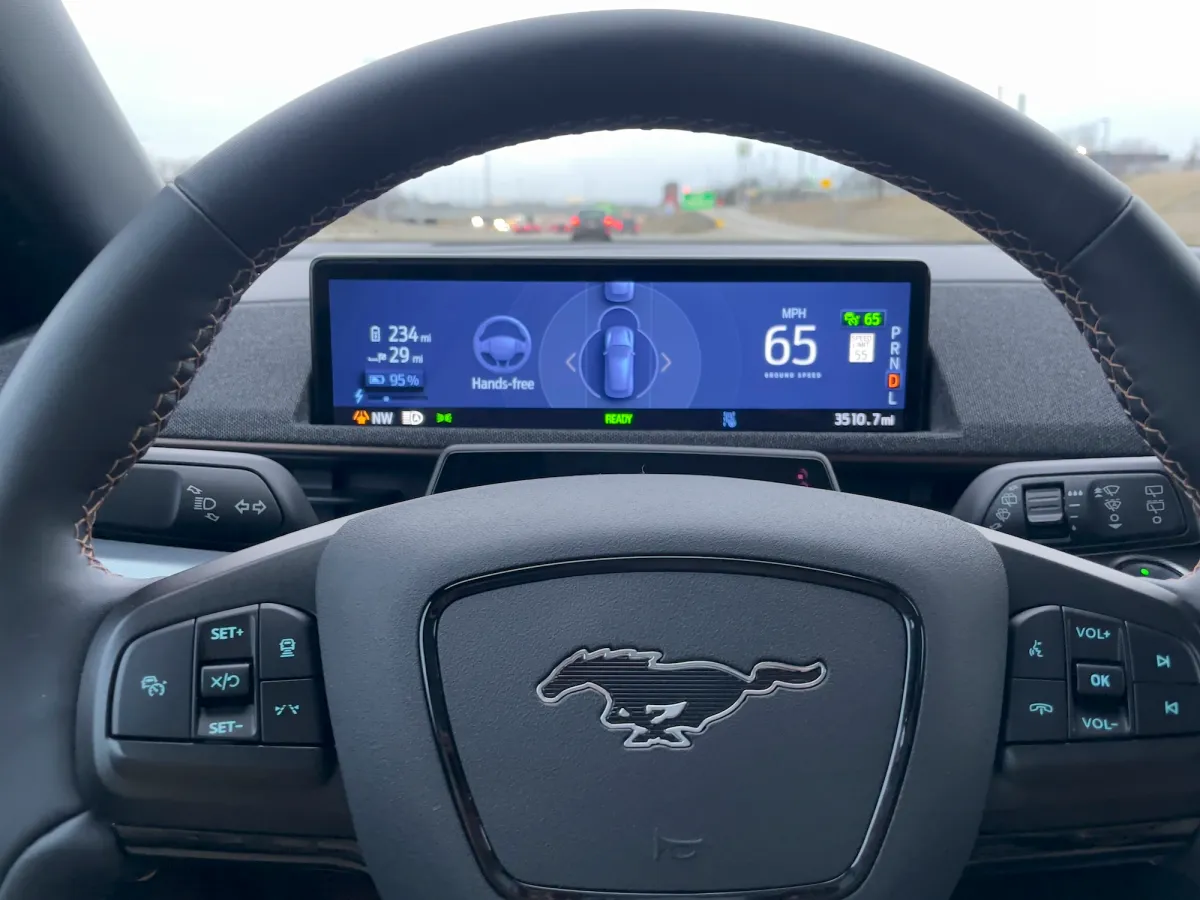
New data divulged by the National Transportation Safety Board (NTSB) on Wednesday indicates that two motorists, who were implicated in deadly collisions in 2024 while utilizing Ford’s BlueCruise autonomous driving feature, were probably inattentive just prior to the crashes.
The safety authority published records pertaining to each accident and declared its intention to convene a public session on March 31 in Washington D.C. During this session, it will deliberate on the discoveries and presumably tender suggestions to Ford. As a distinct federal entity, the NTSB probes transport mishaps yet lacks regulatory power over the sector. The body is anticipated to unveil its conclusive assessment within weeks subsequent to the March 31 hearing.
These collisions prompted inquiries not solely from the NTSB but also from the National Highway Traffic Safety Administration (NHTSA). NHTSA, a regulatory body for safety, stated in early 2025 that it had ascertained BlueCruise exhibits constraints in the “identifying motionless vehicles under specific circumstances,” consequently elevating its scrutiny. The regulator dispatched a comprehensive set of queries to Ford in June 2025 as part of this inquiry, to which the corporation responded in August. The examination continues.
Throughout these events, Ford has consistently asserted that BlueCruise serves as a “comfort amenity” and that operators are perpetually obligated to assume command of their automobile. It further cautions motorists that BlueCruise does “not constitute a collision alert or prevention mechanism.” According to the firm, purchasers of new Ford cars have the option to acquire BlueCruise for a single payment of $2,495 or an annual membership of $495.
Nonetheless, the NTSB’s inquiry — along with the forthcoming hearing this month — is poised to intensify scrutiny on how corporations such as Ford articulate the intended function of these driver aid technologies and how to guarantee their appropriate deployment.
Inattentive driving constitutes a recurrent motif in numerous other probes concerning widely-used driver support programs, including Tesla’s now-discontinued Autopilot and its “Full Self-Driving (Supervised)” program. A previous NTSB examination into an Autopilot-linked fatality in 2018 specifically highlighted the issue of distracted motoring.
“Within this mishap, we observed excessive dependence on technology, instances of inattention, an absence of regulations forbidding mobile phone usage while operating a vehicle, and infrastructural deficiencies, all of which, when aggregated, culminated in this sorrowful demise,” stated NTSB chairman Robert Sumwalt then, addressing the 2018 collision.
Techcrunch event
San Francisco, CA
|
October 13-15, 2026
The initial collision
The BlueCruise accidents transpired in early 2024. The inaugural incident happened that February in San Antonio, Texas. The operator of a 2022 Ford Mustang Mach-E, proceeding in the central lane of Interstate 10, collided with a motionless 1999 Honda CR-V at approximately 74 miles per hour. The Ford motorist was employing BlueCruise immediately prior to the collision, which occurred at 9:48 p.m. local time. The Ford driver suffered slight wounds, whereas the Honda driver succumbed to injuries acquired during the impact.
Fresh data unveiled by the NTSB on Wednesday reveals that Ford’s camera-dependent driver surveillance mechanism recorded the operator observing the primary infotainment display during the five seconds preceding the crash. The driver monitoring system merely identified him glancing at the thoroughfare for scant fractions of a second around 3.6 seconds before the impact, and once more approximately 1.6 seconds prior. He was issued two visual and audible notifications to attend to the road in the 30 seconds before the collision, yet failed to apply brakes before striking.
The records indicate that the motorist informed the San Antonio Police Department of his use of the vehicle’s guidance system to reach a charging point. A report mentions that “he might have gazed at the central screen console as directions to the charging facility were visible there.”
It is conceivable he was dozing off prior to the collision, but almost unfeasible to confirm definitively, given the details disclosed on Wednesday. Ford’s apparatus captured a static picture of the driver two seconds before the impact, which the NTSB asserts depicts him “seated erect and facing ahead, with his head reposing (or nearly reposing) on the headrest and marginally turned to the right.” The driver secured legal counsel after police questioning, and the attorney refused permission for him to communicate with the NTSB.
The subsequent collision
The second deadly BlueCruise incident transpired in March 2024 in Philadelphia. The operator of a 2022 Mach-E was journeying on Interstate 95 at 3:16 a.m. local time when she collided with a 2012 Hyundai Elantra, which had halted on the left shoulder. The Elantra then struck a 2006 Toyota Prius that had previously stopped ahead of it.
Those two chauffeurs were acquaintances who had paused for an unspecified cause; the Prius driver had exited his vehicle and was positioned to the Elantra’s left. Both the Elantra and Prius operators perished, whereas the Mach-E driver suffered superficial wounds.
The Mach-E operator, a 23-year-old female identified as Dimple Patel, was inebriated at the juncture, as per local law enforcement. Towards the end of 2024, she faced charges of DUI homicide. She was progressing at roughly 72 miles per hour prior to the collision, notwithstanding being within a construction area restricted to 45 miles per hour. Zak Goldstein, legal counsel for Patel, informed TechCrunch on Wednesday that the matter remains unresolved and a court date has not yet been established.
The recently released NTSB records indicate that the driver observation system in Patel’s vehicle recorded her gaze as “road-focused” for the entire five seconds preceding the accident. However, the image captured two seconds prior to impact seemingly portrays her clutching a phone above the steering wheel, nearly completely concealed from the driver monitoring system’s perspective.
Ford did not promptly reply to an inquiry regarding its awareness of this potential deficiency in its driver surveillance mechanism, nor if the corporation has undertaken any measures to alleviate it.
Regarding autonomous emergency braking?
Contemporary Ford automobiles come outfitted with a forward-collision alert (FCW) system and autonomous emergency braking (AEB), distinct from BlueCruise.
Beyond cautioning that BlueCruise is “not a collision alert or prevention apparatus,” Ford additionally informs proprietors in small type that FCW and AEB are “driver-aid” functionalities that serve as “additions,” and “do not supersede the operator’s vigilance, discernment, and requirement to command the vehicle.”
This could stem from Ford’s perception of substantial constraints in the capacities of the technology powering these systems — an amalgamation of camera and radar detectors.
The NTSB notes in a report concerning the Texas collision that it convened discussions with Ford personnel regarding “AEB’s reaction to static objects under circumstances akin to this accident.”
The Ford workforce communicated to the NTSB that, “[g]iven the operational restrictions of the sector’s sensing advancements, paired with the situation of vehicle velocity, proximal vehicle movements & surrounding elements, Ford would not anticipate the present iteration of radar-camera fusion AEB systems to identify and categorize a collision objective with adequate certainty for the AEB system to engage.”
Consequently, the NTSB remarked in the documents unveiled Wednesday that no automotive sub-system initiated any braking in either of the lethal accidents.
{content}
Source:{feed_title}