
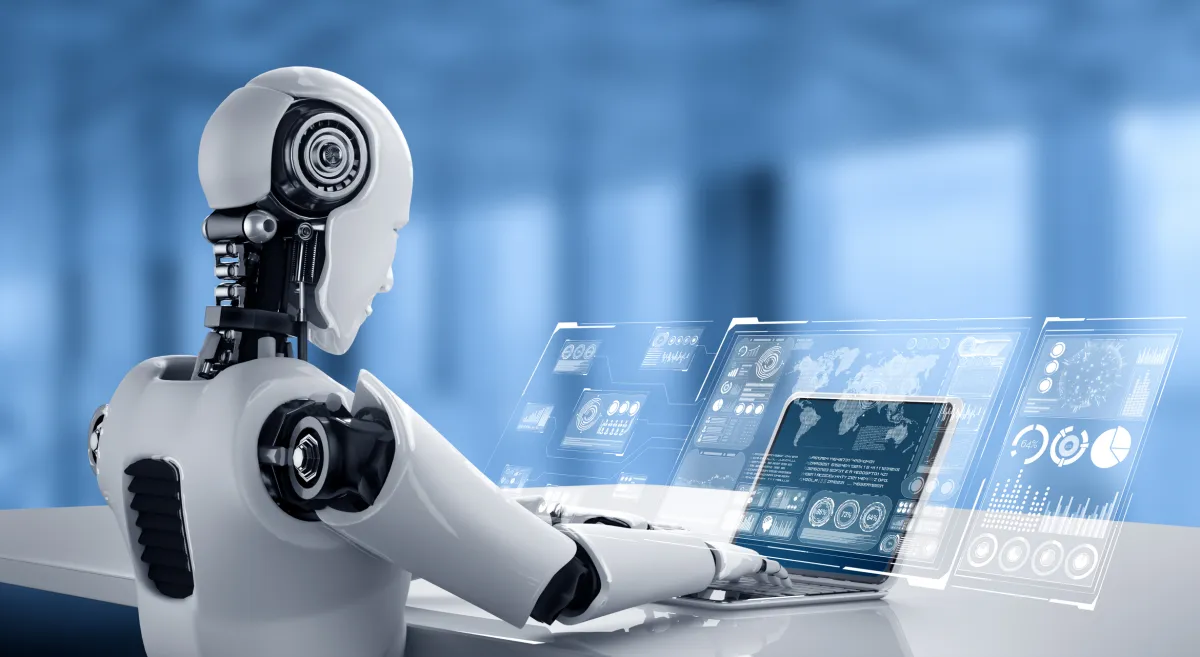
Humanoid robots from China captivated audiences worldwide with their acrobatic martial arts maneuvers during the country’s televised Spring Festival Gala. Concurrently, Chinese smartphone manufacturer Honor is poised to introduce its inaugural humanoid robot at MWC in Spain.
Under the “Made in China 2025” initiative, robotics was identified as a significant focus, though its initial emphasis was on industrial automation rather than human-like machines. Presently, swift progress in multimodal AI is expediting what is termed embodied AI — self-governing devices operating in actual environments. This endeavor, according to authorities, could potentially counteract workforce deficits and foster output enhancements.
In this nascent phase of human-like robot advancement, Chinese enterprises are surpassing their American competitors concerning both rapidity and quantity, stated Selina Xu, a China and AI strategy director at Eric Schmidt’s office.
“China possesses a stronger component procurement network — largely established via the electric vehicle industry, spanning from sensors to power cells — and the globe’s most powerful production infrastructure. This enables its firms to innovate considerably quicker than Occidental rivals,” Xu conveyed to TechCrunch.
Consequently, not only are Chinese robots more affordable, but companies can also introduce fresh versions with greater promptness, Xu observed. She further mentioned that prominent Chinese firm Unitree delivered approximately 36 times the number of devices last year compared to American competitors Figure and Tesla.
Worldwide deliveries of humanoid robots amounted to merely 13,317 devices last year, as per a Forbes publication issued last month. This constitutes a minuscule foundation for a sector projected to almost double each year and attain 2.6 million units by 2035. (Nonetheless, these statistics should be regarded with circumspection. The report notes that it is still ambiguous how many units signify actual purchases versus demonstration units or trial implementations, thus highlighting the nascent character of the industry.)
The leading manufacturers of human-like robots, based on 2025 deliveries, were spearheaded by China’s Agibot and Unitree, subsequently followed by UBTech, Leju Robotics, Engine AI, and Fourier Intelligence, thereby emphasizing Beijing’s initial supremacy within this domain.
Techcrunch gathering
Boston, MA
|
June 9, 2026
The most significant transition recently has been from “demonstration-fueled enthusiasm” to “practicality-based implementation,” Yuli Zhao, head of strategic planning at Galbot, conveyed to TechCrunch. Galbot’s human-like robot, the G1, was featured during this year’s Spring Festival Gala, China’s yearly, government-sponsored Chinese New Year’s Eve broadcast, accompanied by machines from Unitree Robotics, Noetix, and MagicLab.
“A greater number of clients are inquiring: Can the robot operate reliably in actual settings and genuinely alleviate human workload? This pragmatic demand is bolstered in the PRC because government directives and manufacturing plans promote automated improvements, and the production environment facilitates exceptionally rapid refinement,” Zhao noted.
While augmented investment into humanoid startups “has certainly quickened” the rate of advancement, “the longest-lasting implementation occurs when one can demonstrate consistent and reproducible worth in manufacturing or service activities, rather than merely a singular display,” Zhao further explained.
Nonetheless, capital injection assists, and Chinese robotics manufacturers are obtaining it. Last year, Unitree was estimated at approximately $3 billion after completing its Series C funding round, with aspirations to attain up to $7 billion in an upcoming initial public offering. Concurrently, Galbot has garnered over $300 million in new capital, apparently elevating its worth to $3 billion, marking one of the biggest funding rounds in China’s human-like robotics sector thus far.
American firms are also progressing past ostentatious demonstrations to concentrate on practical implementations. Furthermore, they are striving for their own ambitious objectives. U.S. startup Foundation, for example, intends to construct 50,000 human-like robots by late 2027.
However, China is already aiming for a combination of economical widespread-market versions and premium uses, swiftly extending human-like machines across manufacturing, individual, and recuperation domains, as per a December TrendForce report.
Obstacles to China’s supremacy
Regarding artificial intelligence platforms and cohesive software, it is yet ambiguous where Chinese human-like robot firms actually position themselves. The industry is primarily relying on visual-linguistic-behavioral paradigms and “global representations,” but both technologies are still in their initial phases. Nvidia presently heads the field with its complete human-like software architecture, according to Xu; consequently, the majority of human-like robot ventures in China are utilizing Nvidia’s Orin chips. However, indigenous semiconductor manufacturers are creating local substitutes, she mentioned.
Nevertheless, human-like robotics manufacturers are continuing to address core issues. The difficulty lies in empowering foundational robot paradigms to foresee the subsequent tangible condition the robot will encounter in uncertain surroundings, akin to how extensive linguistic models predict the next word. But unlike LLMs, human-like robotics companies cannot merely gather instructional information from the web, Xu explained. Therefore, most are depending on virtual settings, which produce artificial information, though gathering actual-world data stays crucial.
“Due to the issue of data shortage, human-like robots are still distant from self-governance. The physical components currently surpass the programming — the robot body can manage significantly greater agility today than years ago (though it has dependability problems, as observed with the robots that malfunctioned during human-like robot endurance events), but the cognitive core is still developing,” the analyst stated.
Safety also presents a substantial obstacle for human-like robots. A prominent mishap could provoke widespread disapproval, and China is probably considering how to deploy the innovation rapidly without undue haste. As the sector develops, additional rules are anticipated.
Considering the paucity of information, Zhao posits that the requirement for human-like robots will increase primarily in relatively controlled work environments.
“Initial impetus is likely to emerge in factory production, storage facility management, and sales, where duties are routine, shifts are extensive, and procedures are well-defined — thereby generating genuine need and perfect circumstances for human-like robots to provide widespread benefit,” he stated.
Other APAC participants
The advancement of human-like robots isn’t limited to a bilateral contest. Japan’s robotics environment — encompassing everything from emerging companies to major chip manufacturers — is aiming for widespread human-like robot manufacturing by 2027. Historically a trailblazer through projects such as Honda’s Asimo, Murata Manufacturing’s Murata Boy, and SoftBank Robotics’ Pepper, Japan relies on accuracy and sophisticated governance. A particular area for this country is the progressive employment of human-like robots in geriatric care.
James Riney, CEO of Coral Capital, who funds technology firms in Japan, anticipates Tokyo will persist in flourishing within the human-like robotics sector. “Three elements are poised to propel the integration of robotics in Japan. Firstly, the workforce deficit and the inclination to reduce reliance on extensive migration. Secondly, the prevalent societal perspective of robots as companions — more akin to Doraemon than Terminator. Thirdly, Japan already holds a leading position in numerous segments of the robotics supply chain.”
Hyundai Motor’s Boston Dynamics division unveiled a novel Atlas human-like robot for industrial application by 2028, with intentions to manufacture up to 30,000 devices each year in the U.S. as part of its artificial intelligence-propelled robotics initiative.
Nevertheless, for China, state directives, manufacturing plans, workforce deficits, and individual investment are all uniting to accelerate the country’s human-like robotics drive.
“China’s supremacy is best perceived as a rapid scaling benefit,” Zhao stated. “The environment here condenses the complete process — R&D, provision network, production, incorporation, and client implementation — into a very compact circuit. This signifies that human-like robot companies can transition from initial model to practical application more swiftly, gain insights from actual processes, and refine at a speed hard to replicate elsewhere.”
{content}
Source:{feed_title}