
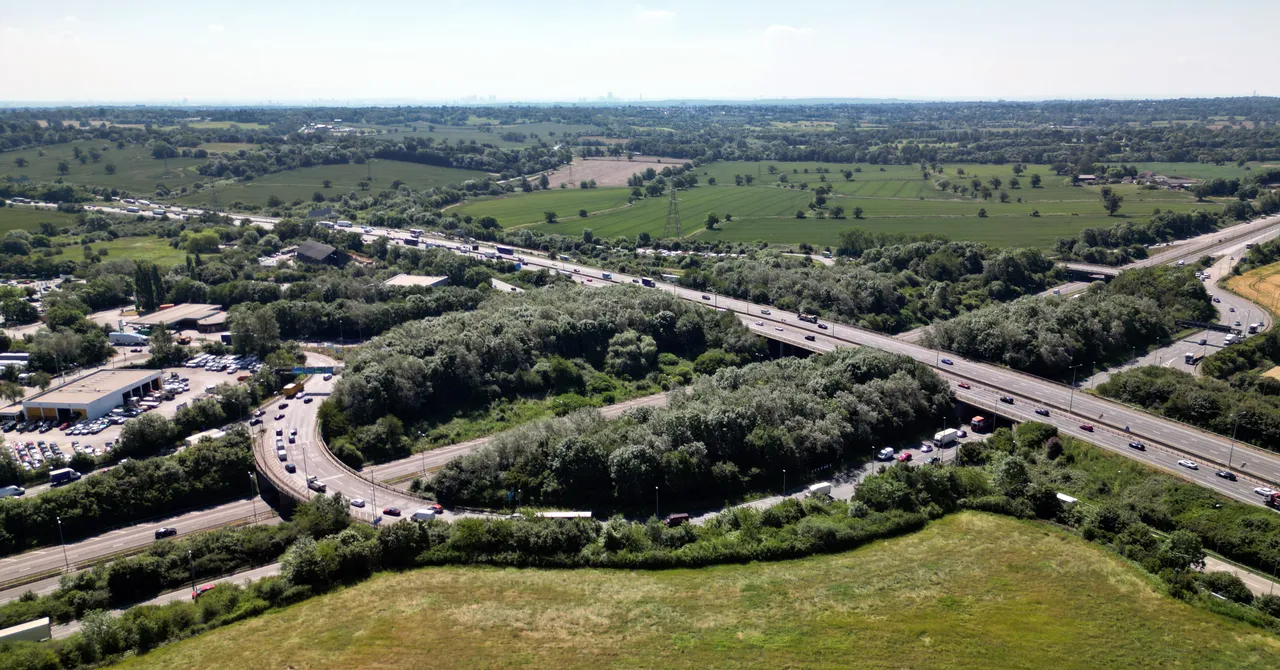
A brief journeyfrom London, the settlement of Potters Bar is divided from the hamlet of South Mimms by 85 acres of undulating agricultural land, crisscrossed by an irregular pattern of hedgerows. Within one of these expanses, a solitary oak offers a pausing point along a public walking path. Recently, this tree has also emerged as a locus of dissent. An announcement affixed to its trunk proclaims: “NO TO DATA CENTRE.”
In September 2024, a real estate firm sought authorization to construct an enormous data facility—poised to be among Europe’s largest—on the agricultural estate. Upon learning of this, local inhabitants formed a Facebook group, hoping to thwart the undertaking. Over 1,000 individuals became members.
The municipal authority has, until now, disregarded the collective’s grievances. In January 2025, it accorded development approval. By the subsequent October, Equinix, a global datacenter corporation, had purchased the parcel; it aims to initiate building work this year.
On a gloomy January Thursday afternoon, I convened near an entrance to the agricultural area with Ros Naylor—one of the Facebook group’s administrators—and six other local inhabitants. They conveyed their opposition to the data center for multiple reasons, highlighting especially the depletion of green expanses, which they perceive as a priceless avenue of retreat from urban settings to rural landscapes and a protective barrier against the motorway and petrol station discernible in the distance. “The allure of traversing this area on foot comes from navigating this very space,” Naylor remarked. “It holds immense significance for psychological health and overall welfare.”
While the UK administration strives urgently to satisfy the insatiable appetite for data centers—essential for training AI models and operating AI applications—analogous vast establishments are poised for construction nationwide. Nevertheless, for residents in immediate adjacency, the notion that AI might bolster the economy or integrate novel functionalities into their mobile devices offers scant comfort for what they regard as an upheaval of their rural lifestyle.
Dismantling Bureaucracy
Since the middle of the 20th century, London has been encircled by a largely continuous expanse of terrain, known as the green belt, comprising farms, woodlands, pastures, and recreational grounds. Under British legislation, building is exclusively authorized on green belt land under “highly unique conditions.” The primary objective is to safeguard rural regions from metropolitan intrusion and to avert adjacent settlements from consolidating into an indistinct mass.
However, subsequent to the current administration’s assumption of office in 2024, the UK established a novel land category—the grey belt—to denote suboptimal plots of green belt where construction might be granted approval with greater ease. Concurrently, the government declared its intention to regard data centers as “vital national infrastructure.” Collectively, these alterations have paved the path for a multitude of fresh data facilities to be erected throughout the UK.
In their endeavor to devise systems capable of exceeding human cognitive abilities, the planet’s foremost AI laboratories intend to collectively allocate trillions of dollars towards foundational infrastructure. Worldwide, in every location where novel data centers are being constructed, developers are encountering coordinated opposition from affected localities.
When the regional development agency sanctioned the Potters Bar data facility, its officials determined that the agricultural site aligned with the classification of grey belt. They additionally noted that their judgment was influenced by the administration’s endorsement of the data center sector. The advantages from a foundational growth and financial perspective, they concluded, surpassed the detriment of reduced open land.
“Individuals harbor a somewhat idealized notion that all green belt land consists of immaculate, undulating verdant expanses. In truth, this particular site, alongside numerous others, is quite the opposite,” states Jeremy Newmark, chairman of Hertsmere Borough Council, the electoral district that includes Potters Bar. “It represents a segment of suboptimal green belt terrain.”
{content}
Source:{feed_title}