
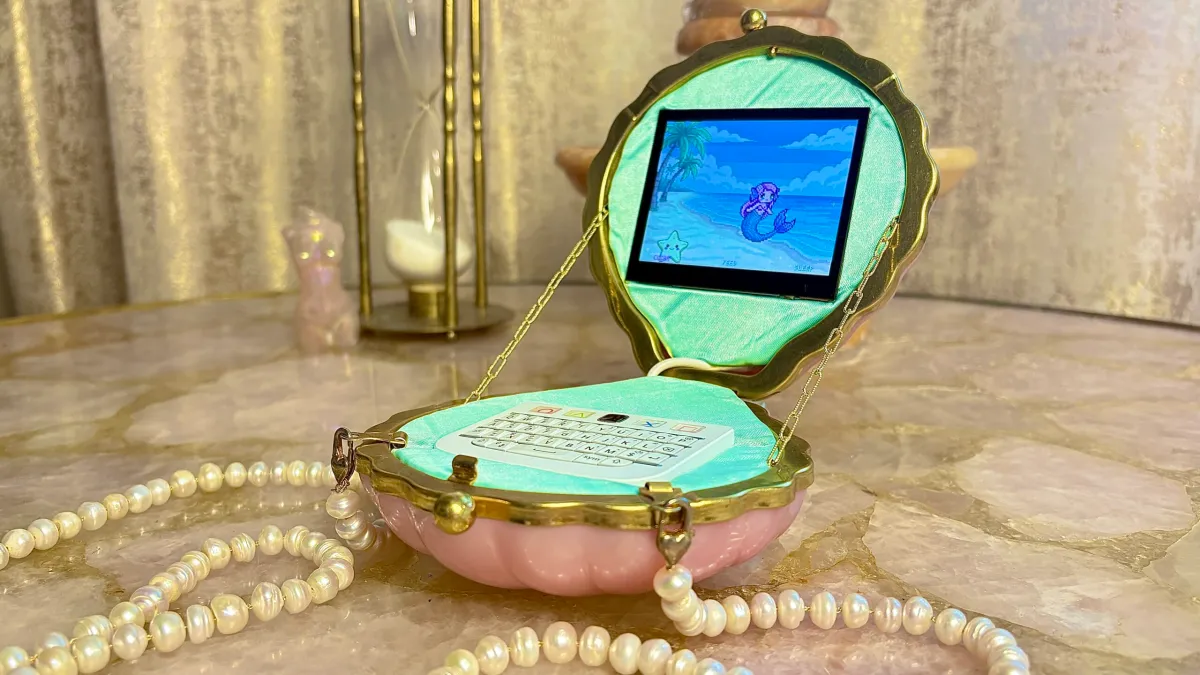
When I reach out to the self-proclaimed “open source baddie” CC for an interview, I’m pretty sure she’s emailing me back from a pink mermaid purse.
“I’m just having so much fun,” she tells me about her seashell cyberdeck. “It’s a Tamagotchi. It’s also an e-reader. It’s networked to my vault and my servers, so it has access to all of my server data, which has all my PDFs, and books, and notes, and everything… It’s also connected to my local AI setup at home.”
The Rise of the Hyper-Feminine Cyberdeck: Reclaiming Tech, One Pink Motherboard at a Time
Key Takeaways
- Aesthetic Rebellion:Women are transforming DIY computers (cyberdecks) into hyper-feminine, artistic expressions, directly challenging the monochromatic, utilitarian norms of big tech.
- Empowerment Through Customization:This vibrant trend signifies a reclamation of control over personal technology, rejecting proprietary “black box” devices in favor of hackable, customizable machines that prioritize user agency.
- Historical & Social Resonance:The movement not only fosters community and mutual education among women in tech but also re-establishes a powerful historical connection to women’s often-overlooked contributions to computing’s earliest days.
Forget the sleek, sterile black and silver gadgets dominating the tech landscape. A new wave of creators is taking computing into a delightfully different, decidedly more vibrant direction. At the forefront are women who are not just building computers, but transforming them into whimsical, hyper-feminine works of art – a movement playfully dubbed “girly cyberdecks.” This isn’t just about aesthetics; it’s a profound statement against the homogeneity of big tech, a reclamation of ownership, and a joyful celebration of creativity in a space often perceived as rigid and exclusive.
The Aesthetic Revolution: From Pink Mermaid Purses to Barbie Dreamhouses
When I reached out to CC, the self-proclaimed “open source baddie” behind the Bimbo Tech blog, I imagined her emailing me back from a device as unique as her persona. My hunch was confirmed: her current project is a seashell cyberdeck – a Tamagotchi, e-reader, and networked server access point, all housed within an embellished shell. “I’m just having so much fun,” she enthuses, highlighting the core motivation behind this burgeoning trend.
CC, who has no formal background in software engineering or computer science, has become adept at constructing these unconventional DIY computers. Her blog serves as a guide, encouraging other women to dive into hardware building, even if they’re still learning the basics of RAM.
The concept of the cyberdeck, originating from William Gibson’s 1984 sci-fi novel “Neuromancer,” found a new life with the advent of credit card-sized computers like the Raspberry Pi in the 2010s. For years, these custom builds thrived in niche online communities. But recently, a vibrant explosion has occurred, fueled by women on social media who are openly sharing their building processes, inspiring a new generation to create artistic, often overtly feminine, machines.
“I have a running joke that there’s this underlying misogyny in tech — because whenever they release a pro model, or an elite model… I’m always like, let me guess, it’s black or silver,” CC points out. “It’s never going to come in pink.”
This sentiment underpins the aesthetic choices. Customizing a cyberdeck has evolved into an art form. Online, one can find a cyberdeck made of wood and moss running Game Boy Color games, a desert-inspired MP3 player encased in a 3D-printed fossil, a Barbie dollhouse concealing a functional mini-computer, or even a duck figurine that records voice notes. As creator Sarahbelle Kim articulates on TikTok, “I don’t want Meta AI glasses. I want to pirate books in a tiny embellished shell. No one can surveil you there. You can get some basic parts at the thrift store or eBay and just customize it.” This speaks to a desire for something deeply personal, playful, and defiant.
Beyond the Glitter: Reclaiming Control from the Black Box
While the aesthetic appeal of a Hello Kitty purse checking your email is undeniable, the motivation behind these bedazzled cyberdecks runs deeper than mere fun. This trend is reaching its zenith at a time when many feel disempowered by the omnipresent homogeneity and proprietary nature of big tech.
“I think that’s such a refreshing thing for people who were sold these devices that are like Apple’s… If you try to jailbreak it, if you try to do anything to this phone that you paid $1,000 for, that you own, it’s out of warranty,” CC states. “So I just love seeing people taking the power back into their hands, taking the control back into their hands, which obviously always means creativity when people are given the means to go outside of the black box.”
The “black box” refers to the sealed, unmodifiable nature of most modern consumer electronics. Girly cyberdecks are a direct counterpoint, advocating for radical ownership and the freedom to tinker, customize, and truly understand the machines we interact with daily.
Weaving History and Hardware: The Craft of Computing
Maro Vardanyan, a blockchain developer, approaches cyberdeck creation with a unique historical perspective. While she doesn’t work with hardware professionally, her hobby of collecting and tinkering with old computer parts led her to a fascinating convergence of fiber art and technology.
“A few months ago, I just started as a hobby making art and jewelry pieces and purses with recycled or upcycled old computers I had,” Vardanyan explains. “When I saw everyone doing cyberdecks, I was like, wait, why am I just doing recycled and upcycled ones when I can actually preserve the pieces on something that’s wearable, that’s movable?”

Vardanyan refers to her creations as “crocheting with computers” or “macrame motherboards.” This choice of language is deliberate, connecting her work to the long, often overlooked history of women’s labor in early computing. Before the advent of silicon processors, some of the earliest computers relied on magnetic-core memory, an intricate web of copper wiring precisely threaded to encode binary data. For instance, to build the Apollo Guidance Computer that powered the moon landing, expert women textile workers meticulously wove complex patterns of wires.

“The original processor was handwoven by seamstresses, not by engineers or anybody else,” Vardanyan emphasizes. “I feel like the hand weaving, and even the fashion-meets-technology… It’s so full circle.” Starting with pink Raspberry Pis, she began weaving them into purses and corsets, documenting her progress on social media platform X.
Confronting the Gatekeepers: Debunking Misogynistic Pushback
Unsurprisingly, such a visible and female-led movement has faced its share of condescension and pushback from traditional, often male-dominated, tech communities. Vardanyan recounts the typical reactions to her macrame cyberdecks:
“Of course, when the macrame went viral, all of the men are like, ‘This is such a waste of the Raspberry Pi,’ … or, ‘what about the rain?’” she says. “And then I have to be like, ‘Actually, it’s preserved in an acrylic shell.’ And then they’re like, ‘This is so performative, and the GPIO is gonna lose energy!’ And I’m like, ‘Actually, I’m using a conductive thread, so it actually will move and be fully functioning.’”
CC has faced similar dismissals. She recalls a Reddit user scoffing, “‘You built your first computer a month ago, calm the f— down.’ Mind you, I’ve been building PCs for years,” CC retorts. The story, however, ends on a positive note: “So, long story short, he ends up apologizing and buying me the circuit board for my next cyberdeck.” These anecdotes highlight the resilience and technical acumen of these creators, who not only build innovative devices but also challenge preconceived notions about who belongs in tech.
A New Era of Tech Ownership
From CC’s mermaid purse computer to Vardanyan’s Raspberry Pi corset, these cyberdecks are a potent rejection of conventional Silicon Valley culture. Their deliberate impracticality and inefficiency – traits considered sacrilegious in an industry obsessed with optimization – are precisely what make them revolutionary. In a world where even unregulated peptide injections are trendy in the pursuit of peak performance, opting for hacky, DIY tech experiences is a radical act. It fosters a closer, more tangible relationship with devices that often feel abstract despite their ubiquity.
“Ten years ago, I would walk into a conference, there would be three girls, and people would literally just be like, ‘Were you hired for the marketing team?’” Vardanyan reflects. “I can’t even tell you how amazing it is seeing so many girls all over my social media and Instagram being into hardware, being into software, and then educating [each other], and that’s definitely the energy that we’re missing on every level in society.”
Bottom Line
The “girly cyberdeck” movement is more than a fleeting trend; it’s a powerful statement of autonomy, creativity, and community. By embracing personalization, challenging male-dominated norms, and re-connecting with the artisanal roots of computing, these women are not just building computers – they are actively reshaping the landscape of technology, making it more inclusive, colorful, and genuinely fun for everyone.
When you purchase through links in our articles, we may earn a small commission. This doesn’t affect our editorial independence.
{content}
Source:{feed_title}