
The glare frommy iPhone’s camera lights up my soiled socks and undergarments as I present each item for the video recording to distinctly capture. As I place my malodorous apparel into the washing machine, I flinch slightly each time the phone emits a sharp alert, sensing that my hands might be outside the view. Fingers must be visible! No, I haven’t transitioned to creating videos of niche material to earn a living—I’m trying DoorDash’s newest freelance platform, called Tasks.
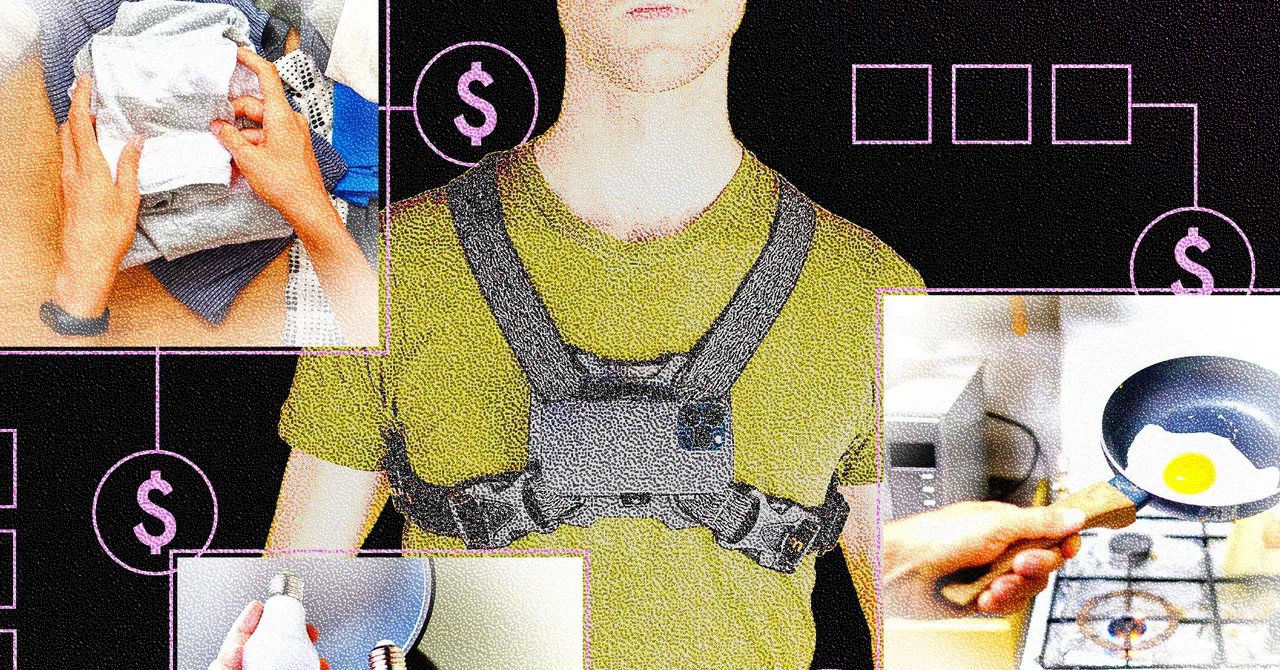
DoorDash’s new Tasks application, from the food delivery service, is unrelated to transporting meals—its sole purpose is collecting informational input from humans, specifically you, for enhancing generative AI models and human-like automatons. “This data assists AI and robotic systems in comprehending the tangible environment,” states DoorDash’s press release. “Payment is disclosed in advance and calculated according to the exertion and intricacy of the activity.” Most assignments necessitate attaching a smartphone to one’s chest and recording hands executing particular duties.
This type of visual information can be utilized by creators of AI models and robotics to improve their capabilities. For instance, numerous recordings of individuals neatly arranging clothes, with their hands plainly discernible, could aid in instructing a robot how to perform the identical chore using machine perception.
Photograph: Reece Rogers
DoorDash intends to broaden this offering to include an even broader spectrum of activities and participants in the future. It remains ambiguous precisely where the app is accessible to individuals initially in the US—residents of California, New York City, Seattle, and Colorado are expressly prohibited from utilizing Tasks. (I succeeded in utilizing the Tasks app and fulfilling assignments while living in Kansas.)
Intrigued by the types of assignments DoorDash is currently presenting, I registered as a “dasher” participant and installed the Tasks app. After accessing the platform, the initial challenge involved recording oneself relocating three objects across a table. Simple enough! I activated the recording device and shifted my coffee cup, pen, and laptop from one side of my desk to the other. My compensation for this did not involve monetary payment—DoorDash dispatched a free wearable holder for my smartphone camera afterward, enabling me to undertake additional assignments within the app.
Following that brief introductory period, I could view the comprehensive inventory of prospective engagements and begin earning income. The assignments presently accessible in the Tasks app primarily categorize as five principal classifications: domestic tasks, manual labor undertakings, meal preparation, spatial guidance, and dialogues in other tongues.The assignments under these headings are quite extensive. The roster of domestic duties encompasses activities such as tidying bedding and filling a dishwashing machine, as well as transplanting flora and disposing of refuse. The manual undertakings span from straightforward activities, like replacing a lamp, to more intricate endeavors, like mixing and laying concrete. The culinary assignments primarily focus on eggs: preparing them by frying, poaching, or scrambling. Orientation assignments involve traversing a museum and perambulating through an apartment complex. For the linguistic assignments, the app solicits “spontaneous dialogues” in Russian and Mandarin Chinese, and various other tongues.
{content}
Source:{feed_title}