
Sam Basu departed his position as a principal software developer at Google in early 2023, shortly following OpenAI’s release of ChatGPT. He made several attempts to launch novel AI enterprises, though none truly materialized until he received an inquiry from a friend requesting assistance with customs declarations.
Basu became “highly intrigued” and commenced cold-contacting customs agents in the Los Angeles region. He discovered that numerous operations were small, family-run entities heavily dependent on facsimile devices and physical documents. The moment his initial client displayed piles of manila folders during a virtual office tour via FaceTime, everything fell into place, Basu recounted to TechCrunch. He traveled to that client’s premises the following day.
“That was the revelatory instant. There were simply documents upon documents,” Basu stated in a recent discussion. “I was simultaneously astonished and captivated. Astonished that this is the operational method of the sector, and captivated that all objects surrounding us, from your timepiece to your spectacles—indeed, everything brought into the country—is processed in this manner covertly.”
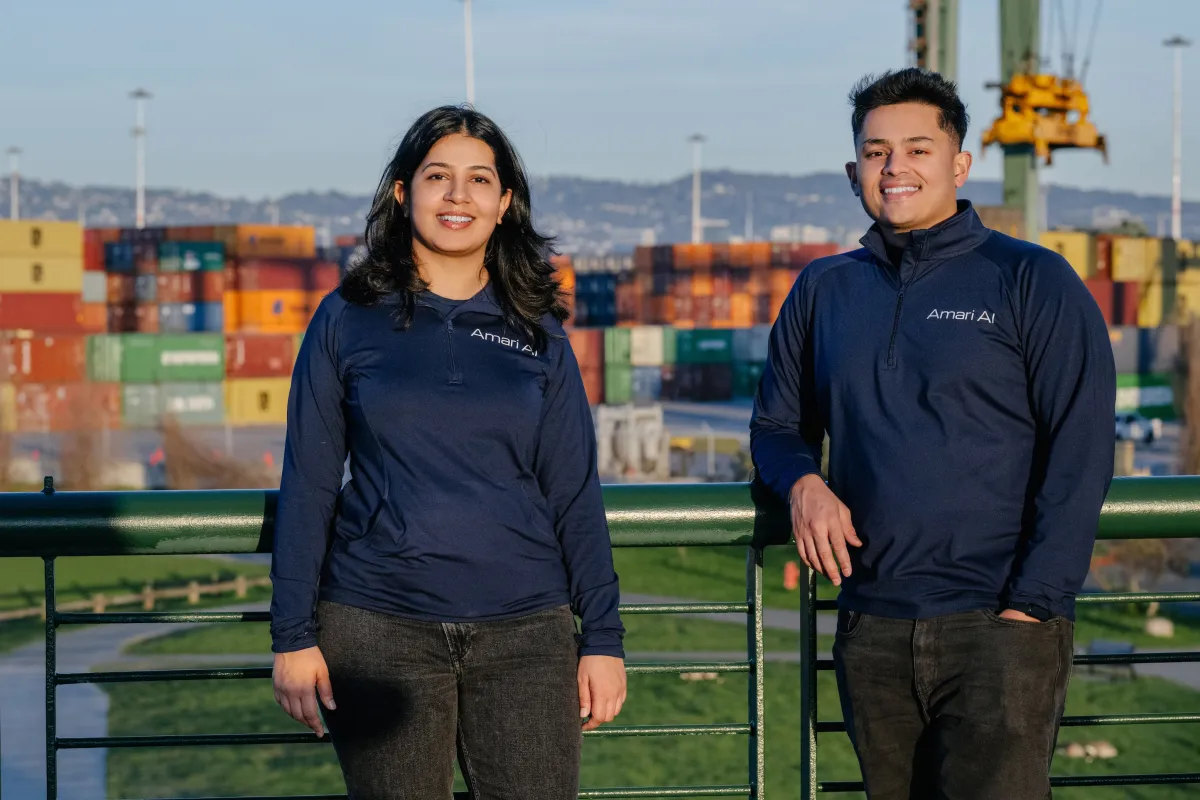
This embryonic concept is currently known as Amari AI, an emerging company co-established by Basu and Arushi Vashist, formerly a lead software developer at LinkedIn. The duo, alongside their compact team, has already amassed over 30 clients and assisted those enterprises in transporting goods valued at more than $15 billion.
Amari has likewise secured $4.5 million in capital, co-spearheaded by prominent early-phase venture firms First Round Capital and Pear VC, all prior to its public unveiling on Thursday.
Basu harbors two objectives for Amari. Firstly, to aid customs intermediaries in modernization. Thus far, he mentioned, many have undertaken minimal effort to incorporate novel technologies. Some utilize optical character recognition programs to expedite data input, but that technology is restricted and fragile, he observed. Amari aims to facilitate the automation of data capture and documentation, enabling staff—who are legally mandated to reside in the United States, thereby preventing firms from employing offshore personnel—to concentrate on assisting clients with cross-border transit of their merchandise.
This is where the second objective becomes relevant. President Donald Trump’s turbulent trade directives have rendered customs agents considerably more crucial, as per Chris Bachinski, CEO of the venerable 125-year-old enterprise GHY International. Bachinski—an early implementer of Amari—informed TechCrunch that numerous of his clients lack their own regulatory adherence personnel. Instead, they turn to intermediaries such as GHY to ascertain how abrupt shifts in trade regulations pertain to their commodities, particularly if these are already en route.
Techcrunch event
Boston, MA
|
June 23, 2026
This disarray has resulted in widespread exhaustion throughout the sector, as per Basu. Given the rigorously regulated workforce, and a licensing examination success rate hovering between 10% and 20%, “it presents an ideal application for AI,” he asserted.
“Seasoned professionals are departing the sector or opting for early cessation of work,” Basu stated. “Therefore, we are presenting ourselves as an additional pair of hands that logistics enterprises can engage or retain in conjunction with human proficiency.”
Basu mentioned that Amari’s AI entities continuously track commercial regulations and revise their logic whenever alterations occur, simplifying the process for brokers to aid their clientele in swiftly grasping any repercussions. Hitherto, such abrupt modifications necessitated manual investigation, which impeded intermediaries’ capacity to clear merchandise into the nation.
Amari achieves this by developing its proprietary AI models, educated on over a million documents pertaining to consignments it has already facilitated through customs, although Basu noted the firm has been utilizing readily available models thus far. He pointed out that certain clients elect to forgo this training, and that Amari renders the data anonymous prior to inputting it into the models.
“We do not vend their information, and we guarantee that their data remains their own,” he affirmed. “They are exceedingly particular regarding these records.”
Todd Jackson, a partner at First Round Capital, credited Amari’s initial triumph to Basu’s readiness to exert considerable effort to ascertain the requirements of these agents.
“He attends conventions, he visits expositions, [and] the informal communication begins to strengthen significantly,” Jackson remarked in a discussion. “It’s a traditional sector.”
It was at one such exposition—the National Customs Brokers and Forwarders Association of America, specifically—that a presentation by Basu captured Bachinski’s attention. GHY International is not a small, family-owned business, nor is it a Fortune 500 corporation such as FedEx; Bachinski has been seeking methods to both maintain competitiveness and expand his enterprise.
Bachinski stated that the paramount apprehension among GHY staff thus far has been employment termination. However, he has assured them there is no cause for concern. He anticipates that technology akin to Amari’s will aid GHY in expansion and in placing greater emphasis on client relations and regulatory adherence tasks.
“It is an antiquated sector, and technology is poised to transform our industry more rapidly than most customs intermediaries, I believe, comprehend,” he commented. And with commerce now perpetually under scrutiny, he stated, agents must exhibit adaptability. “I often jest that last year marked the inaugural occasion in history when our relatives grasped our profession. For abruptly, customs agents attained significant, paramount importance.”
{content}
Source:{feed_title}