
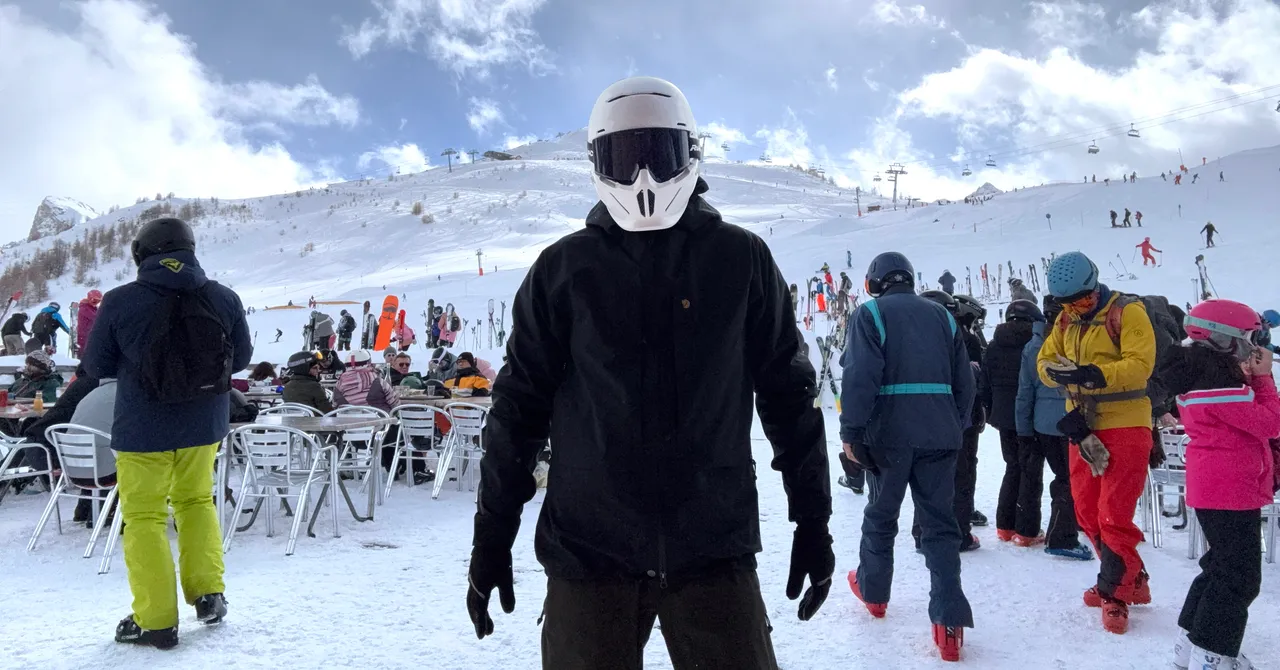
“I dislikeconversing with you when you’re clad in that. It’s rather daunting.”
A companion uttered these words to me—and he was entirely serious. His moniker is Stuart. Stuart embodies as amiable an individual as one could hope to encounter, and we’ve glided down slopes together on several occasions. Presently, nonetheless, he wishes to have no association with me. I haven’t vexed him; we maintain a cordial relationship—yet he despises the item adorning my head. As the week drew to a close, my sentiments mirrored his.
The daunting head-covering I’m donning is the Ruroc RG2. It represents, as per Ruroc, the globe’s sole full-face snow-sport head protector—and currently, I grasp the rationale completely, notwithstanding my initial perception that it seemed the perfect headpiece to substitute my dated POC. Theoretically, the RG2 ought to be a triumph, notwithstanding its initial cost of $379 (rendering it pricier than almost every selection in WIRED’s ski helmet recommendations). Merely upon wearing it do its disadvantages become strikingly apparent.
The RG2 is, in fact, an ISPO Award-honored headgear. It incorporates an embedded Twiceme NFC chip, facilitating the storage of vital medical data, readily retrievable by emergency personnel during urgent situations. For safeguarding your cranium, it’s padded with Rheon, a porous, power-dissipating polymer (initially devised from a NASA undertaking investigating space shuttle foam alternatives) which remains pliable in its normal condition but immediately rigidifies upon collision.
At an additional expenditure, an optional JBL-driven Cardo Communication System is available, enabling users to stream audio, handle phone conversations, link with a GoPro, and converse with as many as 15 other equally formidable Ruroc wearers via a mesh interconnect.
The primary advantage of the RG2 compared to the initial RG1, nonetheless, resides in a straightforward modification within this refreshed iteration. With the RG1, one fastened the lower facial shield employing plastic fasteners that slipped—typically reluctantly—into position. It functioned, yet any perceived appeal for users was instantly diminished as onlookers observed their struggle to manipulate those clips into engagement, without convenient reflective surfaces readily available beyond a typical ski lift or alpine eatery. The remedy? Magnets. Ruroceventuallyadopted that decision following a thorough review of “15 years of immediate input.”
The plastic fasteners have vanished, succeeded by the Magnetic Mask System, which “permits wearers to effortlessly detach the helmet’s chin guard even when gloved.” The challenge, however, was never the removal of the chin component. Affixing the contraption was the predicament. Nevertheless, this novel magnetic mechanism is undeniably simpler, though it is far from infallible, and you will probably still need to attempt securing it multiple times whenever you wish to attach it to the headpiece.
{content}
Source:{feed_title}