
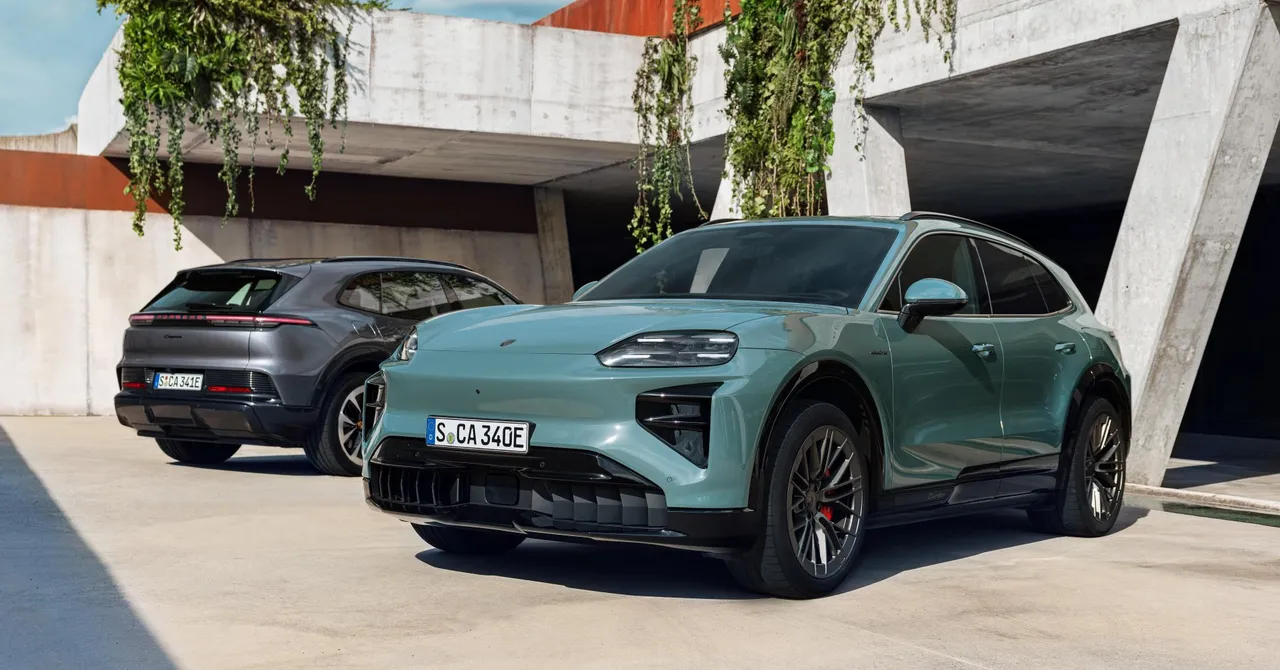
In all respects, the Cayenne offers enhancements compared to the more compact Macan—as is expected, considering the cost disparity and Porsche’s automotive stratification—however, theoretically, its operational distance and charging velocity already trail what the immense Chinese manufacturer BYD is preparing to launch. Nevertheless, vehicles from high-performance marques such as Porsche, even purely electric sport utility vehicles, encompass more than mere technical specifications. A battery-powered Cayenne must handle akin to a Porsche, exude the essence of a Porsche, and serve as a constant reminder to its proprietor of the substantial sum invested for that emblem on the steering mechanism.
Curved Screen
Concerning that aspect, the updated Cayenne proves capable. Its design appears more defined and refined than previously, partly due to diminished cooling demands and an emphasis on a more streamlined, aerodynamically efficient chassis. The forward section is distinctly Porsche, and the dynamic aerodynamic fins extending from the back extremities of the premium Turbo model also align with the brand’s identity, optimizing air movement and boosting performance when moving quickly.
Conversely, the rear is uninspired; with the sole Porsche insignia being an illuminated design element within the light strip, the Cayenne becomes visually indistinct when stationary and powered down. Nonetheless, consumers weary of Tesla’s habit of restricting paint choices to a mere handful will appreciate the Cayenne’s array of 13 external paint shades and 11 rim styles.
Within the cabin, it retains a characteristic Porsche feel, yet features an innovative curved screen descending along the central fascia. This arched OLED panel evokes the initial impression of a foldable mobile device—fortunately, without the fold line. Dismiss it as a novelty if you choose, but I find Porsche’s method here appealing, as it enables the user interface to broaden or divide into two sections across the display’s dual surfaces. Furthermore, it aids in diminishing reflections, while a cleverly positioned panel beneath the screen serves as a support to stabilize one’s hand when interacting with the interface. Tactile controls manage fundamental functions such as climate, ventilation speed, and audio levels, and thankfully, genuine buttons are present on the steering wheel as well, rather than inconsistent haptic feedback.
The infotainment platform from Porsche stands among the finest I’ve encountered recently; within the Cayenne, it has undergone additional enhancements to render menu traversal more straightforward and user-friendly. Its guidance system is similarly commendable against numerous alternatives, though, understandably, most users will probably connect Apple CarPlay or Android Auto. Porsche, however, has yet to transition to CarPlay Ultra, notwithstanding its stated plans to implement it in 2022 and reiterating that commitment twelve months subsequent. Consequently, mobile applications do not project onto the Cayenne’s instrument cluster, and CarPlay lacks control over climate settings or radio operation.
As this is a large sport utility vehicle, ample room accommodates four full-sized adults, with an option for a fifth if necessary, and the cargo area expands from 27.6 to 56 cubic feet based on the back seats’ configuration. An additional front trunk beneath the bonnet provides 3.2 cubic feet, which is convenient for stowing the charging cord.
Speed Demon
Upon its introduction, three distinct versions of the Cayenne Electric are available. The entry-level model is priced from $109,000 and boasts 435 horsepower; the intermediate Cayenne S Electric commences at $126,300 and generates 657 horsepower; and the premier Cayenne Turbo Electric is $163,000, offering 1,139 horsepower alongside 1,106 lb-ft (1,500 Nm) of rotational force. Indeed, that final figure represents an extraordinary output for any automobile, much less a substantial sport utility vehicle. This endows the Turbo with superior potency to a Bugatti Veyron, coupled with twice the rotational force of a V12-powered Ferrari Purosangue.
Acceleration from naught to sixty miles per hour for the Cayenne range is achieved in 4.5, 3.6, and 2.4 seconds, in that order. Once more, the Turbo distinguishes itself considerably, and arguably, its dash from zero to 124 mph (200 km/h) is even more staggering, clocking in at 7.4 seconds. This performance equals a Veyron’s and is roughly comparable to a Tesla Model S Plaid. Candidly, however, minute comparisons of fractions of a second in this context hold little significance. Activate the Cayenne Electric Turbo’s Sport Plus setting, initiate Launch Control, and the outcome is truly discomfiting. My consistent counsel remains to economize by tens of thousands of dollars and opt for the variant offering the greatest range.
{content}
Source:{feed_title}