
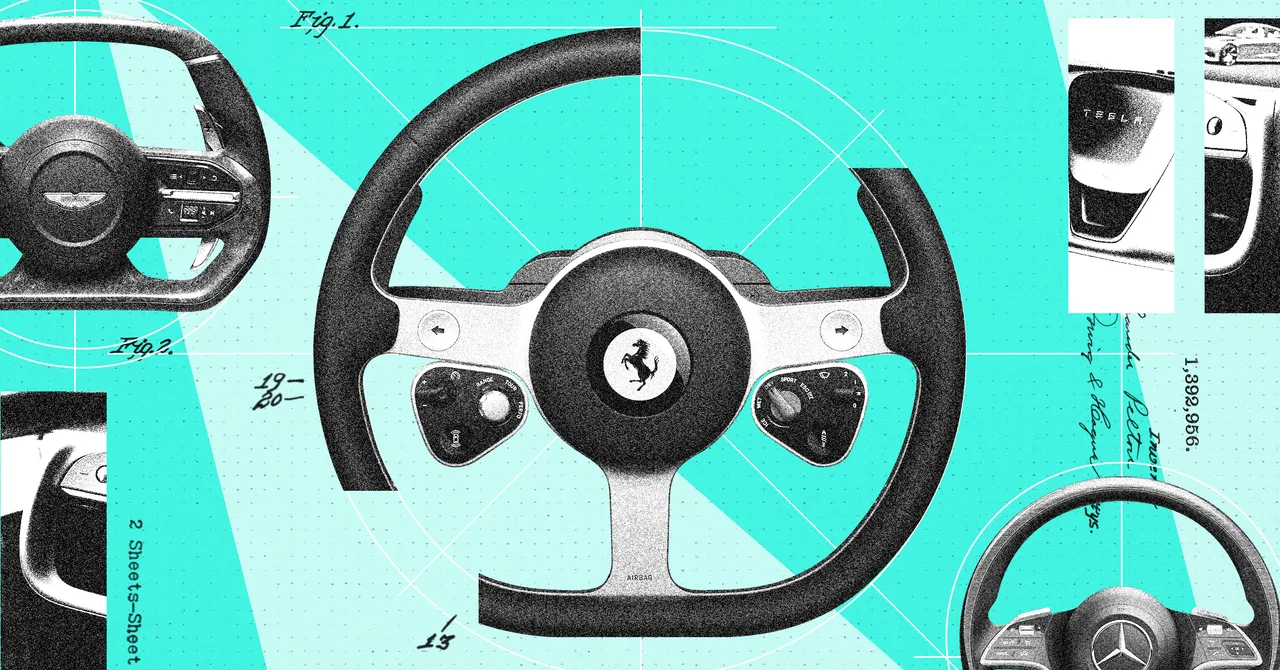
Vehicles weren’t invariably equipped with steering wheels. The inaugural automobile—the 1885 Benz Patent-Motorwagen, conceived by Karl Benz—employed a tiller mechanism: a horizontal pole featuring a grip affixed to an upright rod. This lever-style grip bore a resemblance in numerous ways to a ship’s rudder. Remarkably, nearly a decade elapsed until the French engineer Alfred Vacheron recognized the benefit and installed the inaugural documented steering wheel in his 4-horsepower Panhard for the Paris-Rouen competition. Merely four years subsequent, in 1898, Panhard standardized the vastly superior and more secure steering wheel across all its vehicles. And they have remained in use continuously since then.
Hans-Peter Wunderlich holds the position of Mercedes’ creative director for internal aesthetics. He has dedicated 35 years to conceiving steering wheels. “I commenced work on my initial one in 1991,” he informs me. “A steering wheel truly stands as the most arduous and intricate component to sculpt, to conceptualize, to engineer within a vehicle.” Its complexity is such that Wunderlich has employed the wheel as an assessment for prospective candidates.
“Upon engaging a designer, after reviewing an impressive portfolio, I have assigned them the duty of sketching a steering wheel for me,” he states. “The steering wheel serves, for me, as the conclusive evidence. Am I to employ them or not? Should a designer prove capable of crafting an impeccable steering wheel, even as a mere doodle, then they will demonstrate proficiency for the entire interior of an automobile.”
This particular challenge, in part, drew the attention of Ive and his group. “Our initial approach involved endeavoring to comprehend the fundamental essence of the dilemma requiring resolution, which typically implies discarding conventional wisdom,” Ive confides. “An automobile is an assemblage of numerous components, and, in various respects, we are fashioning furnishings. We are devising intricate and advanced input mechanisms. A primary difficulty lay in attempting to forge unity. Cohesion isn’t achieved through a mere collection of regulations. That presented a splendid novel undertaking, one grappled with over several years.”
For both Ive and Wunderlich, scientific principles accompany the artistic aspect of design. They discuss the complexities of ergonomics, the rationale behind the controls, incorporating an “explosive component at the core” (the airbag), which is steadily growing in intricacy, notes Wunderlich. “Even the periphery itself constitutes an ergonomic discipline,” he supplements, mentioning his team collaborates closely with Mercedes’ internal ergonomics division during these phases. “The split is nearly equitable. We obtain specifications from both engineering and ergonomics departments.”
Wheeling Forth
Examine the edge of your steering wheel attentively; its cross-section will not appear circular. Divide it into sections, and each segment will probably feature a distinct contour, purposed to enhance traction wherever your hands hold the wheel. Even the cushioning must be precisely correct. “It ought not to resemble bone, yet neither should it be excessively plump. A pleasant equilibrium is requisite,” Wunderlich states. “[It should communicate] this automobile is robust, it exudes quality, it is potent, it is formidable, yet it is not unrefined.”
“Should you grip the wheel at the three and nine o’clock locations, your fingers can indent the posterior aspect of the rim—thus presenting the protuberance, the curvature of the rim,” Wunderlich explains. “Subsequently, we sculpt a depression where your fingers may repose. This allows your hands to clench. You experience the sensation of commanding the vehicle. This proves exceedingly difficult, as in that zone, an intricate technical framework must be upheld—comprising complex electronics and warming components. We push the engineers intensely to maintain that region so compact, enabling us to meticulously shape it.”
Ive rigorously challenged Raffaele De Simone, Ferrari’s chief engineer and principal development driver. De Simone is occasionally referred to within the firm as “Client Number One” because, seemingly, no Ferrari street vehicle departs the manufacturing plant until he is content with its operational capabilities.
{content}
Origin:{feed_title}