
The Trump administration on Friday unveiled a regulatory structure for a unified artificial intelligence directive in the United States. This blueprint would consolidate authority in Washington by overriding state AI statutes, potentially undermining the recent wave of initiatives from states to govern the application and evolution of the technology.
“This framework can only succeed if it is applied uniformly across the United States,” a White House declaration concerning the blueprint states. “A disparate collection of conflicting state laws would jeopardize American innovation and our capacity to lead in the global AI competition.”
The framework delineates seven primary aims that prioritize technological advancement and AI expansion, and proposes a centralized federal methodology that would supersede more rigorous regional directives. It assigns considerable onus to guardians for matters such as juvenile protection, and presents rather lenient, non-mandatory provisions for platform culpability.
To illustrate, it states Congress should mandate AI firms to integrate functionalities that “mitigate the risks of sexual exploitation and harm to minors,” but fails to specify any explicit, actionable stipulations.
This blueprint from Trump follows three months after he issued an executive directive instructing national departments to contest regional AI statutes. The order allowed the Department of Commerce a 90-day period to assemble an inventory of “burdensome” state AI regulations, possibly jeopardizing states’ entitlement to national financial aid like internet infrastructure subsidies. The department has not yet released that compilation.
The directive further instructed the government to collaborate with lawmakers regarding a standardized AI legislation. That concept is gaining clarity, and it reflects Trump’s previous AI approach, which emphasized fewer restrictions and greater encouragement for corporate expansion.
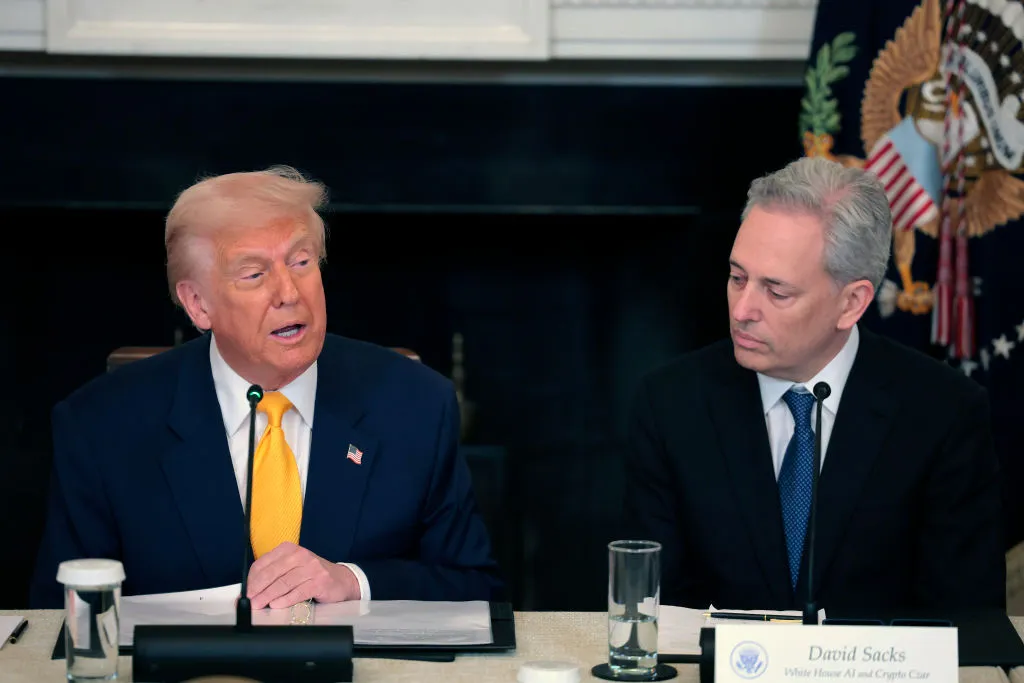
The fresh blueprint advocates for a “minimally arduous national guideline,” reiterating the administration’s wider initiative to “eliminate obsolete or superfluous obstacles to progress” and hasten the integration of AI across sectors. This is a growth-oriented, lenient oversight method advocated by self-proclaimed “accelerationists,” with White House AI chief and investor David Sacks being a prominent supporter.
Techcrunch gathering
San Francisco, California
|
October 13th to 15th, 2026
Although the blueprint acknowledges federal principles, the exceptions for states are rather limited, retaining merely their jurisdiction over common statutes like deception and juvenile safeguarding, urban planning, and governmental AI application. It firmly opposes states governing AI evolution independently, a matter it deems as intrinsically cross-state, connected to homeland defense and international relations.
Moreover, the blueprint endeavors to deter states from “imposing sanctions on AI creators for unauthorized actions by a third party utilizing their systems” — an essential protection against responsibility for creators.
Conspicuously absent from that blueprint are any indications of accountability structures, autonomous supervision, or implementation instruments regarding unforeseen damages that AI might inflict. Consequently, the framework would consolidate AI policy formulation in the capital while concurrently restricting the capacity of states to serve as initial overseers of nascent dangers.
Detractors assert that states function as democratic testing grounds and have proven more agile in enacting legislation concerning novel hazards. Significantly, New York’s RAISE Act and California’s SB-53 aim to guarantee major AI corporations possess and conform to security guidelines which are openly recorded.
“David Sacks, the White House’s AI chief, persists in serving the interests of large technology firms to the detriment of ordinary, diligent U.S. citizens,” declared Brendan Steinhauser, Chief Executive Officer of The Alliance for Secure AI. “This national AI blueprint endeavors to inhibit states from enacting AI laws and offers no avenue for AI creators to be held responsible for the damages their creations inflict.”
Numerous figures within the AI sector are commending this trajectory because it grants them more extensive freedom to “pioneer” unburdened by the menace of governmental oversight.
“This blueprint is precisely what nascent companies have been requesting: a distinct national guideline allowing for rapid development and expansion,” Teresa Carlson, head of General Catalyst Institute, informed TechCrunch. “Entrepreneurs ought not to be compelled to traverse a mosaic of contradictory state AI statutes which hinder advancement.”
Juvenile protection, intellectual property rights and freedom of expression
The blueprint was released at a juncture when juvenile protection has become a primary contentious issue within the discourse on AI. Some states have acted vigorously to enact legislation intended to safeguard young people and assign increased duty to technology firms. The government’s proposition indicates an alternative course, stressing parental oversight more than provider culpability.
“Guardians are optimally positioned to oversee their offspring’s online surroundings and development,” the blueprint declares. “The Government is urging lawmakers to furnish parents with instruments to accomplish this efficiently, like access mechanisms to shield their children’s confidentiality and govern their gadget usage.”
The blueprint further states that the government “contends” AI platforms ought to “deploy functionalities to diminish potential child sexual abuse and the promotion of self-injury.” While it implores Congress to mandate such protections, and asserts that current statutes, notably those outlawing child sexual abuse content, ought to extend to AI systems, the proposition utilizes caveats such as “economically viable,” and refrains from establishing explicit conditions.
Regarding intellectual property rights, the framework endeavors to locate an equitable balance between safeguarding originators and permitting AI platforms to learn from extant creations, referencing the necessity for “equitable application.” Such phrasing reflects contentions presented by AI firms as they encounter an escalating volume of intellectual property litigation concerning their instructional information.
The primary safeguards seemingly delineated by Trump’s AI blueprint entail guaranteeing “AI may seek verity and precision without constraint.” More precisely, it targets the preclusion of state-initiated suppression, as opposed to self-regulation by platforms.
“Lawmakers ought to restrain the U.S. government from pressuring technology suppliers, AI providers included, to prohibit, mandate, or modify material due to factional or doctrinal motives,” the blueprint states. It further directs Congress to establish a mechanism for citizens to pursue legal remedies against state bodies attempting to suppress communication on AI platforms or prescribe data furnished by an AI system.
The blueprint emerges concurrently with Anthropic’s lawsuit against the state for purportedly violating its First Amendment liberties, following the Department of Defense’s classification of it as a supply chain hazard. Anthropic contends the DoD’s designation is in reprisal for its refusal to permit the armed forces to employ its AI offerings for widespread monitoring of U.S. citizens, and for utilizing its systems in autonomous deadly weaponry for aim and discharge determinations. Trump has characterized Anthropic and its CEO, Dario Amodei, as “socially conscious” and an “extremist” progressive.
The blueprint’s wording, which underscores safeguarding “legitimate political speech or disagreement,” appears to expand upon Trump’s prior Executive Directive aimed at what is termed “socially aware AI,” which compelled national departments to implement systems considered politically impartial.
The distinction between suppression and typical content management remains ambiguous, thus, such phrasing might impede collaboration between overseers and platforms regarding matters such as false information, electoral meddling, or societal security hazards.
Samir Jain, the policy vice president at the Center for Democracy and Technology, highlighted: “[The blueprint] correctly asserts that the state ought not to compel AI firms to prohibit or modify material driven by ‘factional or doctrinal motives,’ however, the Government’s ‘socially aware AI’ Executive Directive issued this past summer achieves precisely that.”
{content}
Source:{feed_title}