
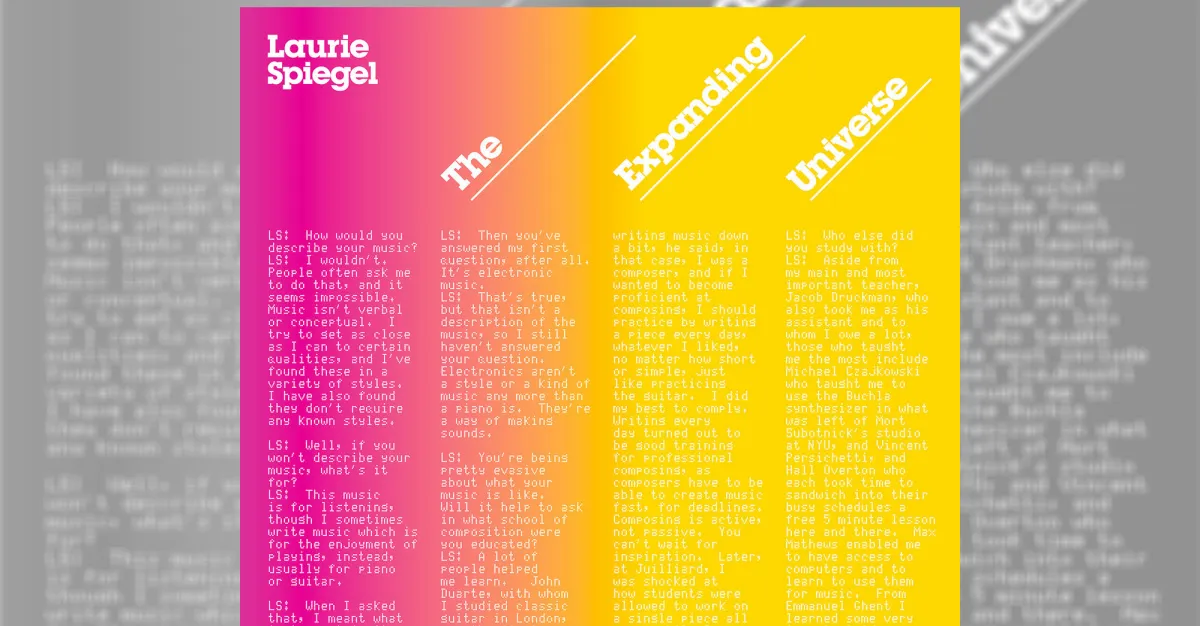
Lately, I had the privilege of conversing with Laurie Spiegel for this platform. In anticipation of our discussion, I devoted considerable time over the past few weeks immersing myself in Spiegel’s albums, chieflyThe Expanding Universe, her seminal 1980 work. This album masterfully fuses synth exploration with pioneering instances of what would later on be known as ambient music, alongside computer-aided compositional methods. It’s a wonder that resonates as both evocative of the past and avant-garde simultaneously.
Compositions such as “Patchwork” and “A Folk Study” explore lively arpeggiations, inviting parallels with The Who’s “Baba O’Riley.” Meanwhile, “Old Wave” and “East River Dawn” evoke the nascent sounds of M83 or Boards of Canada. The sonic spectrum she utilizes is vibrant and perennial, seldom sounding dated in the manner of her subsequent (equally superb) album,Unseen Worlds, which periodically features FM bells.
The album also includes leisurely explorations into more quintessential ambient sounds, such as “Appalachian Grove II” or “The Unanswered Question.” Their melodies progress with such unhurriedness that they might, at times, seem almost entirely arbitrary. Compositions like these, along with “Music for Dance II,” would seamlessly integrate into contemporary ambient Instagram or modular synth YouTube communities – scenes that clearly draw heavily from Spiegel’s groundbreaking compositions.
While the overwhelming bulk of the compositions are devoid of rhythmic elements, a few deviations exist, predominantly the brisk and multifaceted in rhythm “Drums.” However, the most striking piece, in my opinion, is “Clockworks.” It delves into the early industrial grit and clatter one might encounter in a Throbbing Gristle record or even a contemporary Trent Reznor score. It’s astonishing to me that it has seemingly not been sampled (at least according to WhoSampled) and reimagined as the core of an underground hip-hop track.
AlthoughThe Expanding Universemay not inherently offer a unified artistic statement, it nonetheless comes across as the unique articulation of an artist at their creative zenith. The 2012 reissue further enhances Spiegel’s heritage by featuring over 100 minutes of supplementary content absent from the initial pressing.
While the notion of 1970s experimental synth music might deter uninitiated audiences, many compositions onThe Expanding Universepossess an engaging quality. Certainly, some pieces, such as the consecutive concluding pieces “Kepler’s Harmony of the Worlds” and “Wandering in Our Times,” confidently reside for prolonged durations in discord and challenging sonorities. However, predominantly, Spiegel’s compositions are melodious and accessible.
{content}
Source:{feed_title}