
**Key Takeaways:**
- **Rapid Ascent to Unicorn Status:** XDOF, a robotics data startup, is reportedly on the verge of closing a Series B round at a staggering $1.2 billion valuation, less than three months after its Series A, fueled by annualized revenues approaching $50 million.
- **Solving Robotics’ Data Bottleneck:** Co-founded by UC Berkeley researchers, XDOF specializes in building the critical data pipelines, collection tools, and annotation systems essential for training general-purpose robots, a fundamental challenge that currently impedes the industry’s progress.
- **Innovative Data Collection & Impact:** Utilizing a hybrid approach of remote robot teleoperation and human-worn sensors, XDOF is poised to release the world’s largest high-quality robot training dataset, ABC, positioning itself as the “Scale AI for physical robotics” and a vital enabler for frontier AI labs.
XDOF Surges Towards Unicorn Status: A $1.2 Billion Bet on the Future of Robotics Data
In a stunning display of investor confidence and market demand, XDOF, a nascent yet rapidly growing startup focused on providing real-world teleoperation data for training general-purpose robots, is reportedly in advanced discussions to secure a Series B funding round. This new investment is set to catapult the company to an impressive valuation of approximately $1.2 billion, with leading venture capital firm 8VC at the helm, according to sources privy to the confidential negotiations.
This impending valuation is particularly remarkable given XDOF’s recent emergence from stealth mode. Founded in 2024 by UC Berkeley researchers Philipp Wu (CEO) and Fred Shentu (CTO), the company only secured its $70 million Series A round in June. That initial funding saw participation from a roster of top-tier investors including Thrive Capital, Andreessen Horowitz, Lux, and Spark Capital. The initial plan wasn’t to re-enter the fundraising arena so swiftly. However, the startup’s explosive growth – indicated by its annualized revenue swiftly approaching the $50 million mark – created an irresistible draw for venture capitalists, who proactively initiated discussions for a new round.
While the precise total capital being raised in this Series B, or whether the reported valuation incorporates the new funding, remains undisclosed, the momentum behind XDOF is undeniable. It’s important to note, as with all high-stakes deals, that the terms are still subject to finalization and could undergo adjustments. Both XDOF and 8VC have, understandably, declined to comment on the ongoing discussions, adhering to the standard protocol for private fundraising rounds.
Building the Foundation for Autonomous Futures: XDOF’s Critical Mission
At its core, XDOF is tackling one of the most significant bottlenecks currently impeding the advancement of general-purpose robotics: the severe lack of high-quality, real-world training data. The startup’s ambitious mission is to construct the essential data pipelines, sophisticated collection tools, and robust annotation systems that most frontier AI labs and robotics companies find exceptionally challenging and resource-intensive to build in-house. In essence, XDOF is positioning itself as the indispensable outsourced data-supply chain for the burgeoning robotics industry.
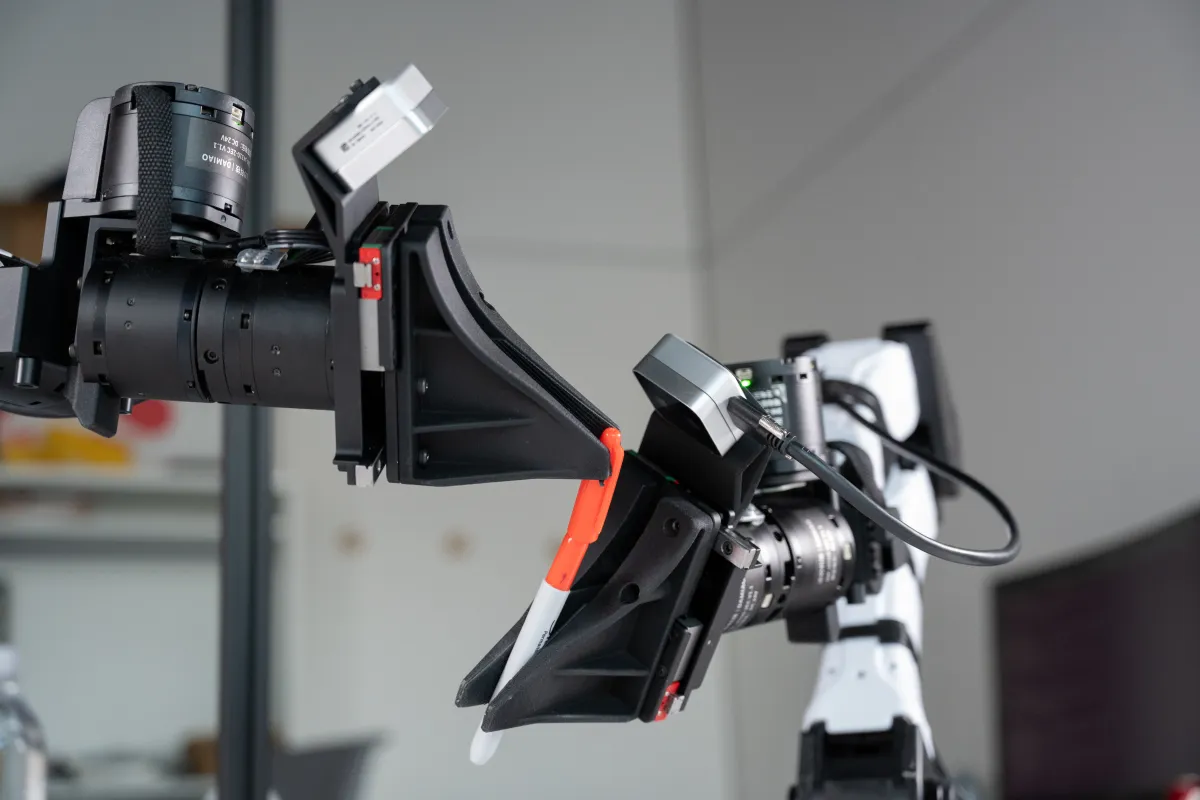
This vision stems directly from the academic insights of its founders. As a PhD student, Philipp Wu was deeply immersed in the study of how robots learn effectively from extensive datasets. A recurring and formidable obstacle in his research, as he shared with TechCrunch in June, was the stark “lack of large-scale data to work with.” Recognizing this critical gap, Wu collaborated with Fred Shentu on a groundbreaking project named GELLO. This innovative initiative developed a low-cost teleoperation system, enabling a human operator to remotely control a robotic arm to generate much-needed training data. Their pioneering work culminated in an influential academic paper that laid the groundwork for XDOF.
The market now views XDOF as the equivalent of Scale AI or Mercor, but specifically tailored for the realm of physical robotics. These data-labeling giants played a pivotal role in fueling the recent boom in large language models (LLMs) by providing the vast, labeled datasets necessary for their training. However, the paradigm for physical robots is distinctly different. While LLMs initially leveraged the entirety of the internet as an unparalleled, albeit unstructured, dataset, physical robots lack an analogous real-world dataset to learn from. This fundamental disparity makes the collection of high-quality, relevant data an absolutely critical bottleneck in the quest to develop truly general-purpose machines capable of interacting intelligently with our complex physical world.
Innovative Data Capture: The ABC Dataset and Global Expansion
To address this monumental data challenge, XDOF is not only building the infrastructure but also actively generating foundational datasets. The company is collaborating with UC Berkeley’s renowned AI Research lab to release what promises to be the largest collection of high-quality robot training data ever assembled, aptly named ABC. This initiative alone underscores XDOF’s commitment to not just facilitating data collection, but also to spearheading the creation of open, impactful resources for the entire robotics ecosystem.
The methodology for capturing this crucial data is multifaceted and innovative. XDOF ingeniously combines remote robot teleoperation, where human operators guide robots from a distance, with direct human participation. This involves human collectors wearing advanced sensors to meticulously record everyday tasks, ranging from the mundane like folding clothes to more intricate actions such as flattening boxes. This dual approach ensures a rich and diverse dataset that accurately reflects the complexities and nuances of human interaction with objects and environments.
Looking ahead, XDOF has ambitious plans to scale its data collection efforts globally. The startup intends to hire and rigorously train diverse teams of data collectors worldwide. These teams will include specialized teleoperators skilled in remotely steering robots to perform tasks, as well as egocentric operators who wear body sensors to capture first-person movement data, providing an invaluable perspective for robot learning. This global expansion strategy is critical for gathering the sheer volume and variety of data needed to train robots that can operate reliably and effectively in countless real-world scenarios.
Market Position and The Path Ahead
Despite its relatively short operational history, XDOF has already garnered significant traction within the industry. The company previously disclosed that it is actively working with approximately 20 customers, a list that includes several prominent frontier AI labs. This early customer adoption is a strong validation of XDOF’s value proposition and the pressing need for its specialized services in the rapidly evolving fields of AI and robotics.
The competitive landscape is also heating up, with other startups like Mecka AI attempting to collect real-world data for robot training. Furthermore, established human-data platforms such as Scale AI and Micro1 are expanding their offerings beyond large language models to cater to the unique demands of physical robotics. However, XDOF’s deep academic roots, its focus on large-scale teleoperation, and its partnership with UC Berkeley for the ABC dataset provide it with a unique edge in this burgeoning market.
The company’s meteoric rise, from stealth to a potential unicorn valuation in mere months, reflects both the urgency of the robotics data problem and the strength of XDOF’s solution. As the world moves closer to a future populated by general-purpose robots, the infrastructure XDOF is building will be indispensable.
***
The Bottom Line
XDOF’s reported $1.2 billion valuation, achieved in an astonishingly short period, underscores the profound market demand for high-quality, real-world data in the burgeoning robotics sector. By effectively acting as the outsourced data engine for frontier AI labs and robotics companies, XDOF is directly addressing a critical bottleneck that has long stymied the development of truly intelligent, general-purpose machines. Its innovative blend of teleoperation and egocentric data capture, coupled with a strategic vision for global expansion, positions XDOF not just as a high-growth startup, but as a foundational pillar for the next wave of robotic and AI innovation. The company’s rapid trajectory suggests it is poised to become an essential enabler, accelerating the path towards a future where robots seamlessly integrate into our daily lives and industries.
When you purchase through links in our articles, we may earn a small commission. This doesn’t affect our editorial independence.
{content}
Source:{feed_title}