
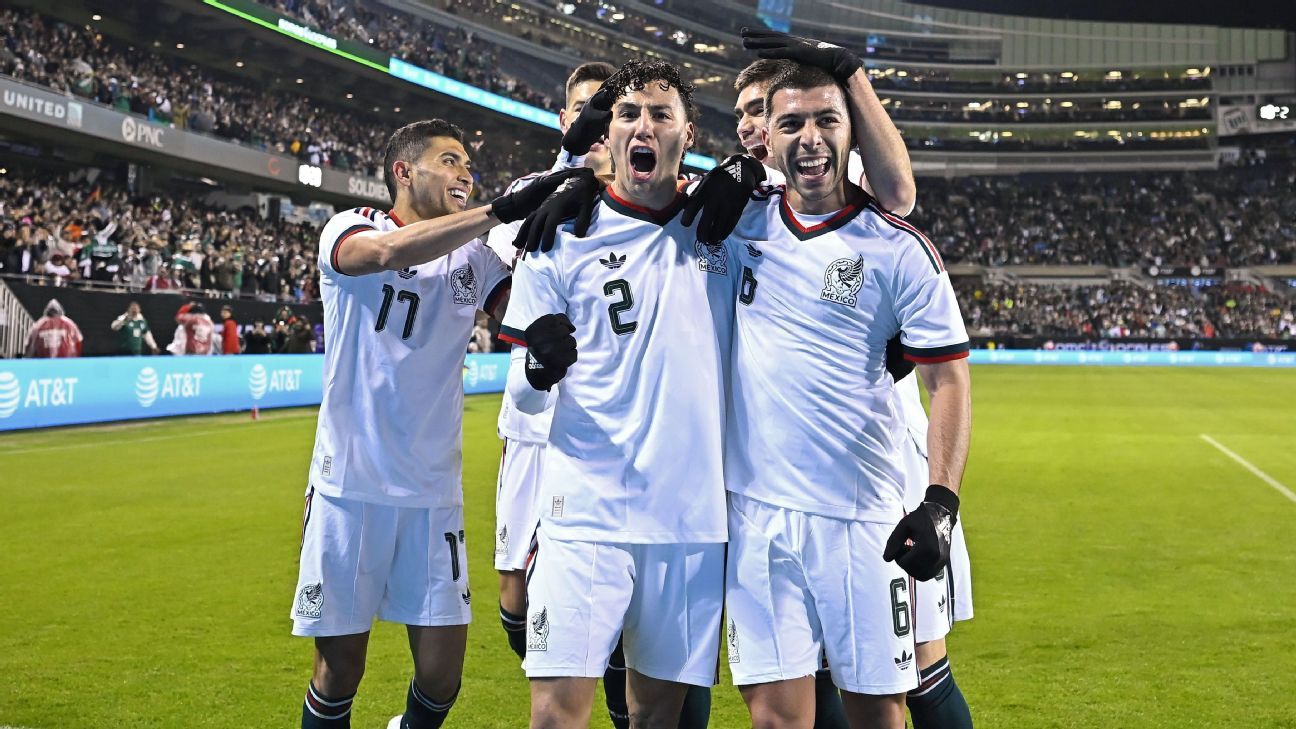
One might readily overlook the truly grim and tempestuous circumstances Mexico faced only a few months prior.
The national squad,El Tri, concluded 2025 in a disheartening manner, faltering through a bleak six-match stretch without a victory, which represented their poorest performance in ten years. With a FIFA World Cup year on the horizon, warning signals started to sound.
“Mexico succumbs to Paraguay and also sheds all of its credibility,” declared another article, which then proceeded to ponder if this was indeed the weakest national team of the last half-century.
Typically outspoken, yet with a subtle grin, even the charismatic manager Javier Aguirre appeared solemn while conversing with reporters after his final game of the previous year.
“You can never genuinely feel at ease when you are not achieving victories,” Aguirre disclosed to the media during the winter. “Occasionally, issues resurface, matters you believed you had already resolved, and a negative outcome makes you realize otherwise. We have not yet arrived at our desired destination.”
How swiftly circumstances can shift. Commencing January with a narrow 1-0 triumph over World Cup-bound Panama, Mexico has navigated clear of its once-troubled waters and initiated a five-game undefeated streak in 2026. With a commendable 3W-2D-0L record and an impressive plus-6 goal difference across these fixtures,El Triis now accumulating momentum as summer approaches.
Admittedly, those pair of stalemates occurred during this March international window against Portugal (0-0) and Belgium (1-1), but considering both nations rank within the top 10 of ESPN’s World Cup assessments, these outcomes nonetheless signify progress for the national team program — particularly when scrutinizing Tuesday’s draw with Belgium.
Mexico outshot their adversaries 10-5 (0.9 xG for Mexico, 0.3 xG for Belgium), claimed victory in more duels (54.4% to 44.9%), and generated a greater number of key passes (seven to two) than the European contingent, who seemed bewildered byEl Tri‘s intensity throughout the encounter. Had it not been for a spectacular long-range effort from Dodi Lukebakio to net Belgium’s solitary goal, we would be discussing a momentous achievement for Aguirre and his players.
Domestic media outlets, once exasperated with Aguirre andEl Tri, have also altered their perspective. Ricardo “Tuca” Ferretti, a former coach for Mexico and current commentator on Futbol Picante, offered abundant commendation after Tuesday’s tie with Belgium.
“In the Javier [Aguirre] era, this is the finest match I’ve witnessed,” he stated.
Bear in mind, it’s an imperfect parallel given roster rotations, but this is the very same Belgium that decisively defeated a fellow Concacaf counterpart, the U.S. men’s national team, 5-2 last week. The U.S. subsequently went on to suffer a 2-0 loss to Portugal on Tuesday. For Aguirre, averting such defeats and managing to keep pace with Portugal and Belgium indicate that he is finally steering his squad toward his objectives.
“The team’s disposition was excellent… the training camp proved constructive,” he remarked concerning the past two contests. “I am departing [the March window] content.”
But what precisely transformed for Mexico in 2026? It’s one matter to overcome more manageable adversaries like Panama, Bolivia, and Iceland earlier in the year, but how did they manage to nearly best an elite squad like Belgium and compete equally with a World Cup contender such as Portugal?
A multitude of elements can be emphasized here — an intriguing development to observe in 2026 is an increasingly resilient Mexico that is prevailing in more individual battles — but perhaps the most evident factor in the most recent window, and generally this year, is the chance afforded to alternative players. With injuries affecting several positions, the competition for World Cup roster spots has become more accessible.
Key international figures such as Edson Álvarez, Rodrigo Huescas, Mateo Chávez, Gilberto Mora, and César Huerta are recuperating from minor ailments, and individuals like Luis Ángel Malagón and Marcel Ruiz are entirely sidelined due to more severe injury complications. Undeniably, having a completely healthy roster presents the most favorable scenario, but this also served as a catalyst for others to step forward and assume responsibility in their stead.
During both March fixtures, reserves and fresh faces such as Brian Gutiérrez, Erik Lira, Obed Vargas, and Álvaro Fidalgo shone in their starting roles. Julián Quiñones, a player who has intermittently featured in Aguirre’s teams, was arguably the standout performer against Belgium. Jorge Sánchez, who could potentially be a No. 3, No. 4, or even No. 5 option at right back if the squad were fully fit, surpassed expectations in his Tuesday start and initiated the scoring with a goal in the 19th minute.
The catalogue continues, and these athletes are driven not only by the present opportunity but also by the awareness that the latest international window essentially served as the conclusive audition before Aguirre selects his contingent for the World Cup. When questioned after the Belgium result if he felt he had secured his position for the major tournament, the Spanish-born Fidalgo chuckled in response.
“No, no, no, certainly not,” he declared. “There are genuinely formidable players here. I must continue to perform well. At my club, I simply have to keep playing. I need to keep developing.”
With 71 days remaining until their World Cup inaugural match against South Africa, willEl Trialso continue its progression?
That will be the primary query for Aguirre & his team as they refine their strategy for what could potentially be a bright and glorious summer. In the tournament they will co-host with the U.S. and Canada, the outlook is almost invariably auspicious for host nations of any World Cup.
The gloomy skies of Mexico’s winter have dissipated. With some backing from fresh talents, they have yet to reappear, for the moment.