
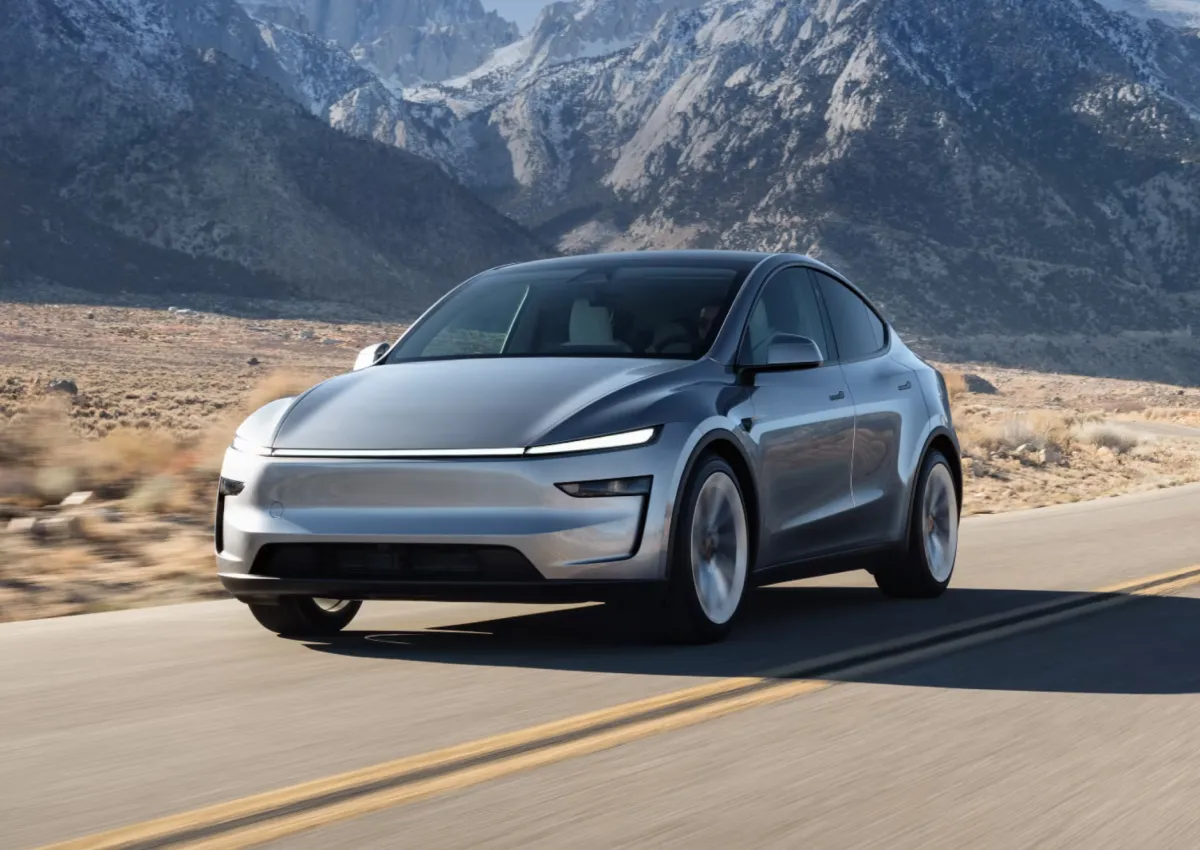
For over a year, Tesla publicized the imminent arrival of “more affordable” cars. These finally debuted last October, offering simplified versions of the Model Y and Model 3, priced from $39,990 and $36,990, in that order. However, first-quarter data indicates these new vehicles are not significantly boosting Tesla’s total sales performance.
On Thursday, Tesla announced its global delivery of 358,023 EVs during the initial three months of the year, a figure below analysts’ projections of approximately 368,000. Furthermore, the company manufactured considerably more units than it sold, with its total production count reaching 408,386.
Consequently, Tesla’s vehicle deliveries in the first quarter of this year increased by merely about 6% compared to Q1 2025, a period marking the firm’s poorest performance in recent memory. The results for Q1 2025 were additionally impacted by the company halting assembly lines for several weeks to swap out certain machinery, suggesting the Q1 2026 statistics may not represent a substantial true enhancement.
These delivery numbers are notable, considering the company’s past pledge to boost EV sales by 50% annually. Furthermore, the weak initial quarter implies Tesla now faces the danger of witnessing a decrease in its total sales for the third consecutive year, concurrently with its plummeting earnings.
Tesla is not the sole entity contending with slow EV sales growth, particularly within the U.S. market. Established car manufacturers have retreated from — and, in certain instances, completely scrapped — formerly ambitious blueprints and aspirations for new electric vehicles. Emerging players have also faced difficulties. Rivian announced Thursday morning that it dispatched slightly above 10,000 units in the first quarter, a number largely consistent with its quarterly announcements.
Rivian does have an upcoming vehicle poised for release, as it is on the verge of delivering its more economical R2 SUV, expected to invigorate deliveries. The company is relying on the R2 achieving immense initial success, even though its most affordable variant is not slated for release until late 2027.
Tesla lacks a new, widely accessible vehicle prepared for launch. The companyhadbeen developing a considerably more affordable EV, with an anticipated price point of approximately $25,000. However, CEO Elon Musk scrapped the initiative, opting instead to fully commit to the “CyberCab.” Rather than that $25,000 automobile, Musk directed Tesla to craft the basic Model Y and Model 3 instead.
Techcrunch event
San Francisco, CA
|
October 13-15, 2026
The sole genuinely novel model unveiled by Tesla in recent years is the Cybertruck. Although it surpasses most other all-electric pickups in sales, it has proven to be a utter disappointment when measured against Tesla’s — and Musk’s — projections for the metal-bodied electric vehicle. In the first quarter of this year, Tesla merely shifted 16,130 “other models,” encompassing the Cybertruck and the now-discontinued Model S and Model X.
{content}
Source:{feed_title}