
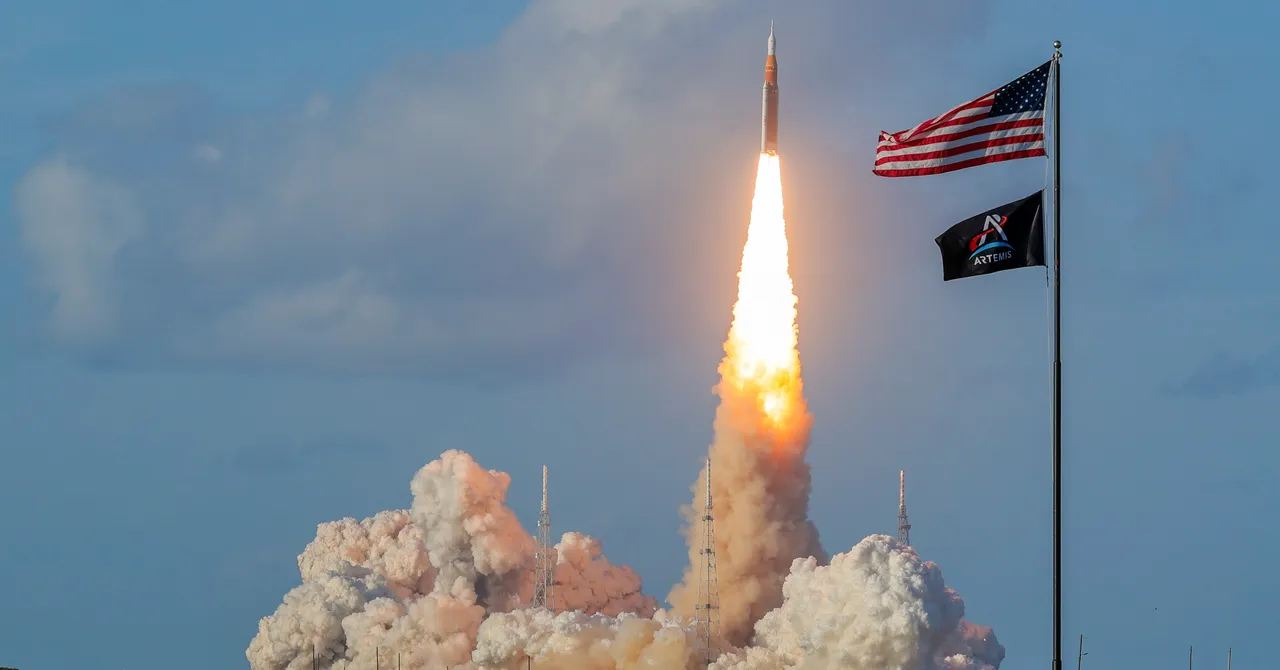
Ascent. At 6:35pm ET on April 2, a Space Launch System rocket propelled an Orion capsule from Earth. Inside were Artemis II crew members Reid Wiseman, Victor Glover, Christina Koch, and Jeremy Hansen. By Thursday, they became the inaugural humans to journey beyond low Earth orbit since the Apollo 17 mission in 1972.
The team intends to evaluate advanced systems that will prove beneficial for future expeditions, including mechanisms for radiation protection and for enabling communication between the capsule and Earth from lunar proximities. Furthermore, the mission’s flight path, which Artemis II is set to trace, stands out as one of its most captivating features.
The Cosmos Beckons
In contrast to common perception, the voyage toward the moon does not involve a straightforward, straight-line course linking our planet’s ground to the lunar expanse.
Subsequent to liftoff, the initial stage of the SLS detached from the remaining components of the craft—comprising the Interim Cryogenic Propulsion Stage (ICPS) upper stage and the Orion module. The ICPS then propelled the module into a high Earth orbit; however, the astronauts continued to circle our planet for roughly 23 hours. Once all inspections and confirmations ensured proper functionality, the ICPS disengaged from Orion. It was at this juncture that the expedition to the moon genuinely commenced.
Image provided by NASA
Circumlunar Passage
The mission’s midpoint is slated for the evening of April 6. The Artemis II crew members are set to journey roughly 10,300 kilometers past the moon, thereby surpassing all prior benchmarks for remoteness from our planet. Presently, the Apollo 13 mission holds the distinction, having achieved a distance of around 400 kilometers beyond the lunar body.
Artemis II’s nearest proximity to the lunar surface, measuring 7,400 kilometers, will be achieved during its passage over the far side. Rather than entering lunar orbit, the craft will perform a flyby, leveraging a gravitational assist to make its way back to Earth. This maneuver creates a distinctive figure-eight path connecting the two cosmic entities. The flight path has been finely tuned to guarantee a safe return to Earth, even should propulsion systems malfunction.
Earthward Descent
The return journey will employ a passive course: Subsequent to its lunar passage, Orion will, in essence, be in unpowered descent towards Earth, requiring no engine activation. Should any issues arise with the propulsion unit or other apparatus, the module is still designed to safely arrive back on Earth.

Photo credit: Mario Tama/Getty Images
The descent will culminate in a splashdown within the Pacific Ocean on April 11, precisely 9 days and 13 hours following the mission’s initiation. At that location, the US Navy will retrieve the astronauts, bringing their homeward voyage to its conclusion.
This article was initially featured in WIRED Italia and subsequently rendered from its original Italian.
{content}
Source:{feed_title}