
Audio of this article is brought to you by the Air & Space Forces Association, honoring and supporting our Airmen, Guardians, and their families. Find out more at afa.org
The U.S. Air Force is planning a significant investment in its new Family of Affordable Mass Munitions (FAMM) program, intending to allocate over $12 billion in funding across the next five years. This ambitious initiative aims to procure nearly 28,000 missile units and recently challenged the defense industry to develop versions capable of striking targets beyond 1,200 miles.
Budget documents released earlier this month detail the service’s strategy to bolster its munitions stockpiles. This effort is part of a broader Department of Defense push to acquire both high-cost, advanced projectiles and more economical options. The goal is to prepare for a potential large-scale conflict with peer adversaries, such as China, which could necessitate striking 100,000 or more targets.
Procurement for the FAMM program is set to begin cautiously, with the Air Force requesting $355 million in the 2027 budget to acquire 1,000 missiles. However, the Future Years Defense Program (FYDP), which outlines spending projections for the next five years, indicates a rapid acceleration in funding and production:
- 2028: $1.85 billion for 5,300 missiles
- 2029: $2.3 billion for 5,920 missiles
- 2030: $4.03 billion for 7,700 missiles
- 2031: $4.13 billion for 7,990 missiles
The FAMM program is structured into two main categories: “lugged munitions,” designed to be carried internally or externally by traditional fighter and bomber aircraft, and “palletized munitions,” which can be dropped in batches from cargo aircraft. While budget documents did not specify the exact quantities for each type, they did indicate that the palletized version is currently the service’s primary focus.
Initially, the Air Force is seeking munitions capable of engaging targets within a range of 250 to 500 miles. However, the documents also highlight that “future increments” of FAMM program funding could be directed towards developing extended-range capabilities, beyond-line-of-sight targeting, and enhanced long-range kill-chain communications.
Pushing for Longer Ranges
The Air Force Life Cycle Management Center (AFLCMC) reinforced this push for greater range with an April 20 notice, seeking industry information on an affordable cruise missile capable of traveling more than 1,200 miles. This specific variant, dubbed “FAMM-Beyond Adversary Reach,” is intended for striking slow-moving maritime targets, such as enemy ships.
The notice outlined key performance requirements, including a weapon capable of flying at least 537 miles per hour (Mach 0.7) and receiving midcourse navigation updates to adjust its trajectory. Contractors would be expected to produce between 1,000 and 2,000 of these missiles annually. The project’s overarching goal is to “streamline the battlespace by developing a single, common, air-to-surface munition that is affordable, adaptable, and possesses significant standoff range.”
To maximize operational flexibility, the AFLCMC is seeking a weapon that can be launched from a variety of platforms. The notice specifies that the missile “must be both internally/externally lug-mounted by fighters/bombers and deployed from a cargo pallet or for maritime operations on [U.S. Navy] ships.” While the initial operational focus will be on deployment from a cargo pallet, the long-term vision includes adaptability for diverse launch methods. Beyond air and sea platforms, the missile is also envisioned to strike land-based targets when launched from U.S. Army ground launchers, indicating a multi-domain application.
The Palletized Munitions Concept
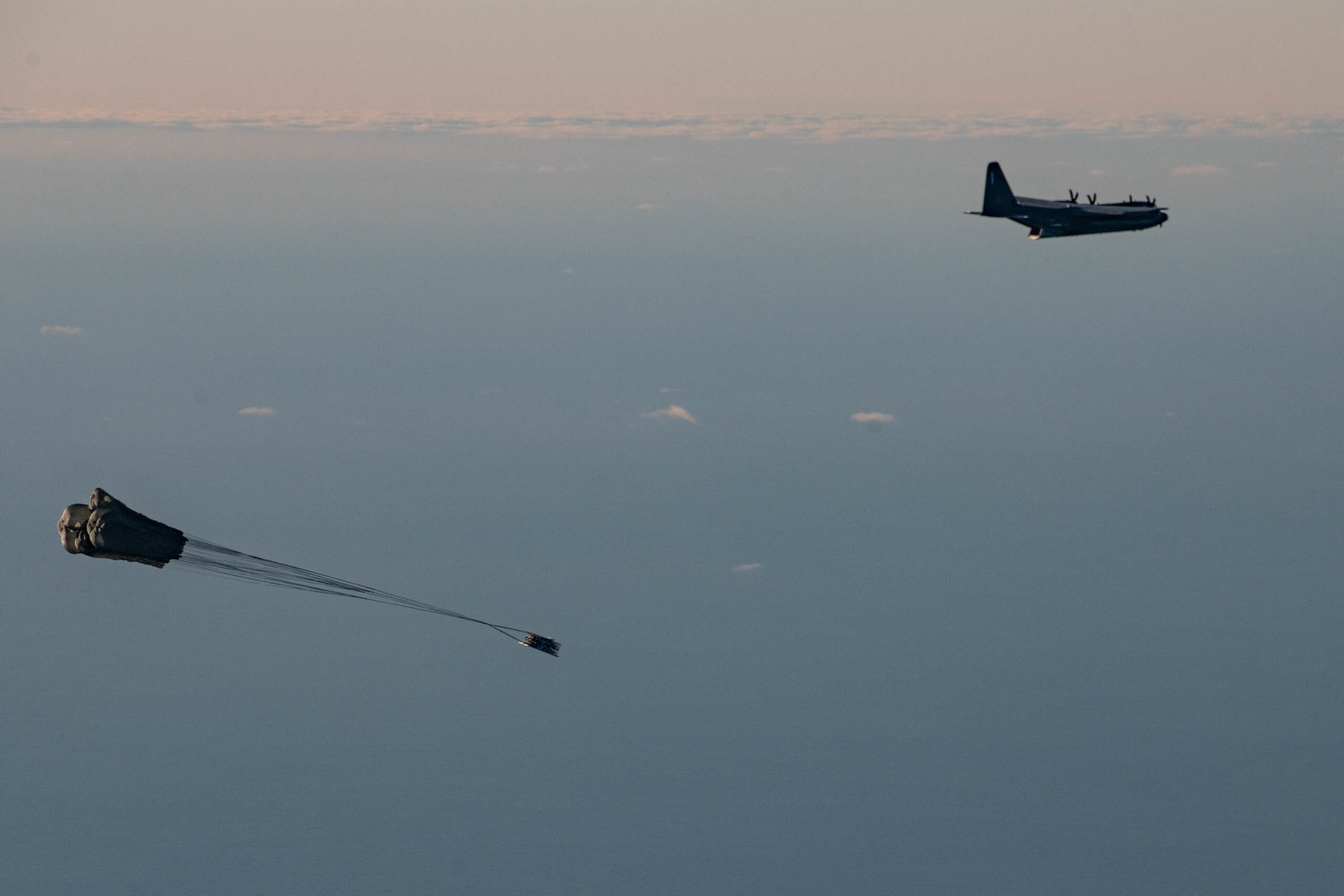
The emphasis on palletized munitions directly builds upon the Air Force’s experimental Rapid Dragon program, which began in 2019. This program aimed to transform standard cargo aircraft, such as the C-130 and C-17, into versatile weapon delivery platforms. Rapid Dragon explored the concept of launching large numbers of missiles from a roll-on/roll-off pallet system, enabling cargo planes to contribute to strike missions.
The Air Force Research Lab (AFRL) conducted multiple tests using both the C-130 and C-17, including a notable live-fire test from Eglin Air Force Base in December 2021. During this test, the crew of an Air Force Special Operations Command MC-130J Commando II successfully dropped pallets containing nine AGM-158B Joint Air-to-Surface Standoff Missiles-Extended Range (JASSM-ERs). According to an AFRL release, the JASSM-ERs were secured in pallet crates, extracted from the aircraft by a parachute after deployment, and then ignited their engines to proceed toward their designated targets.
The JASSM-ER, built by Lockheed Martin, along with its maritime variant, the Long-Range Anti-Ship Missile (LRASM), is considered an “exquisite” or high-technology, high-cost weapon, with an estimated price tag of $1.5 million per unit. The FAMM program aims to provide a more affordable, mass-producible alternative to such specialized and expensive munitions.
Following its experimental phase, the Rapid Dragon palletized concept transitioned into a program managed by the Defense Innovation Unit (DIU), known as “Franklin.” This initiative focused on developing long-range weapons with a significantly lower cost target of approximately $100,000 per round, as reported by Air & Space Forces Magazine. Lt. Gen. Michael G. Koscheski, then-deputy commander of Air Combat Command, stated at the 2024 Air Force Futures conference that the Franklin program sought to produce a “$100,000 weapon that can go about 500 miles and can punch a hole in a ship.”
The drive for low-cost, mass-producible missiles has spurred innovation across the defense industry. Several companies have since unveiled their own competitive offerings, including Anduril’s Barracuda, Lockheed Martin’s Common Multi-Mission Truck (CMMT), L3Harris’ Red Wolf, Leidos’ Black Arrow, and Zone 5 Technologies’ Rusty Dagger. Another entrant, CoAspire, recently showcased its Rapidly Adaptable Affordable Cruise Missile-Extended Range (RAACM-ER) at the Navy League Sea-Air-Space trade show. According to the company’s website, the RAACM-ER is designed to fly 1,200 miles and be launched from sea, air, and ground platforms, mirroring the multi-domain flexibility sought by the Air Force for its FAMM program.
Why This Matters
This substantial investment in the Family of Affordable Mass Munitions (FAMM) program represents a critical strategic shift for the U.S. Air Force and the broader Pentagon. For decades, the U.S. military has prioritized the development of highly advanced, often costly, “exquisite” weapons designed for precision and effectiveness against specific threats. While these systems remain vital, the FAMM program signals a recognition that a potential large-scale conflict, particularly with a peer adversary like China, would demand not only advanced capabilities but also sheer quantity and affordability.
The ability to produce tens of thousands of relatively inexpensive, yet effective, long-range missiles could fundamentally alter deterrence strategies and warfighting doctrines. It addresses the challenge of rapidly replenishing munitions stockpiles, which could be depleted quickly in an intense conflict, and provides a means to overwhelm sophisticated enemy air defenses through saturation. This shift moves towards a “mass production” approach, aiming to leverage industrial capacity to create a decisive advantage in a prolonged struggle.
Furthermore, the emphasis on “palletized munitions” is a game-changer for military flexibility and logistics. By enabling cargo aircraft like the C-130 and C-17 to launch missiles, the Air Force significantly expands its pool of potential weapon platforms. This reduces reliance on a limited number of specialized bombers and fighter jets, making strike capabilities more distributed, harder for an adversary to target, and more resilient. It also allows for rapid deployment of offensive capabilities to remote or austere locations, enhancing the U.S. military’s reach and responsiveness in complex operational environments, particularly in the vast Indo-Pacific theater.
Economically, this $12 billion investment will fuel significant activity within the defense industry. It will drive competition, foster innovation in manufacturing processes and materials, and likely create numerous jobs across the defense sector as companies vie for lucrative contracts to design and produce these next-generation weapons. The rapid development timelines and cost targets set by programs like “Franklin” could also establish new benchmarks for defense procurement, pushing for greater efficiency and affordability in future military acquisitions.
Finally, the pursuit of multi-domain launch capabilities – from air, sea, and ground platforms – underscores a holistic approach to joint warfare. A common missile adaptable to various launchers would simplify logistics, training, and potentially enable greater interoperability with allied nations. This could strengthen collective defense postures and present a more unified front against potential aggressors, making the overall U.S. and allied defense posture more robust and adaptable to future global security challenges.
Audio of this article is brought to you by the Air & Space Forces Association, honoring and supporting our Airmen, Guardians, and their families. Find out more at afa.org