
Audio of this article is brought to you by the Air & Space Forces Association, honoring and supporting our Airmen, Guardians, and their families. Find out more at afa.org
The Pentagon’s proposed budget for fiscal year 2027 (FY27) hinges significantly on Congress’s ability to pass a legislative package using a process known as reconciliation. This strategy seeks to fund nearly a quarter of the Defense Department’s ambitious $1.5 trillion request, allocating substantial sums to critical defense priorities, including the F-35 fighter jet, advanced munitions, and unmanned systems.
However, this approach has drawn skepticism from both defense experts and lawmakers across the political spectrum, who express concerns about the inherent risks and potential future complications should the plan falter.
The budget request, unveiled earlier this month, splits the Pentagon’s total $1.5 trillion topline between two distinct funding mechanisms. The majority, $1.15 trillion, is earmarked for the traditional “discretionary” base budget, which undergoes the conventional congressional appropriations process. The remaining $350 billion, however, is requested through “reconciliation,” a legislative tool designed for mandatory spending. Reconciliation bills are not subject to the typical, more arduous appropriations procedures and can be passed with a simple majority vote in both chambers of Congress. This mechanism was notably employed last year when Congress approved $150 billion in mandatory defense spending as part of broader reconciliation legislation referred to as the “One Big Beautiful Bill Act.”
The primary points of contention surrounding the new reconciliation request, voiced during recent congressional hearings with senior Defense Department officials, revolve around issues of risk and congressional process. While reconciliation can indeed expedite funding for specific defense priorities, its success is heavily reliant on strong, unified political support from the party currently in power.
Lawmakers recall that last year’s reconciliation bill required months of intricate negotiation and political maneuvering to secure passage. The current political landscape presents an even narrower path, with Republican majorities in both the House and Senate being particularly slim. Furthermore, the upcoming midterm elections in November introduce an element of significant uncertainty, as they could potentially shift congressional control. Compounding these challenges, Republican lawmakers are reportedly already engaged in crafting a separate, immigration-focused reconciliation package, raising questions about the legislative bandwidth and political appetite for approving a third mandatory spending bill on defense.
The implications of this funding strategy are particularly high for both the Air Force and the Space Force, as significant portions of their respective budget requests are tied to the reconciliation package.
For the Air Force, its proposed $397 billion topline includes $16 billion in reconciliation funding. According to a Pentagon budget document detailing the department’s mandatory spending proposal, these funds are allocated to several key programs:
- $2.3 billion for the procurement of 14 F-35 fighter jets, a cornerstone of U.S. air superiority.
- $1 billion for 330 extended-range Joint Air-to-Surface Standoff Missiles (JASSM-ER), crucial for long-range precision strike capabilities.
- $990 million for Joint Advanced Tactical Missiles (JATMs), representing advancements in tactical missile technology.
- $953 million for up to 618 Advanced Medium Air-to-Air Missiles (AMRAAMs), vital for air-to-air combat effectiveness.
The Space Force’s $71 billion request includes approximately $12 billion designated as mandatory spending. Of this amount, $7.8 billion is slated for the Air Moving Target Indicator program, which provides critical intelligence, surveillance, and reconnaissance capabilities. Nearly $4 billion is allocated for the development and procurement of the Space Data Network, essential for robust space-based communications and data transfer.
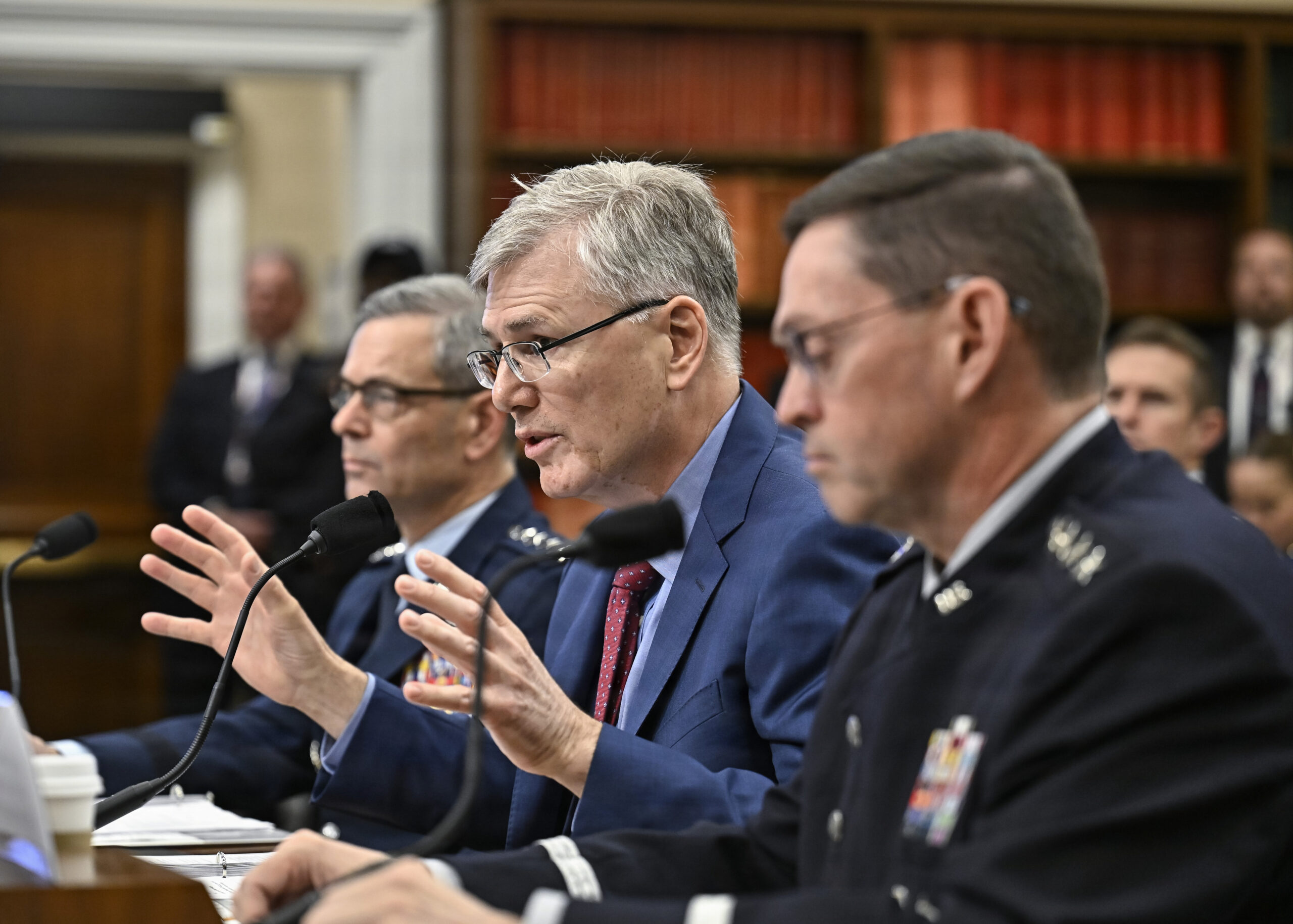
During an April 30 House Appropriations defense subcommittee hearing, Chairman Ken Calvert (R-Calif.) voiced strong objections to placing these crucial programs within the reconciliation framework. He argued that such key priorities should not be subjected to the inherent uncertainties of reconciliation. Instead, Calvert suggested they be incorporated into the traditional base budget or proposed as part of a separate supplemental funding request. Pentagon officials have previously indicated their intention to seek supplemental appropriations to replenish depleted weapons stocks and repair systems damaged during Operation Epic Fury, an undisclosed military operation.
“Mandatory funding bypasses the annual appropriation process, which is how Congress exercises oversight responsibility,” Calvert asserted. “If these programs are as critical as the budget request suggests, and I believe they are, then they deserve all the full scrutiny and sustained attention that the appropriations process provides. I would urge the department to work with us to bring these programs into the discretionary budget where they belong.”
During the same hearing, Rep. Joe Morelle (D-N.Y.) questioned Air Force Secretary Troy Meink regarding whether the services had developed a contingency plan should the reconciliation effort fail. Meink, however, declined to elaborate on the department’s strategic alternatives.
Similar concerns were echoed by Rep. Ronny Jackson (R-Texas) at an April 29 House Armed Services Committee hearing, attended by Defense Secretary Pete Hegseth and Chairman of the Joint Chiefs of Staff Gen. Dan Caine. Jackson focused his questioning on the Pentagon’s Defense Autonomous Warfare Group (DAWG), a critical initiative driving the department’s strategy to field thousands of drones in the coming years. He highlighted that the majority of DAWG’s $54.6 billion funding request falls within the reconciliation budget.
“I remain concerned about the potential gaps created if such a package fails to occur or if DAWG funding is not included in future budget requests,” Jackson stated. He then pressed Secretary Hegseth on how the Pentagon would fund DAWG if the reconciliation package stalled and whether the program would be transitioned to the base budget in subsequent years. Hegseth did not offer a specific backup plan but affirmed the Pentagon’s intent to work “hand in glove” with Congress and the White House “to ensure that the reconciliation package is properly tailored and timed so that it is passed.”
It’s Complicated
While the annual appropriations process is frequently characterized by lengthy deliberations and political stalemates, the inclusion of reconciliation introduces an additional layer of complexity and uncertainty. Experts caution that this could prolong the passage of a final appropriations bill even beyond typical timelines. Approving both a reconciliation bill and a regular appropriation before the midterm elections would present a significant legislative challenge, particularly given the sheer magnitude of this year’s budget request, according to Seamus Daniels, a defense budget analysis fellow at the Center for Strategic and International Studies (CSIS).
Daniels emphasized that for the reconciliation process to begin, lawmakers must first pass a budget resolution, and the timing of this initial step will “have a major impact” on the bill’s ultimate prospects. “I think it’s ultimately going to come down to the divide between budget hawks and other moderate Republicans who are willing to spend more, especially on defense, whether they’ll ultimately be able to overcome those divisions,” he told Air & Space Forces Magazine. “I do think starting that process before the midterms will show that they are serious about trying to get this done.”
Regardless of when Congress decides to initiate the reconciliation process, its failure would necessitate a significant reshuffling of defense funding priorities. This would likely involve either integrating the affected programs into the base budget, which would require substantial cuts elsewhere, or including them in a separate supplemental spending package. Byron Callan, a managing partner and defense analyst at Capital Alpha Partners, noted in an April 26 newsletter that the failure of the reconciliation bill could trigger “domino-like implications” for the entire appropriations process. “It’s a set-up for a messy [2027] that won’t be at $1.5 trillion and for which Congress will have to make major adjustments to the request to fit priorities into a smaller budget,” Callan wrote.
Process and Precedent
Some lawmakers, particularly those on appropriations committees, have expressed deep skepticism regarding the White House’s growing reliance on budget reconciliation to bypass standard legislative processes and potentially circumvent rigorous budget scrutiny. During an April 27 Senate Armed Services Committee hearing focused on the fiscal ’27 budget for missile defense, Sen. Angus King (I-Maine) characterized reconciliation as the “son of OCO,” a reference to the Pentagon’s controversial Overseas Contingency Operations (OCO) account. Congress established OCO in 2001 as a temporary mechanism to fund military operations in Afghanistan and Iraq. However, it persisted until 2021, evolving into what many critics viewed as an off-budget “slush fund” for defense spending, allowing significant sums to bypass normal budgetary caps and oversight.
“We’re talking about taking 25 percent of the defense budget away from the appropriations committee, and effectively away from the Armed Services Committee, and handing it to … the White House,” King stated, referring to the fiscal ’27 reconciliation package. “That’s not the way our system is supposed to work.”
Rep. Morelle, during the House Appropriations defense subcommittee hearing, echoed these sentiments, calling the reconciliation approach “a dangerous precedent” that undermines the constitutional role of appropriators.
Why This Matters
The Pentagon’s strategy of relying on budget reconciliation for a significant portion of its Fiscal Year 2027 request carries profound implications for national security, congressional oversight, and the stability of the defense budget. Firstly, at stake are crucial defense programs – including the F-35 fighter jet, advanced missiles, and vital space systems – which are foundational to maintaining U.S. military superiority and strategic deterrence. Any delay, reduction, or failure to secure funding for these programs could directly impact military readiness, technological advancement, and the nation’s ability to respond to emerging global threats.
Secondly, this approach raises serious concerns about congressional oversight, a cornerstone of democratic governance. By routing a quarter of the defense budget through reconciliation, the executive branch effectively bypasses the detailed scrutiny and debate inherent in the traditional appropriations process. This reduces the power of congressional committees to thoroughly examine spending proposals, question their necessity, and ensure accountability. Critics argue this move could set a dangerous precedent, weakening the legislative branch’s checks and balances over defense spending and potentially leading to less transparent and efficient allocation of taxpayer dollars.
Thirdly, the political complexities surrounding reconciliation introduce significant instability into defense planning. The need for strong, unified party support, the narrow congressional majorities, and the pressures of an election year create a high degree of uncertainty. If the reconciliation package fails, the Defense Department would face a scramble to reallocate funds, potentially delaying critical procurements, research, and development. Such budgetary volatility can disrupt long-term strategic initiatives, complicate defense industrial base planning, and undermine confidence among allies and adversaries alike regarding U.S. defense commitments.
Finally, the comparison to the Overseas Contingency Operations (OCO) account highlights a broader concern about the normalization of non-traditional funding mechanisms. If reconciliation becomes a routine tool for major defense spending, it could fundamentally alter how future defense budgets are structured and approved, potentially institutionalizing a system that prioritizes speed over comprehensive review. This shift could have lasting consequences for the balance of power between the executive and legislative branches and for the overall health of the nation’s democratic processes.
A contentious debate is unfolding within the United States Congress regarding the Pentagon’s increasing use of mandatory, or “reconciliation,” funding to support major defense programs. This method, which bypasses the traditional annual appropriations process, has sparked significant discussion among lawmakers who are weighing the benefits of funding flexibility against concerns over congressional oversight and fiscal responsibility.
Typically, the vast majority of the Pentagon’s budget is determined through an annual appropriations process, where Congress meticulously reviews and approves spending for specific programs each fiscal year. However, “reconciliation funding” refers to a mechanism where certain expenditures are designated as mandatory spending, placing them outside this yearly review cycle. While designed for specific legislative purposes, its application to defense has become a focal point of debate.
Senator Roger Wicker (R-Miss.), who serves as the ranking member of the Senate Armed Services Committee, has emerged as a vocal critic of this funding approach. He recently underscored his concerns to defense officials, emphasizing the importance of congressional oversight as a cornerstone of both legislative integrity and accountability to the American people. In a recent interaction with Air Force leaders, Wicker explicitly stated, “The role that is vested in this committee to do oversight… this is really important not only for congressional integrity and congressional responsibilities, [but] for the American people.” He urged the leaders to convey this message to those involved in budget decision-making, highlighting his apprehension that using mandatory spending could erode Congress’s traditional authority to scrutinize defense expenditures.
Representative Jack Bergman (R-Mich.) echoed these sentiments, pointing to the previous fiscal year’s “One Big, Beautiful Bill” as an example of what he views as an overreach. While not explicitly detailed in the provided text, this phrase suggests a large, omnibus-style piece of legislation that bundled various provisions, potentially including significant mandatory defense spending. Bergman expressed frustration that such measures could enable the Pentagon to circumvent congressional oversight, describing them as “pretty much a free-for-all” that sidesteps the typical review process. He argued that this approach diminishes Congress’s ability to fulfill its constitutional duty of overseeing how taxpayer dollars are allocated and spent.
Despite these criticisms, not all lawmakers view the use of reconciliation funding negatively. House Armed Services Committee Chairman Mike Rogers (R-Ala.) has actively championed its application, particularly for addressing critical defense needs that may require multi-year funding commitments or significant, immediate investment. During an April 28 hearing, Chairman Rogers specifically asked Deputy Secretary of Defense Kathleen Hegseth to elaborate on how the previous year’s bill had benefited the department. Hegseth responded positively, characterizing the funding as providing “rocket fuel” for high-priority initiatives such as shipbuilding, the Golden Dome program, and munitions production. This perspective suggests that for certain strategic investments, the flexibility and longer-term certainty provided by mandatory funding can be highly advantageous.
Funding Flexibility
Pentagon officials have consistently articulated several benefits associated with placing important programs within its mandatory spending requests. The primary advantage cited is enhanced financial flexibility. Unlike annual funding, which typically expires within two or three years depending on the specific account, reconciliation funding can be utilized for up to five years. This extended timeframe allows for more strategic planning and execution, especially for large-scale, complex projects that span multiple fiscal years.
During an April 21 budget briefing, acting Comptroller Jules Hurst explained the rationale behind this approach to reporters. “If we use mandatory spending, number one, we have some more flexibility on when we obligate those funds,” Hurst stated. She further elaborated that this method is often applied to initiatives that are considered “one-time plus ups” – significant, non-recurring increases in funding designed to accelerate or bolster specific capabilities. Additionally, Hurst noted that mandatory funding is particularly well-suited for rapidly evolving technological areas, such as the Golden Dome and DAWG programs, where quick adaptation and sustained investment are crucial for staying ahead of adversaries.
However, analysts like Daniels have raised questions about whether the Pentagon is fully leveraging the inherent flexibility of these funds. Daniels observed that despite the potential for multi-year spending, the Pentagon has indicated plans to expend the entirety of the $150 billion allocated in the fiscal year ’26 bill within that same fiscal year. “That would point to the fact that they may not be taking full advantage of that flexibility that comes along with it,” he commented, suggesting a potential disconnect between the stated benefit of flexibility and the department’s actual spending intentions.
Congress retains a significant opportunity to influence the department’s use of mandatory funding, particularly through the fiscal ’27 National Defense Authorization Act (NDAA). Lawmakers could utilize this legislative vehicle to impose more specific limitations on how and when the Pentagon can obligate these funds. Daniels highlighted a key distinction from previous efforts: “What we saw in the One Big, Beautiful Bill last year is they sent over guidance after the fact, meaning that that’s not in law.” He explained that if guidance is not explicitly written into the law, the Pentagon is primarily bound by the broad terms of the bill. However, “the chance that we could see Congress write more detailed provisions that are actually in the text of the law, which then affects flexibility,” he added. This underscores Congress’s power to reclaim or assert greater control over mandatory defense spending through specific legislative language, potentially balancing the Pentagon’s desire for flexibility with congressional demands for accountability.
The ongoing debate reflects a fundamental tension between the executive branch’s need for agile resource management in a dynamic global security environment and the legislative branch’s constitutional mandate to provide robust oversight of public funds. As the Pentagon continues to seek innovative ways to fund critical defense priorities, Congress is grappling with how to ensure transparency and accountability without unduly hindering national security objectives.
Audio of this article is brought to you by the Air & Space Forces Association, honoring and supporting our Airmen, Guardians, and their families. Find out more at afa.org
Why This Matters
This congressional debate over the Pentagon’s use of mandatory “reconciliation” funding carries significant implications for several critical areas:
- Congressional Oversight and Checks and Balances:The core of the issue lies in the power dynamic between the legislative and executive branches. If the Pentagon increasingly relies on funding mechanisms that bypass the annual appropriations process, it could weaken Congress’s traditional role in scrutinizing defense spending. This erosion of oversight impacts the fundamental system of checks and balances designed to ensure accountability, prevent waste, and align military expenditures with national priorities as determined by elected representatives. It raises questions about democratic accountability for significant portions of the defense budget.
- Fiscal Responsibility and Transparency:Mandatory spending, by its nature, can be less transparent and subject to less frequent review than annual appropriations. While it offers flexibility, critics worry it could lead to less scrutiny of how taxpayer dollars are spent on large-scale defense programs, potentially increasing the risk of inefficiencies or misallocations. For taxpayers, understanding how their money is being used for national defense becomes more challenging when significant sums are moved outside traditional budgeting processes.
- National Security and Defense Modernization:Proponents argue that reconciliation funding provides crucial flexibility and stability for long-term, high-priority defense programs, such as shipbuilding and advanced technology development (e.g., Golden Dome, DAWG). In a rapidly evolving global security landscape, the ability to make sustained, multi-year investments without the uncertainty of annual budget battles can be vital for maintaining a technological edge and readiness. Hindering this flexibility could, in theory, slow down critical modernization efforts.
- Precedent for Future Spending:How this debate is resolved could set a precedent for how future government spending, not just in defense, is handled. If mandatory spending becomes a more common avenue for funding large, strategic initiatives, it could fundamentally alter the federal budgeting process across various departments, potentially diminishing the role of annual appropriations and the detailed review it entails.
- Impact on Strategic Planning:For the Pentagon, the availability of multi-year, stable funding allows for more effective long-term strategic planning for major acquisitions and research and development projects. Conversely, for Congress, the challenge lies in ensuring that this strategic planning aligns with overall national policy and fiscal constraints, even when the funding mechanism is less amenable to annual adjustment.
Ultimately, this discussion is about balancing the executive branch’s operational needs for flexibility and long-term planning with the legislative branch’s constitutional duty to ensure responsible, transparent, and accountable use of public funds in safeguarding national security.