
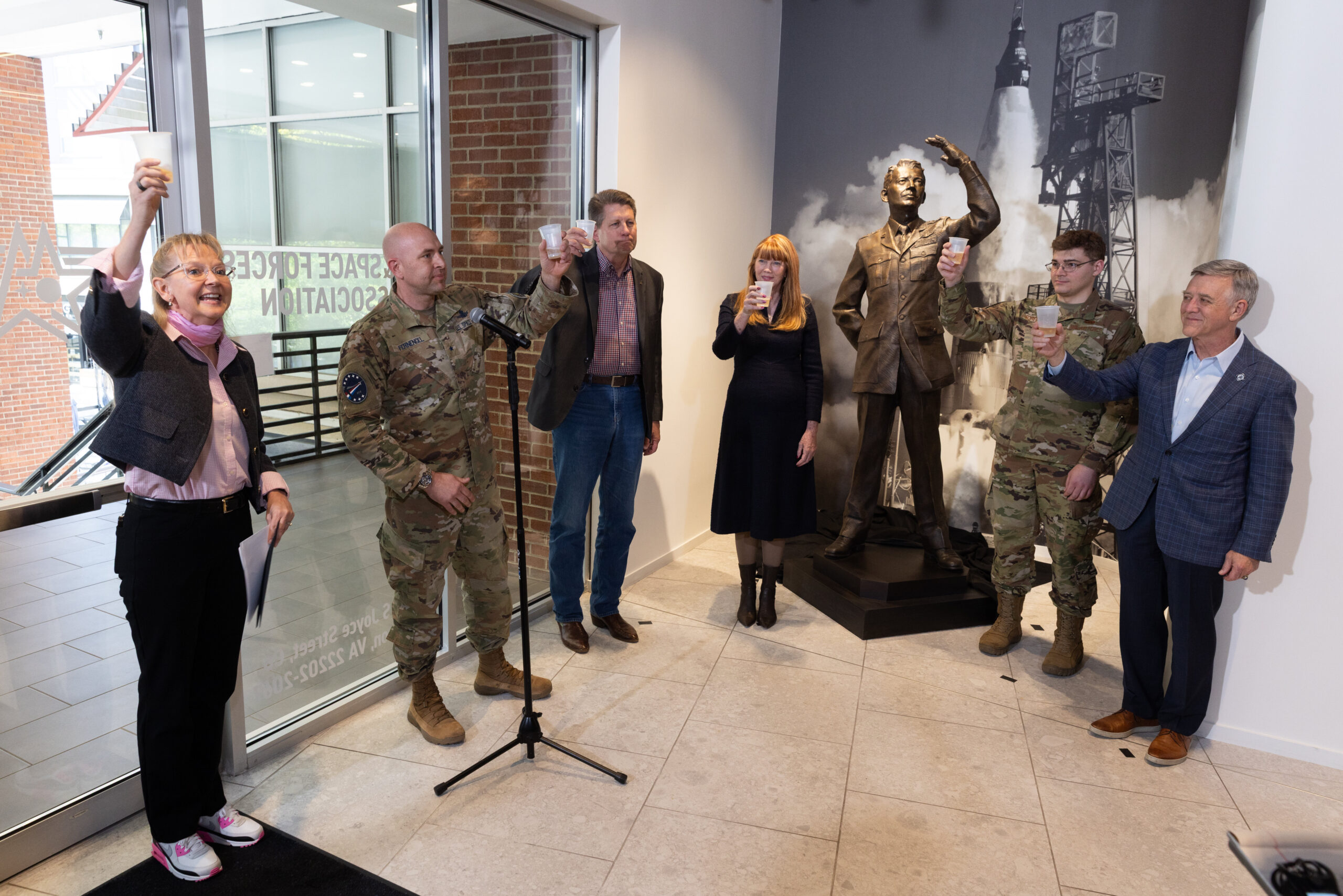
In a ceremony held on May 1, the Air & Space Forces Association unveiled a bronze statue of Air Force Gen. Bernard A. Schriever, a figure widely recognized for his pivotal role in propelling the United States into space. The event, the association’s inaugural “Salute to Space,” took place at its Arlington headquarters, where the sculpted image of Schriever now stands, depicted with his left hand shielding his eyes, seemingly gazing skyward. Behind the statue, a photograph illustrates the Atlas rocket’s ascent with astronaut John Glenn aboard, visually linking Schriever’s foundational work to a landmark moment in U.S. space history.
Retired Lt. Gen. David Deptula, dean of the Mitchell Institute for Aerospace Studies, emphasized Schriever’s profound influence during the ceremony. “There are moments in history when a single individual changes not just the trajectory of a service but the trajectory of a nation, and Gen. Schriever was one of those individuals,” Deptula stated, adding, “He didn’t just imagine the future, he delivered it.”
The unveiling coincided with National Space Day, an observance initially established by Lockheed Martin in 1997 and later expanded to International Space Day in 2001 by then-U.S. Senator John Glenn. This timing underscored the enduring significance of Schriever’s efforts to advance rocket and space technology, which commenced in the 1950s and were instrumental in developing the capabilities and personnel that ultimately contributed to the United States’ success in the Cold War space race.
Often referred to as the “father of the Air Force ballistic missile and space programs,” Schriever’s military career began in 1933 as a pilot in the U.S. Army Air Corps. According to the National Museum of the USAF, he flew combat missions during World War II and subsequently focused on the development of jet and rocket technology. Retired Air Force Lt. Gen. Burt Field, president and CEO of the Air & Space Forces Association, highlighted Schriever’s team’s critical contributions to the development of Intercontinental Ballistic Missile (ICBM) technology, which simultaneously propelled U.S. industrial production capacity into the nascent space age. Field remarked, “What they did in that timeframe makes it almost magic, in my opinion.”
Space Force Linkage
Multiple senior Air and Space Force officials, both retired and active, present at the ceremony drew direct connections between Schriever’s pioneering work and the establishment of the U.S. Space Force in 2019, as well as its evolving mission today. Space Force Brig. Gen. Christopher Fernengel, director of plans and programs, noted, “It’s no longer fiction, it’s at our doorstep, it’s happening now.”
Fernengel further elaborated on the parallels between the Cold War space race and the contemporary space mission. Both periods, he observed, are characterized by uncertainty regarding the extent to which adversaries—then the Soviet Union, now nations such as China—might contest the space domain. Both eras have also necessitated a sense of urgency and a rapid acceleration of technology development among space professionals to meet emerging challenges. Deptula reiterated this sentiment, stating, “If there’s one lesson we can take from Gen. Schriever, it’s this: the future does not belong to those who wait. It belongs to those who build.”
The contemporary reality of space as a contested environment was underscored by Schriever’s great-grandson, USAF Reserve Master Sgt. Brett Schriever. As a space systems operator serving in a unit at the National Reconnaissance Office, Brett Schriever shared his perspective: “Space is no longer a benign environment; it is a rapidly developing warfighting domain.” The family’s deep involvement in space extends through generations, with his grandfather having served as a “Star Catcher” – part of the flight crews responsible for capturing Corona spy film capsules reentering from orbit – and his father currently serving as a Space Force officer with over three decades of service.
Retired Gen. David D. Thompson, the first vice chief of space operations, highlighted Schriever’s characteristic drive as a crucial lesson for the nascent Space Force. Thompson remarked that Schriever “was famous for maintaining momentum, especially by forcing decisions to keep moving forward,” emphasizing the importance of continuous progress for the new service.

A Toast to History
The newly unveiled bronze statue at the AFA headquarters shares a connection with another significant artwork. Famed sculptor Eugene Daub was previously commissioned to create a 9-foot statue of Schriever, which is now located outside Space Systems Command in Los Angeles, California. Retired Air Force Maj. Gen. Thomas Taverny noted that this earlier effort was spearheaded by the Air & Space Forces Association’s Schriever Chapter 147. Taverny explained that Daub meticulously studied dozens of photographs of Schriever and listened to his speeches to accurately capture the general’s character, ultimately depicting him as “a visionary, a man with great imagination.”
Following the statue unveiling, attendees participated in a recent tradition associated with the Space Force: a champagne toast using plastic cups. This humble ritual traces its origins to December 20, 2019, the day the new service was officially established. Thompson recounted that on that day, the first chief of space operations, after flying to a ceremony in a hangar on Andrews Air Force Base, Maryland, and flying out the same day, instructed his staff to celebrate the historic event. The crew procured an $11 bottle of champagne and found plastic cups to facilitate the impromptu celebration. Thompson described this as “the first toast of the Space Force the night it was created.”
During the “Salute to Space” event, this tradition was continued, also marking the inaugural “Schriever Charge,” led by Brigadier General Fernengel. The charge proclaimed: “To honor the past, challenge assumptions, and build the future.”
Why This Matters
The unveiling of General Bernard A. Schriever’s statue serves as a tangible reminder of the foundational contributions that shaped the United States’ preeminence in space. Schriever’s foresight and relentless drive in the mid-20th century laid the groundwork for critical advancements in ballistic missile and space technology, fundamentally influencing national security and strategic capabilities during the Cold War. Today, as space increasingly becomes a contested domain, understanding this legacy is crucial. The U.S. Space Force, established in 2019, directly inherits Schriever’s mission to innovate and secure the nation’s interests in orbit. The ongoing competition in space, particularly with nations like China, underscores the strategic importance of this domain for everything from military operations and intelligence gathering to global communication, navigation, and economic infrastructure. Honoring figures like Schriever not only commemorates past achievements but also reinforces the imperative for continuous innovation, leadership, and a proactive approach to safeguarding space capabilities, which are now integral to modern life and national power.