
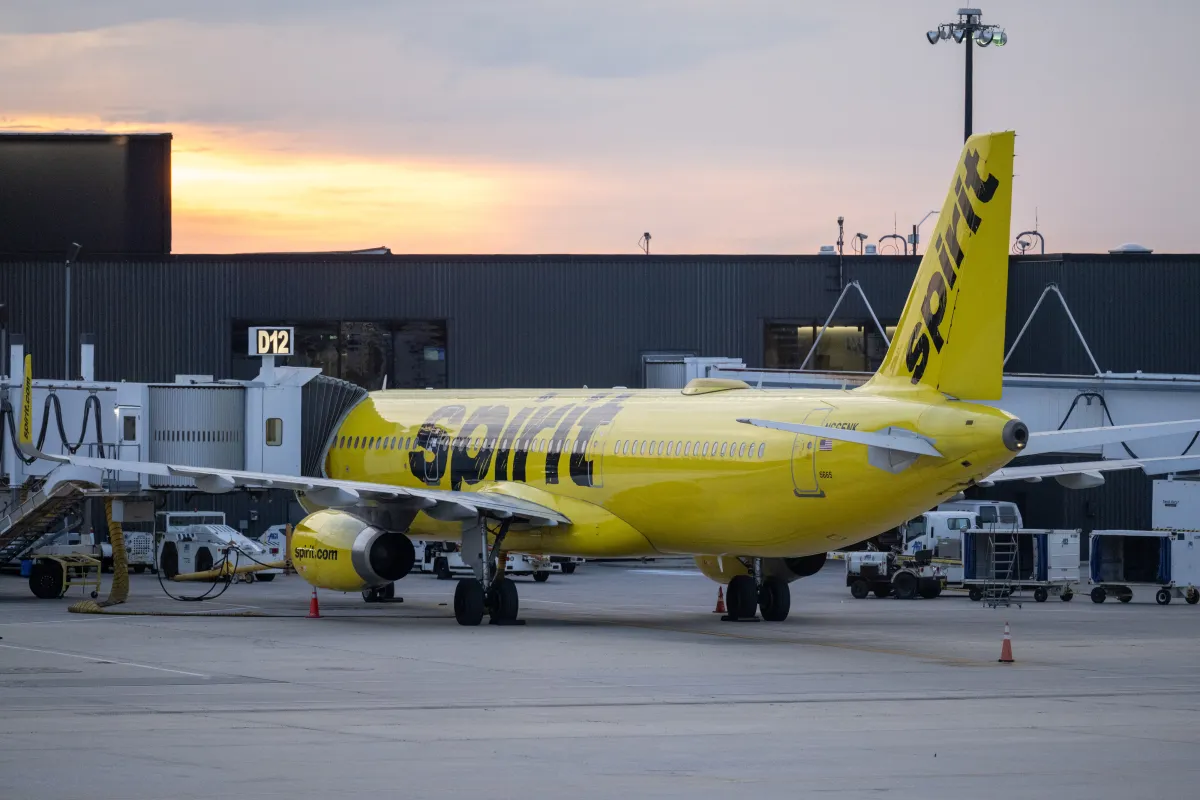
When Spirit Airlines shut down overnight Saturday — canceling all flights, letting go of 17,000 employees, and telling ticketholders to justnot come to the airport— people were flabbergasted but also bereft. For all its indignities, Spirit was cheap. Then one of them had an idea.
Hunter Peterson, a voice actor with frequent flyer grievances, posted a TikTok asking: what if 20% of American adults chipped in the price of a Spirit fare and just . . . bought it? He called it “Spirit 2.0: Owned by the People.” Within hours he’d thrown up a website — a janky, one-hour job, by his own admission — and by Sunday, 36,000 “founding patrons” had pledged nearly $23 million, crashing his servers in the process.
None of it is real money. These are non-binding pledges. Also worth noting: the actual cost of acquiring and relaunching an airline runs into the billions. Peterson knows this. In a video posted earlier today, he winkingly tried recruiting aviation lawyers, PR people, and lawyers with a one-word ask: “Help?”
“I know what I don’t know,” he told his followers, but “you’re committing to this bit, so I’m committing to this bit.”
**Key Takeaways:**
* **Viral Concept:** A hypothetical Spirit Airlines shutdown sparked a viral TikTok idea for the public to collectively buy and relaunch the airline, dubbed “Spirit 2.0: Owned by the People.”
* **Instant Traction & Digital Activism:** Despite being non-binding, the idea garnered over $23 million in pledges from 36,000 “founding patrons” within hours, showcasing the power of social media to mobilize collective sentiment, even for audacious goals.
* **Blending Satire and Aspiration:** While creator Hunter Peterson acknowledges the financial and logistical hurdles of acquiring an airline, the movement highlights widespread consumer frustration with air travel and the aspirational desire for a more democratized, user-centric service model.
***
### **The People’s Airline: When a TikTok Dream Takes Flight (Figuratively)**
Imagine a world where one of America’s most polarizing airlines, Spirit, suddenly vanished. No more ultra-low fares, no more cramped seats, no more endless add-on fees. It’s a scenario that would undoubtedly leave many travelers both relieved and, surprisingly, a little bereft, given Spirit’s undeniable niche in affordable air travel. This very “what if” scenario became the unlikely catalyst for a viral social media phenomenon, demonstrating the potent mix of public frustration, digital collective action, and a healthy dose of internet humor.
The protagonist in this unfolding digital drama is Hunter Peterson, a voice actor whose own frequent flyer grievances clearly run deep. Peterson took to TikTok with a simple, audacious question: What if, hypothetically, 20% of American adults each chipped in the price of a single Spirit fare, and together, they simply *bought* the airline? He wasn’t just proposing a thought experiment; he was pitching “Spirit 2.0: Owned by the People.”
#### **From Grievance to Groundswell: The Genesis of a Digital Movement**
Peterson’s initial TikTok wasn’t just a rant; it was a rallying cry. It tapped into a vein of collective exasperation many travelers feel towards the airline industry—the constant nickel-and-diming, the perceived lack of customer service, and the general feeling of being at the mercy of large corporations. Spirit, with its no-frills model, often sits at the epicenter of these frustrations, making it a perfect, if ironic, target for a “people’s takeover.”
The response was immediate and overwhelming. Within hours of his post, Peterson, by his own admission, cobbled together a “janky, one-hour job” of a website. By Sunday, less than 24 hours later, the pledges began pouring in. A staggering 36,000 individuals signed up as “founding patrons,” collectively pledging nearly $23 million. The sheer volume of interest was so intense that it crashed his servers, a testament to the idea’s unexpected resonance.
It’s crucial to note that these pledges are entirely non-binding. No actual money has changed hands, and no legal agreements have been forged. Yet, the symbolic power of $23 million committed in a matter of hours cannot be understated. It signifies a genuine hunger for change, or at least, a genuine willingness to engage with an idea that challenges the status quo, even if playfully.
#### **Beyond the Bit: The Sobering Reality of Airline Acquisition**
While the initial momentum is exhilarating, the practicalities of acquiring and operating an airline quickly bring the venture back to Earth. Peterson himself is keenly aware of this disconnect. “I know what I don’t know,” he candidly admitted in a follow-up video, a winking acknowledgment that his viral success has outpaced his operational expertise.
The actual cost of acquiring a major airline like Spirit doesn’t run into the millions; it runs into the *billions*. Beyond the sticker price, there’s a labyrinth of regulatory hurdles, fleet maintenance, fuel contracts, employee relations (including the 17,000 employees hypothetically laid off in the initial premise), route planning, and global logistics that would dwarf the efforts of even the most well-funded startups. Peterson’s subsequent, humorous appeal for “Help?” from aviation lawyers, PR experts, and financial wizards highlights the vast chasm between a viral idea and a viable enterprise.
#### **Why This Idea Took Flight: A Reflection of Modern Consumerism**
The allure of “Spirit 2.0: Owned by the People” goes far beyond its immediate feasibility. It taps into several powerful undercurrents in modern consumer culture and digital activism:
1. **The Desire for Democratization:** In an era of increasing corporate consolidation, the idea of ordinary people collectively owning a major service provider resonates deeply. It’s a democratic fantasy, a grassroots challenge to established power structures.
2. **Crowdfunding and Collective Power:** From Kickstarter to meme stocks, the internet has repeatedly proven its capacity to mobilize collective capital and attention. This initiative, while not traditional crowdfunding, leverages the same psychological principles of shared ownership and purpose.
3. **Anti-Corporate Sentiment:** Spirit Airlines, like many budget carriers, has historically faced criticism for its customer service model. The idea of taking control of such an entity can be seen as a form of playful protest, an expression of exasperation with current industry standards.
4. **The Blurring Lines of Satire and Sincerity:** Peterson’s “bit” is undeniably humorous, but beneath the surface, there’s a sincere wish for a better, more consumer-friendly airline experience. The line between irony and genuine aspiration is often incredibly thin in internet culture, allowing movements like this to thrive on both levels.
This viral moment serves as a powerful reminder of how quickly digital ideas can capture the public imagination, transforming a casual thought into a movement, even if that movement is more symbolic than immediately actionable. It speaks to a collective yearning for agency and influence in a world often dictated by large institutions.
#### **The Future of “Spirit 2.0”: More Than Just an Airline**
While it’s highly improbable that “Spirit 2.0” will ever truly take to the skies as a publicly owned airline, the movement itself could have lasting implications. It might:
* **Spark Innovation:** Highlighting widespread consumer demand for a truly transparent, customer-centric airline could inspire existing carriers or new startups to rethink their models.
* **Demonstrate Collective Bargaining Power:** Even if they don’t buy an airline, a collective of 36,000 (and growing) engaged individuals represents a significant consumer voice that could influence policy or industry practices.
* **Pioneer New Forms of Digital Activism:** This blend of humor, aspiration, and collective pledging could become a template for other “impossible” ideas, pushing the boundaries of what online communities can achieve.
Peterson, for his part, seems committed to seeing where this “bit” takes him. And in the unpredictable landscape of the internet, where memes can become movements and niche ideas can go global overnight, the journey of “Spirit 2.0: Owned by the People” is worth watching, not for its literal destination, but for what it reveals about the collective aspirations of the digital age.
{content}
**Bottom Line:** The viral sensation of “Spirit 2.0: Owned by the People” brilliantly encapsulates the modern internet’s capacity to blend satire with genuine aspiration. While the literal acquisition of an airline by the public remains a fantastical notion, the overwhelming response underscores a profound public desire for greater consumer agency and a more equitable, user-centric approach to essential services, proving that sometimes, the most audacious ideas are the ones that truly resonate.
Source:{feed_title}