
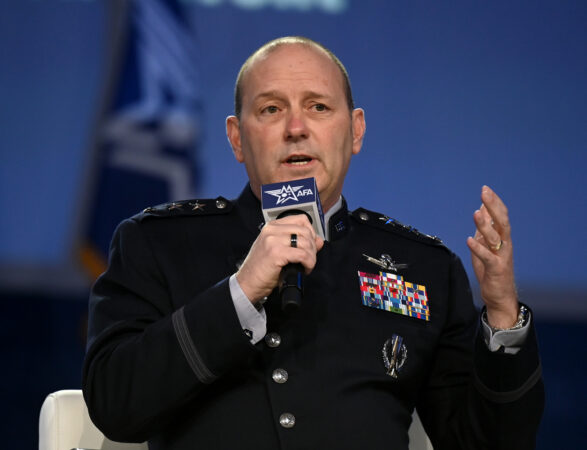
Washington D.C. – President Donald Trump has nominated Lt. Gen. Douglas A. Schiess to serve as the next Chief of Space Operations (CSO), the highest-ranking uniformed officer in the U.S. Space Force. The nomination was formally published in a congressional notice on April 30.
Should his nomination be confirmed by the Senate, Lt. Gen. Schiess would become the third individual to hold the Chief of Space Operations position since the service’s establishment in December 2019. He is slated to succeed Gen. B. Chance Saltzman, who assumed the role in September 2022. While service chiefs are typically appointed to four-year terms, they serve “at the pleasure of the president,” which means their tenure can be adjusted by the executive branch.
Lt. Gen. Schiess currently serves as the Deputy Chief of Space Operations for Operations, designated as the S3 within the Space Force’s organizational structure. He has been considered a strong candidate for promotion to this leadership position for approximately the past year. If confirmed, Schiess will be tasked with overseeing the service’s ambitious objective to significantly increase its personnel and capabilities in the coming years. His leadership would also come at a critical juncture marked by escalating global demand for on-orbit capabilities, which have become increasingly integral to modern military operations. Recent events, such as the widely discussed integration of space forces during operations like Epic Fury in Iran, underscore the evolving utility of space assets in providing foundational support for various military actions.
Following the announcement of his nomination, Lt. Gen. Schiess issued a statement highlighting the Space Force’s rapid advancements. “The Space Force has made tremendous progress in a short time, and our mission has never been more important,” Schiess remarked. “I’m humbled by the President’s nomination. If confirmed, I will focus on sharpening our lethality and accelerating the delivery of space capabilities to the warfighter, keeping the Space Force ahead against any adversary. My wife Debbie and I also look forward to serving all Guardians and their families if given the opportunity.” This statement signals a clear focus on enhancing the Space Force’s operational effectiveness and ensuring its technological edge in an increasingly contested domain.
Lt. Gen. Schiess brings extensive experience as a career space operator. Prior to his current role, he held the distinction of being the inaugural commander of U.S. Space Forces–Space (SPACEFOR-SPACE). This component serves as the Space Force’s primary liaison to U.S. Space Command (SPACECOM), which is one of the eleven unified combatant commands within the U.S. military, akin to geographic commands such as U.S. European Command (EUCOM) or U.S. Indo-Pacific Command (INDOPACOM). While the Space Force is a military service responsible for organizing, training, and equipping space forces, SPACECOM is responsible for conducting global space operations, integrating space capabilities into joint military operations, and protecting U.S. and allied interests in space.
During his tenure, Gen. Saltzman has been credited with laying the groundwork for substantial near-term growth within the Space Force. He has also been instrumental in establishing a robust framework for articulating the service’s evolving requirements and anticipating future threats in the space domain. In a statement regarding his successor, Gen. Saltzman expressed confidence in the nomination. “Leading the Space Force has been the privilege of a lifetime for Jennifer and me,” Saltzman stated. “Doug is the right leader at the right time. He understands the mission, he understands the stakes, and he will continue to push the Space Force to deliver the capabilities the Joint Force and the American people rely on.”
The nomination has received support from key advocacy organizations. The Air & Space Forces Association (AFA), a non-profit organization promoting aerospace power, released a statement commending the selection. Lt. Gen. Burt Field, President & CEO of AFA, commented, “Doug Schiess is the perfect choice at this crucial time for the Space Force, as it begins a substantial new period of growth.” Field further elaborated on the continuity of leadership, noting, “Just as Gen. Jay Raymond set the conditions for Gen. ‘Salty’ Saltzman to succeed as the second-ever Chief of Space Operations, so has Salty created the vision, budget, and operational vectors for Gen. Schiess to hit the ground running when he becomes CSO.” He added, “The Space Force at six is more mature and ready than it’s ever been, but the challenges and threats ahead continue to mount, and the Space Force we need is still being built. Doug Schiess has the operational experience to help get us where we need to be.” These remarks underscore the ongoing development of the Space Force amidst complex and growing challenges in the global space environment.
Why This Matters
The nomination of Lt. Gen. Douglas A. Schiess as the next Chief of Space Operations is a significant development with wide-ranging implications for U.S. national security, global military strategy, and the future of space exploration and utilization. As the leader of the newest branch of the U.S. armed forces, the Chief of Space Operations plays a pivotal role in shaping the nation’s capabilities and posture in the increasingly vital space domain.
Firstly, this nomination represents a critical juncture for the U.S. Space Force. Established just over four years ago, the service is still in its formative stages, defining its doctrine, acquiring key technologies, and growing its personnel. Lt. Gen. Schiess will be responsible for spearheading an ambitious expansion plan, which will directly impact the service’s ability to meet escalating demands for space-based intelligence, surveillance, reconnaissance, navigation, and communication assets essential to all other military branches. His leadership will determine the pace and direction of this growth, affecting budget allocations, technological investments, and recruitment strategies.
Secondly, the strategic importance of space has never been greater. Modern warfare and critical civilian infrastructure, from GPS systems to global communications networks, are increasingly reliant on space-based capabilities. The U.S. views space as a contested domain, with adversaries like China and Russia developing anti-satellite weapons and other capabilities that could threaten U.S. and allied space assets. The next CSO will be at the forefront of developing strategies and technologies to protect these vital assets, deter aggression in space, and ensure the U.S. maintains its competitive edge. This includes advancing defensive and offensive space capabilities, integrating space operations more seamlessly with terrestrial forces, and fostering innovation to stay ahead of evolving threats.
Finally, Lt. Gen. Schiess’s leadership will influence the broader international landscape of space. The decisions made by the U.S. Space Force will have ripple effects on international norms, arms control discussions related to space, and the potential for cooperation or conflict among spacefaring nations. His focus on “sharpening our lethality and accelerating the delivery of space capabilities to the warfighter” indicates a continued emphasis on military readiness in space, which will be closely watched by allies and rivals alike. This nomination, therefore, is not merely an internal military appointment but a signal of the U.S.’s enduring commitment to securing its interests and maintaining stability in the ultimate high ground.