
U.S. Air Force Commits Billions to Modernize Aging Executive Airlift Fleet
The United States Air Force is embarking on a significant modernization effort for its executive airlift fleet, with plans to allocate billions of dollars over the coming years. This ambitious program aims to replace decades-old aircraft responsible for transporting high-ranking military and civilian leaders, including the President of the United States.
Central to this initiative is a projected expenditure of $2.19 billion over the next five years for new C-37 jets, which transport military, civilian, and congressional officials. This investment comes in addition to an estimated $1.17 billion already earmarked for the ongoing replacement program for the VC-25B, colloquially known as “Air Force One.”
The push for modernization is driven by the increasing age and declining reliability of the current fleet. Many of these specialized transport aircraft have been in service for decades, presenting growing maintenance challenges despite considerable efforts to ensure their operational readiness for critical, high-profile missions.
Recent incidents have underscored these reliability concerns. In January, a VC-25A Air Force One aircraft carrying then-President Donald Trump was compelled to return to Joint Base Andrews, Maryland, due to a “minor electrical issue.” The President subsequently utilized a smaller backup aircraft for his overseas travel. Another incident occurred in October 2025 when a C-32, transporting Secretary of Defense Pete Hegseth on an international trip, had to make an unscheduled diversion to an airbase in England after its windshield cracked in flight. Furthermore, mission capable rates for the C-37, the executive transport aircraft for senior military and Pentagon civilians, showed a slight dip in 2024, the most recently available data.
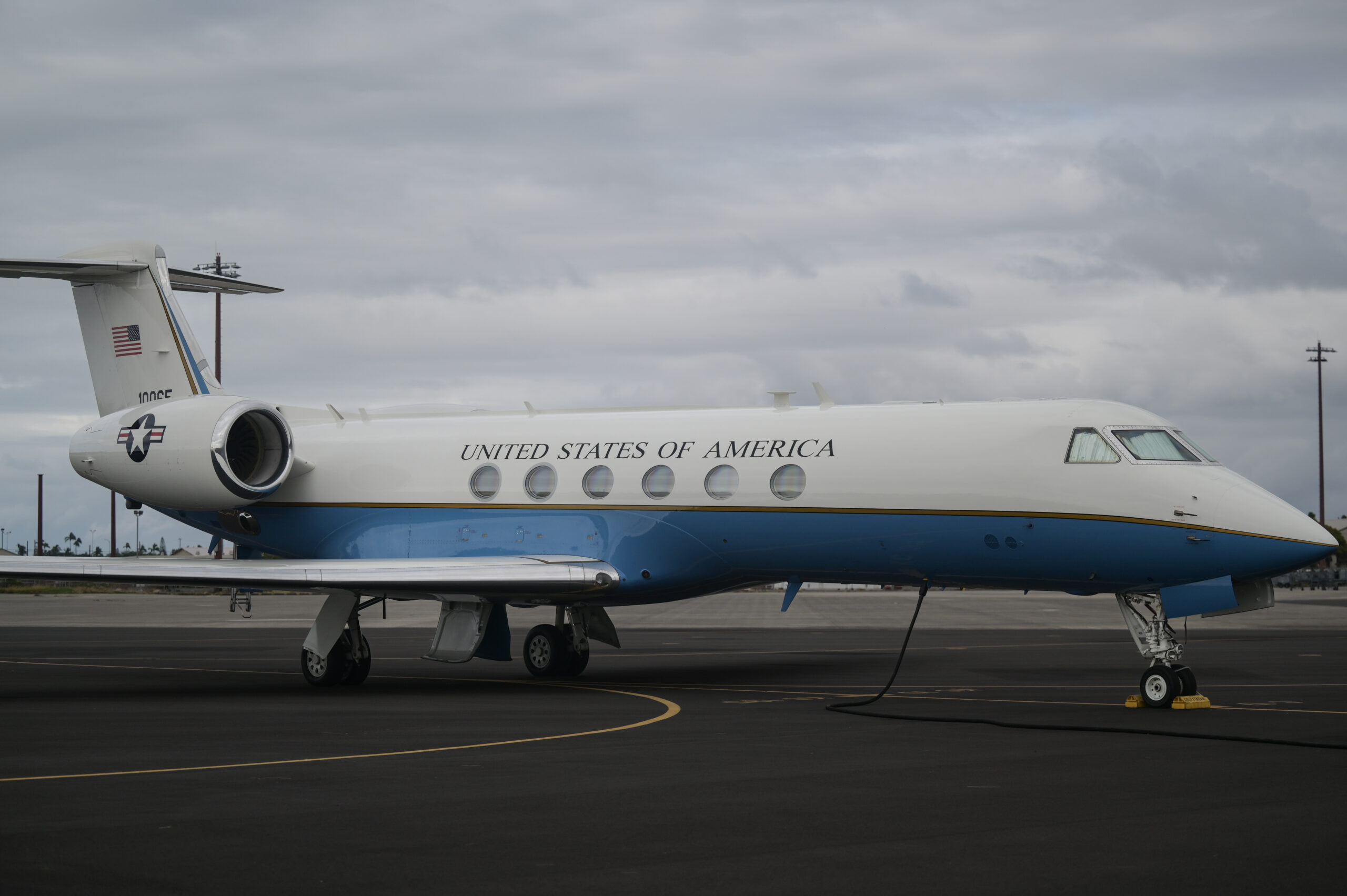
In its 2027 budget request, the Air Force unveiled a new program specifically designed to replace its existing C-37A and C-37B models. The C-37A is a modified Gulfstream V, while the C-37B is a variant of the Gulfstream G550. Both models are configured to carry 20 passengers and operate with a five-person aircrew.
The proposed plan involves the acquisition of 17 new C-37C jets, which will be based on a yet-to-be-determined commercial aircraft platform. Sixteen of these new aircraft are intended to directly replace the current C-37 fleet on a one-for-one basis, with an additional airframe designated as a trainer. The budget documents indicate an initial allocation of $208 million in 2027 for the first C-37C. The comprehensive five-year spending plan projects nearly $2.2 billion for this program, with peak annual funding reaching $548 million between 2029 and 2031.
U.S. Air Force Executive Airlift Fleet Overview
| Aircraft | Modified From | Mission | Current Inventory | Average Age |
|---|---|---|---|---|
| VC-25A ‘Air Force One’ | Boeing 747 | Presidential airlift | 2 | 37 |
| C-21A | Learjet | VIP Transport | 19 | 40.5 |
| C-32A ‘Air Force Two’ | Boeing 757-200 | Transport for VP, first spouse, and Cabinet; can be used as Air Force One when President is aboard | 4 | 27 |
| C-37A | Gulfstream V | Executive Airlift for senior military and Pentagon civilians | 9 | 24.47 |
| C-37B | Gulfstream G550 | Executive Airlift for senior military and Pentagon civilians | 7 | 9.57 |
| C-40B | Boeing 737-400 | “Office in the Sky” for Cabinet and members of Congress | 4 | 21.65 |
| C-40C Clipper | Boeing 737-400 | “Office in the Sky” for Cabinet and members of Congress | 7 | 19.76 |
Source: Air & Space Forces Magazine Almanac
Air Force One Replacement Program Continues
Beyond the C-37 fleet, the Air Force remains committed to finalizing the much-anticipated VC-25B program, despite facing significant delays. The 2027 budget request earmarks over $710 million for this crucial initiative, broken down as follows:
- $555 million allocated for engineering and manufacturing development tasks.
- $122 million designated for upgrade kits, specifically targeting airborne communications technology.
- $34 million for the acquisition of initial spare parts.
The Air Force is acquiring two VC-25Bs, which are highly modified Boeing 747-8 Intercontinental jets, to replace the two VC-25A models that entered service in 1990. Planned enhancements for the new presidential aircraft include advanced self-defensive systems, integrated airstairs for ground-level boarding, autonomous baggage handling capabilities, updated electrical systems, an additional auxiliary power unit, and cutting-edge mission communications gear. The first delivery of these new presidential aircraft is currently projected for mid-2028.
Boeing initiated the complex conversion work on two 747-8s to meet Air Force One specifications in 2020 under a substantial $3.9 billion contract. In anticipation of potential future requirements for the presidential transport mission, the Air Force is also procuring two additional 747-8s. Furthermore, the nation of Qatar generously gifted a fifth 747-8 to the U.S., which will serve as a temporary VC-25B “Bridge” aircraft. Modifications and testing for this interim aircraft have been completed, as confirmed by the Air Force on May 1, with flight operations expected to commence this summer.
Status of Other Executive Airlift Aircraft
The C-40 and C-32 jets currently represent the most operationally healthy components of the executive fleet, both achieving mission capable rates of 90 percent in fiscal year 2024. The Air Force intends to bolster the C-40 fleet, having secured $250 million in the 2026 budget for the acquisition and modification of one new jet, which will be based on the Boeing 737-700. The search for a suitable used airliner began in February. The C-40 “Clipper” is versatile, capable of carrying between 42 and 111 passengers, and functions as a mobile “office in the sky” for the first spouse, various government officials, and military leaders. Budget documents indicate that the C-40’s design service life is 35,000 flying hours, with an average of 21,700 hours remaining across the fleet.
Regarding the C-32 fleet, also known as “Air Force Two,” budget documents reveal ongoing low-cost modifications to its satellite communications system. First delivered in 1998, the C-32 fleet, consisting of six aircraft, is projected to remain in service through 2038, following the Air Force’s decision to discontinue earlier plans for its replacement.
Why This Matters
The U.S. Air Force’s multi-billion-dollar investment in modernizing its executive airlift fleet is a critical undertaking with far-reaching implications for national security, international diplomacy, and operational effectiveness. The safe, reliable, and secure transportation of the President, Vice President, Cabinet members, senior military leaders, and congressional officials is paramount to the continuity of government and the nation’s ability to respond to domestic and global crises.
Firstly, the reliability of these aircraft directly impacts national security. Incidents like mechanical failures, even minor ones, can cause significant disruptions to the schedules of key decision-makers, potentially delaying critical policy decisions or responses to urgent events. An aging fleet with increasing maintenance demands poses a tangible risk to the uninterrupted functioning of the highest levels of government. Modernizing these platforms ensures that U.S. leaders can project power and leadership globally without operational impediments.
Secondly, these aircraft serve as crucial tools for diplomacy and international engagement. “Air Force One” and other executive transports are not merely means of conveyance; they are symbols of American prestige, capability, and resolve on the world stage. A modern, secure, and technologically advanced fleet enables the President and other senior officials to conduct international relations effectively, often operating as mobile command centers with secure communications capabilities. The ability to travel anywhere in the world rapidly and securely reinforces America’s global leadership role.
Thirdly, the substantial financial commitment reflects the strategic importance placed on these assets. While the price tags for these specialized aircraft are considerable, they represent an investment in sustained operational readiness and security for the nation’s leadership. These costs cover not only the aircraft themselves but also extensive modifications for security, communications, and comfort, transforming commercial airframes into highly specialized government assets. This ensures that taxpayers are funding a fleet capable of meeting the unique demands of executive transport for decades to come.
Finally, the modernization effort integrates cutting-edge technology into these critical platforms. Upgrades to self-defensive systems, communications, and other onboard capabilities are vital in an increasingly complex global security environment. These technological advancements ensure that U.S. leaders remain connected, protected, and capable of executing their duties no matter where they are in the world, reinforcing the principle of “no-fail” missions for executive airlift.