
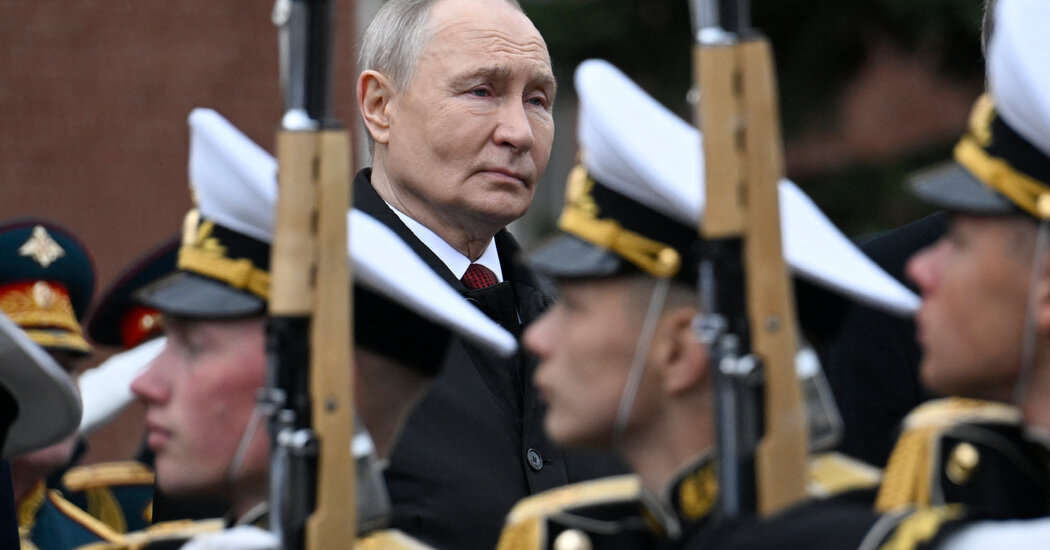
Russia’s annual commemoration of the Soviet Union’s victory over Nazi Germany during World War II, held this weekend, was notably subdued, prompting observers to suggest that President Vladimir V. Putin may be facing significant domestic and international pressures. The traditional Victory Day parade in Moscow’s Red Square featured a reduced display of military hardware, an unusual occurrence for an event typically showcasing Russia’s military might.
These pressures appear to stem from multiple fronts. Externally, Ukraine has intensified its long-range drone and missile strikes deep into Russian territory, while the front lines of the conflict remain largely stalemated, preventing decisive advances by Russian forces. Internally, there is growing evidence of public discontent among Russians, driven by increasing internet restrictions, economic challenges such as rising inflation and living costs, and a pervasive fatigue with a conflict now entering its fifth year.
Following the subdued festivities, President Putin addressed journalists, delivering remarks that analysts interpreted as an effort to project confidence while acknowledging the desire for an end to the prolonged conflict. His statement, “I believe the matter is coming to a close,” garnered considerable attention globally, suggesting a potential shift in rhetoric regarding the war in Ukraine.
However, a closer examination of President Putin’s broader comments reveals a nuanced position, indicating that while he seeks an end to the hostilities, it must be on terms favorable to Russia, with many of his primary strategic objectives in Ukraine still unfulfilled. He clarified that the limited military display in Red Square was not only for security considerations but also to ensure that the Russian armed forces could “focus its attention on the final defeat of the enemy.” This statement reinforced the Kremlin’s continued commitment to its war aims and its current military strategy.
During the same news conference, Putin reiterated long-standing grievances against Western elites, accusing them of disregarding Moscow’s legitimate security interests, provoking the conflict, and mistakenly anticipating Russia’s collapse under the weight of sanctions and international isolation. He offered no indications of a willingness to modify his core demands for a peace settlement, signaling a continued hardline stance despite the public acknowledgment of a desire for an end. Stefan Meister, a Russia analyst at the German Council on Foreign Relations, commented on this duality, stating, “He wants to send a message: ‘I understand this war needs to end soon, but it needs to end on my conditions.’”
While recent data from the Levada Center, an independent pollster, indicates a decline in Mr. Putin’s approval ratings, they still remain considerably higher than levels observed prior to Russia’s full-scale invasion of Ukraine in February 2022. It is crucial to note, however, that the reliability and interpretation of approval polls in an authoritarian political system, where dissent can be suppressed, are subject to inherent limitations. Nevertheless, the expert consensus, as articulated by Mr. Meister, suggests that “it’s not that this regime is now suddenly breaking down and there is no support anymore. I think what we understand now is, he is under pressure. And pressure works. He has to react somehow to it,” indicating that the Kremlin is responsive to prevailing sentiments, even if indirectly.
The prospect of peace talks, which once offered a glimmer of hope for an end to the conflict and captured public imagination, has largely faded from the international discourse. Their absence from recent headlines reflects a shift in global diplomatic priorities, notably with the focus of the United States administration turning towards the escalating tensions in the Middle East, among other pressing issues.
Domestically, signs of increased public dissatisfaction are emerging, particularly as observed by Boris B. Nadezhdin, an opposition politician. Nadezhdin, who was barred from running against President Putin in the 2024 presidential election due to alleged irregularities in his signature collection, is now preparing for parliamentary elections scheduled for the fall. His ongoing focus groups reveal a level of public anger directed at the government that he claims has not been seen in Russia since the 1990s, a period marked by significant economic and political upheaval following the collapse of the Soviet Union.
In a recent phone interview, Mr. Nadezhdin elaborated on these observations, noting, “Somehow, things have taken a sharp turn for the worse since the beginning of this year.” He identified three primary segments of society expressing discontent. The first includes older demographics, who are primarily concerned with low incomes and the spiraling cost of living, which has been exacerbated by inflation and sanctions. The second comprises younger individuals, frustrated by increasingly frequent internet outages and the throttling of popular applications, which restrict access to information, communication, and entertainment. The third, a broad cross-section of society, is simply experiencing profound fatigue and frustration with the protracted conflict now entering its fifth year, with no clear end in sight.
Significantly, Mr. Nadezhdin noted that much of this blame is directed at the government broadly or at local authorities, rather than at President Putin directly. This phenomenon, which he described as embodying the popular Russian saying, “‘the tsar is good, the boyars are bad,’” suggests a prevailing public perception that while the leader may be benevolent, his advisors or subordinate officials are responsible for the nation’s problems. This traditional narrative often serves to insulate the top leader from direct public criticism even amidst widespread dissatisfaction, allowing for a degree of stability at the highest level of government.
Despite the lack of an immediate electoral threat to President Putin’s rule, Mr. Nadezhdin characterized the current public mood as the “first stage of awakening,” implying a nascent but growing awareness of systemic issues and a potential for future shifts in public sentiment. Analysts suggest that recent international events, such as the reported killings of Iran’s top leaders by the United States and Israel, may have amplified President Putin’s concerns regarding his own security. These concerns, it is argued, could provide a rationale for more stringent measures domestically, including the disruptive internet restrictions currently being implemented to control information flow and potential dissent. Concurrently, Kyiv has escalated its strategy of long-range strikes into Russian territory, utilizing new domestically produced cruise missiles and drones, further adding to the perceived vulnerability of the Russian state and its leadership to external threats.
Why This Matters
The evolving situation in Russia, marked by President Putin’s nuanced statements on the war and rising domestic discontent, carries significant implications for global stability and the future trajectory of international relations. Firstly, any indication from a major nuclear power about the potential conclusion of a prolonged conflict demands close scrutiny. While Putin’s remarks about the war “coming to a close” might offer a glimmer of hope, his insistence on achieving Russia’s objectives suggests a continued commitment to a military solution rather than a genuine shift towards de-escalation or negotiation on mutually acceptable terms. This prolongs the conflict’s devastating humanitarian toll in Ukraine and sustains geopolitical tensions, impacting global security frameworks.
Secondly, the reported increase in domestic pressure on the Kremlin, stemming from economic hardships, internet censorship, and war fatigue, could have profound internal consequences for Russia. While President Putin’s approval ratings remain relatively high and direct challenges to his authority are minimal, widespread dissatisfaction, if it continues to grow, could incrementally erode state stability. The “tsar is good, boyars are bad” narrative, while traditionally protecting the leader, may not indefinitely shield him from collective anger, potentially leading to unpredictable social or political shifts in the long term. Such internal dynamics within Russia, a permanent member of the UN Security Council and a key player in global energy markets, invariably impact international affairs, from energy supply to diplomatic alignments.
Finally, the sustained conflict and the internal pressures on the Russian leadership directly influence global economic stability and regional security. The ongoing war contributes to volatility in energy and food markets, impacting economies worldwide and exacerbating inflationary pressures. For Europe, the conflict continues to reshape security architecture, necessitating increased defense spending and a reassessment of alliances, particularly within NATO. The interaction between Russia’s internal state of affairs and its external actions will largely determine the future course of the war in Ukraine, the prospects for peace, and the broader balance of power in the 21st century. Monitoring these developments is crucial for understanding potential shifts in Russia’s foreign policy and its engagement with the international community, making informed responses to a complex and evolving geopolitical landscape paramount.