
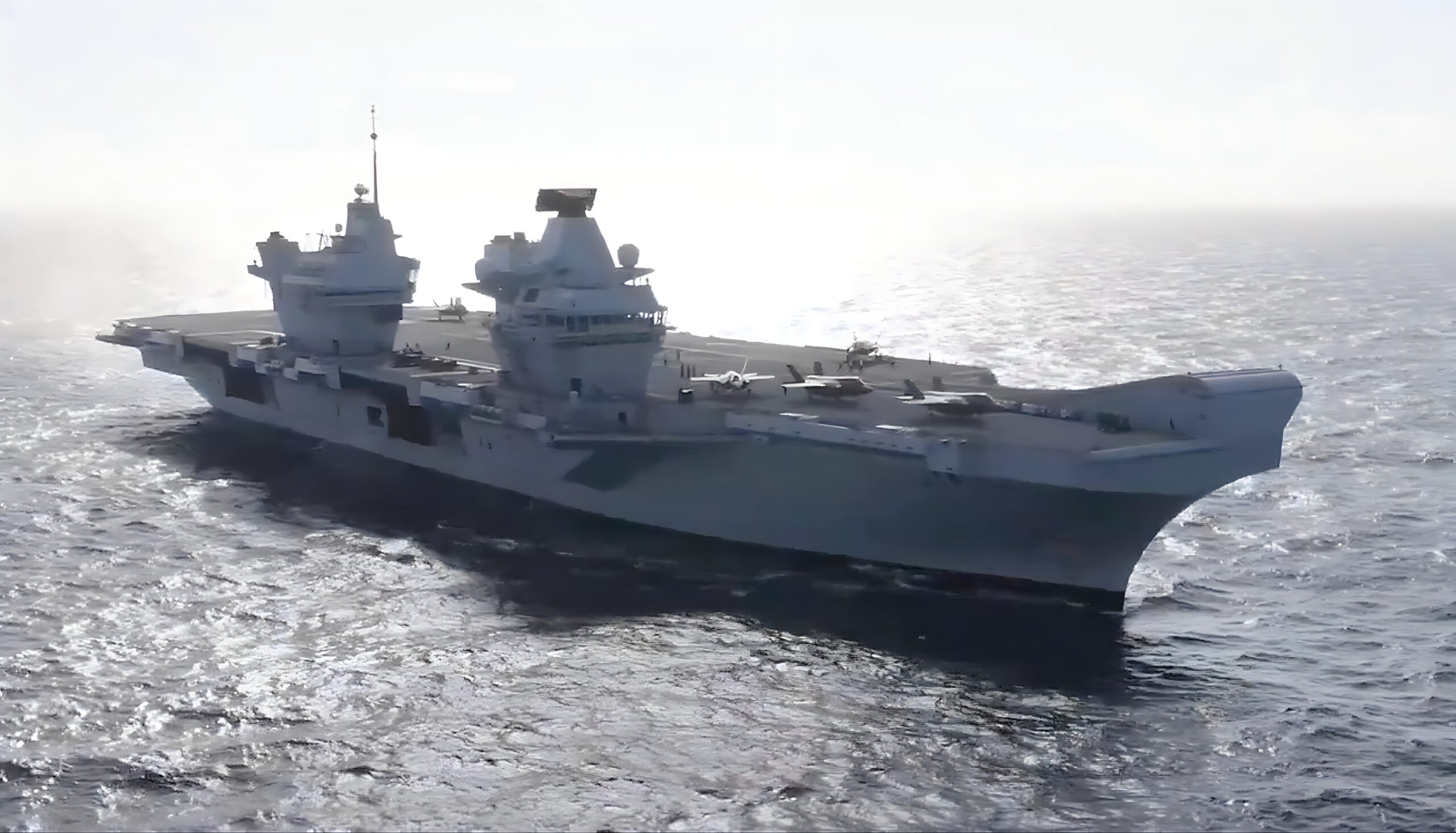
Stavanger, Norway– The Royal Navy’s flagship aircraft carrier, HMS Prince of Wales, has arrived in Stavanger, Norway, following its participation in Exercise Tamber Shield. The port call provides a strategic pause in an active deployment that has seen the UK Carrier Strike Group operating across Nordic waters since departing Scotland earlier this month.
The carrier strike group, a formidable naval contingent, includes the Type 45 destroyer HMS Duncan, known for its advanced air-defence capabilities, and the Royal Fleet Auxiliary (RFA) tanker Tidespring, crucial for sustained operations at sea. The group is currently operating under the command staff of Commander UK Carrier Strike Group and is slated to continue its mission into the High North. This upcoming phase will involve further commitments to NATO tasking, notably Exercise Dynamic Mongoose, the alliance’s principal anti-submarine warfare exercise in Northern Europe.
The arrival in Stavanger, announced by the carrier via social media, marks the successful completion of Exercise Tamber Shield. This exercise, conducted within the complex and confined fjords near Bergen, was specifically designed to test and refine the strike group’s capabilities in defending high-value assets against simulated “swarm attacks.” These attacks, characterized by numerous small, fast-manoeuvrable threats, represent a growing concern for modern naval forces operating in challenging littoral environments.
The UK’s Flagship, HMS Prince of Wales has arrived in Stavanger following Exercise TAMBER SHIELD. Working with partners and allies, she remains ready to continue operations in the North Atlantic and High North.@RoyalNavypic.twitter.com/lw7lF2ekco
— HMS Prince of Wales (@HMSPWLS)May 14, 2026
During Exercise Tamber Shield, the HMS Prince of Wales and its escorts engaged in advanced defensive drills alongside a range of allied assets. Participants included Wildcat helicopters from 815 Naval Air Squadron, Royal Navy P2000 patrol boats, and Norwegian missile craft. This multinational and multi-platform approach underscores NATO’s emphasis on interoperability and collective defence against diverse threats.
The strategic importance of exercises like Tamber Shield cannot be overstated. They are meticulously designed to replicate the challenging threat environments a carrier strike group might encounter in the narrow and often contested waters of the Norwegian fjords. In such geographies, limited manoeuvre space places a critical premium on sophisticated, layered close-in defence systems. The development of advanced tactics, techniques, and procedures to effectively counter coordinated small-boat and aerial swarm attacks in these complex terrains is an escalating priority for NATO navies. This focus is directly informed by observations from recent conflicts, which have demonstrated the proliferation and effectiveness of inexpensive uncrewed platforms, highlighting a paradigm shift in naval warfare.
HMS Prince of Wales is one of two Queen Elizabeth-class aircraft carriers, representing the largest warships ever operated by the Royal Navy. Displacing approximately 65,000 tonnes and stretching 280 metres in length, the carrier is a formidable platform for power projection. It is designed to embark up to 36 F-35B Lightning II stealth fighter aircraft, alongside a versatile complement of Merlin and Wildcat helicopters, providing extensive air combat, reconnaissance, and anti-submarine warfare capabilities.
Destroyer joins aircraft carrier for Nordic deployment
The carrier’s propulsion system comprises two Rolls-Royce MT30 gas turbines and four diesel generators, feeding an integrated electric propulsion system, enabling a top speed of 25 knots (approximately 46 km/h). With a ship’s company of around 700 personnel, and the capacity to accommodate a total complement of up to 1,600, including an embarked air group and command staff, the Queen Elizabeth class carriers are pivotal assets for global security operations.
Stavanger itself holds significant historical resonance for the Royal Navy and NATO. During the Second World War, it served as a critical base for Allied operations. Today, it remains one of Norway’s principal naval ports, underscoring its enduring strategic importance as a gateway to the North Sea and the wider Atlantic, and a key hub for NATO maritime activities.
Why This Matters
The deployment of HMS Prince of Wales and its carrier strike group to Nordic waters, encompassing exercises like Tamber Shield and upcoming participation in Dynamic Mongoose, carries significant geopolitical weight and operational implications:
- NATO Deterrence and Readiness:This deployment underscores NATO’s commitment to maintaining a robust defensive posture in the North Atlantic and High North. These regions are increasingly vital strategic corridors, particularly given heightened geopolitical tensions and increased Russian naval activity. The presence of a formidable carrier strike group demonstrates the alliance’s readiness to project power, deter potential aggression, and safeguard its northern flank.
- Adapting to Evolving Threats:Exercise Tamber Shield’s focus on countering swarm attacks by small, fast-manoeuvrable threats is a direct response to lessons learned from recent conflicts, particularly concerning the proliferation and effectiveness of uncrewed surface and aerial systems. This reflects a critical adaptation in naval warfare doctrine and training, ensuring NATO forces are prepared for the complex, multi-axis threats of the 21st century. The development of advanced close-in defence tactics is essential for protecting high-value assets in congested and contested environments.
- Strengthening Interoperability and Alliance Cohesion:The participation of British and Norwegian forces in Tamber Shield, along with the broader integration into NATO tasking like Dynamic Mongoose (focused on anti-submarine warfare, a critical capability in the North Atlantic), reinforces interoperability. Such exercises enhance communication, coordination, and shared operational procedures among allied navies, strengthening the collective defence capabilities of the alliance. This cohesion is vital for effective multinational operations.
- Projecting UK Naval Power and Global Reach:As the flagship of the Royal Navy, HMS Prince of Wales represents a significant investment in the UK’s defence capabilities. Its deployment demonstrates the UK’s capacity to project power globally, contribute meaningfully to international security, and fulfill its commitments as a leading NATO member. The carrier strike group provides a flexible platform for a wide range of tasks, from humanitarian aid to high-intensity combat operations.
- Securing Critical Maritime Routes:The North Atlantic and the High North are crucial for global trade and energy security. The presence of a carrier strike group helps ensure the security of vital sea lines of communication, protecting economic interests and upholding the principle of freedom of navigation in strategically important waters.