
Unlock the Editor’s Digest for free
Roula Khalaf, Editor of the FT, selects her favourite stories in this weekly newsletter.
Key Takeaways
- El Niño’s Overstated Global Inflationary Impact:Historically, the direct effect of El Niño on global food price inflation has been less significant than commonly perceived, largely due to advancements in agricultural productivity, efficient global trade, and credible central bank monetary policy.
- Geopolitical Risk and Policy Failure as Primary Drivers:Current global food supply vulnerabilities are primarily driven by geopolitical disruptions, such as the blockage of critical trade routes affecting fertilizer supply, and long-term government inaction on climate change, rather than El Niño itself.
- Human Agency Determines Market Resilience:The global economy’s ability to withstand weather-related shocks hinges on strategic policymaking, maintaining open trade, and investing in agricultural innovation, underscoring that human decisions are now the greatest variable in food market stability.
If you took a global public opinion poll on what the world needed right now, a weather system so destructive it’s pre-emptively been nicknamed Godzilla probably wouldn’t top the list. For financial markets, the emergence of a “Godzilla El Niño” narrative often triggers speculative movements in agricultural futures, ignites inflation fears, and prompts reassessments of supply chain resilience, even if the underlying fundamentals are more nuanced.
The El Niño phenomenon, named after the infant Jesus by 19th-century fishers off the coast of Peru who noticed their quarry disappearing out to sea around Christmas, arrives every 3-5 years. The system starts in the tropical Pacific and can disrupt ocean currents, change air temperatures and rainfall and cause storms around the world. It’s acquired the status of legend, a Prince of Peace who brings havoc to Earth, creating a powerful psychological anchor for market participants when considering potential disruptions.
Early predictions foresee a particularly severe episode later this year, variously named a Super or Godzilla El Niño. A shock to weather which affects food production is precisely what the global economy, still navigating inflationary pressures and supply chain fragilities post-pandemic, doesn’t need. Such forecasts can immediately translate into heightened volatility in soft commodity markets, driving up prices for staples like wheat, corn, and soybeans on mere anticipation of supply constraints, regardless of eventual outcomes.
In reality, though, not only are predictions of the phenomenon very tentative at this stage — hugely experienced Australian climate scientists warn against prematurealarm— but El Niño’s mythical destructiveness is also overstated in terms of its global macroeconomic impact. It certainly provides a stress test for the resilience of the global economy, particularly for agriculture-dependent emerging markets. But the problem, El Niño or not, is that Donald Trump’s Iran war on top of the uncertainty of climate change has made global food supply more vulnerable than for decades, introducing significant geopolitical risk premiums into agricultural supply chains.
The modern lore of El Niño almost certainly derives from the episode of the weather system in 1972-73. Breakthroughs in oceanography and meteorology enabled better observation and analysis. Global food prices shot higher and there were famines in south Asia and sub-Saharan Africa. This period is often cited as a benchmark for El Niño’s potential impact, yet market analysis reveals a broader set of drivers.
In reality, that period of global inflation — in all goods, not just food — was created in Riyadh and Washington more than in the currents of the Pacific. The Arab countries’ embargo on oil supply in 1973 pushed the cost of crude higher, driving up energy costs across the board and embedding inflationary pressures into production and transport. Economists’ subsequent assessments of the episode,most famouslyby former Federal Reserve chair Ben Bernanke, say monetary policy was a big culprit. The Fed and other central banks allowed commodity price shocks to escalate into inflationary wage-price spirals, demonstrating a crucial lesson for today’s policymakers about anchoring inflation expectations.
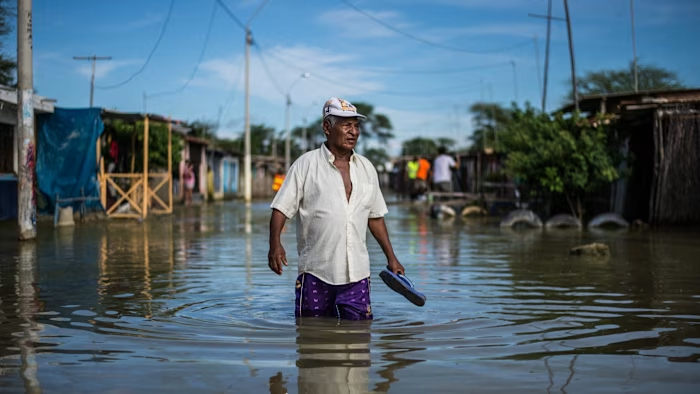
Policymakers’ greater credibility during subsequent decades meant the world economy could ride El Niños and other shocks to commodity prices without setting off generalised inflation. Central banks adopted more robust inflation-targeting frameworks, and markets learned to trust their commitment to price stability, which helped prevent temporary supply-side shocks from morphing into sustained inflationary trends. Certainly, the weather system still causes localised food shortages, particularly in low-income net-importing countries, which can be devastating. However, the correlation between it and global food inflation has been weak since the 1970s, suggesting that while local humanitarian crises occur, the broader market mechanisms effectively absorb the shocks.
The food price surge of 2007-2008 did not have an El Niño trigger; instead, it was driven by factors such as rising demand from emerging economies, biofuel mandates, and financial speculation. A particularly large “Super El Niño” in 2015-2016 caused localised food problems but no global inflation, demonstrating the market’s improved resilience. An episode in 2023-2024 arrived just as the shock of Russia’s invasion of Ukraine was dissipating and food inflation was dropping sharply, and it did not reverse it. For the past half century, El Niño has been the weather system who cried wolf, failing to deliver the systemic market disruption its fearsome reputation might suggest.
As well as the greater anti-inflationary credibility of central banks, the astonishing increases in agricultural productivity over the past few decades, together with an efficient global food trading system, have ensured that supply has overwhelmed shocks. Innovations in crop science, irrigation, and farming techniques have dramatically boosted yields, creating significant buffers against regional weather anomalies. As it happens, El Niños aren’t necessarily bad for production across the board: higher rain can bring better yields in some regions, offsetting losses elsewhere. As economists at the consultancy Capital Economics point out, the 2023-2024 El Niño actually caused the prices of some staple food crops — corn, soyabean, wheat — to fall, reflecting diverse regional impacts and the global market’s ability to reallocate supply. In any case, in the longstanding battle of agricultural yields and open trade in food versus population growth, bad weather and wars, the farmers and shipping lines have persistently won.

The disturbing new development is that governments in general and Trump in particular have entered the lists on El Niño’s side. Rising agricultural productivity has been heavily dependent on artificial nitrogen fertiliser, much of the supply of which has now been cut off by the effective closure of the Strait of Hormuz. This geopolitical choke point, a critical artery for global trade, especially in energy and increasingly, fertilizer inputs, introduces a systemic risk far greater than regional weather patterns.
True, some of the recent forecasts of imminent production catastrophe from fertiliser shortages were clearly overdone. North American and European farmers, for example, seem to have got in enough fertiliser for the northern hemisphere planting season before shipments were cut off. But if the blockage persists in the Strait — and there are air pockets of supply in the system even if it restarts — the effect on food production by next year could be dramatic, leading to elevated commodity prices, increased food insecurity, and potential social unrest in vulnerable nations. This introduces a significant premium for geopolitical risk into agricultural market pricing.
There isn’t much evidence that climate change has materially damaged global agricultural production as yet. But it adds uncertainty, and there is some evidence that climate change amplifies the effects of an El Niño episode, leading to more extreme weather events like prolonged droughts or intense floods. Governments’ failure to reduce carbon emissions over the decades is another horrible mistake, creating long-term systemic risks for global food security and increasing the volatility of agricultural yields, impacting futures markets and long-term investment decisions in sustainable agriculture.
Despite its name, the El Niño weather phenomenon is not an indomitable act of God for global markets. For the last half-century, wise policies, technological ingenuity, and market efficiency have kept its broader economic impact at bay. Human folly, manifested through geopolitical adventurism and a lack of climate action, has turned it back into a serious threat, underscoring that the greatest risks to market stability are often man-made.
[email protected]
Market Impact
The confluence of an anticipated El Niño, geopolitical instability impacting key trade routes, and long-term climate change implications creates a complex risk profile for global markets. Investors should brace for heightened volatility in soft commodity futures, particularly for grains, edible oils, and fertilizers, as supply chain disruptions and input cost increases become more prominent. Food-importing nations, especially emerging economies, face increased inflation risks and potential balance of payments pressures, which could impact sovereign credit ratings and currency stability. Central banks will need to carefully differentiate between weather-induced, temporary price shocks and more persistent, geopolitically driven inflation when formulating monetary policy. Furthermore, the agricultural sector, from seed producers to food processors, faces increased operational costs and supply uncertainty, potentially impacting corporate earnings and prompting a re-evaluation of supply chain diversification strategies. Finally, the growing interdependency of food, energy, and geopolitical stability means that events like the Strait of Hormuz blockage could trigger broader market contagion, raising overall systemic risk and increasing demand for hedging strategies against these interconnected threats.