
**Key Takeaways**
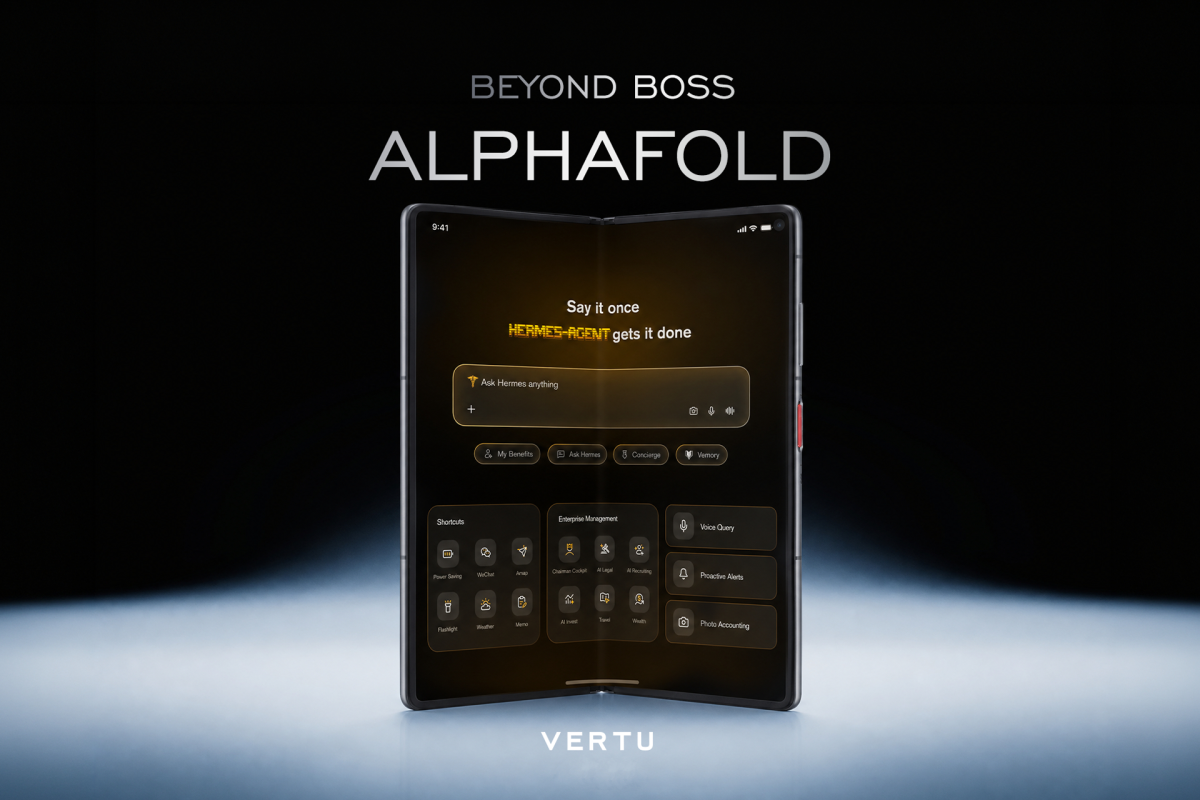
- **Vertu’s High-Stakes AI Foldable:** Luxury smartphone brand Vertu has launched the Alphafold, a premium foldable device integrating an enterprise-focused AI agent (Hermes) designed to streamline business operations for executives.
- **Targeting the Executive Niche:** Starting at $6,880, the Alphafold positions itself as a luxury status symbol and a productivity tool, aiming to fill a perceived gap in the market for advanced, enterprise-grade AI on smartphones.
- **Emphasis on Privacy and Security:** The device features a proprietary A5 security chip for on-device data isolation and processing, aiming to address critical data privacy concerns for sensitive corporate information, although third-party audits are still pending.
Vertu, a name synonymous with opulent mobile devices and a storied past in the luxury smartphone market, is attempting a significant comeback. The company has officially unveiled the Alphafold, a new foldable smartphone that boldly fuses its signature high-end aesthetics with cutting-edge artificial intelligence. Priced to appeal exclusively to the ultra-affluent, the Alphafold isn’t just a phone; it’s a statement, a tool, and a strategic bet on the future of enterprise mobility.
Targeting top-tier executives who orchestrate complex business operations and manage critical communications while on the move, the Alphafold aims to redefine the premium smartphone experience. The device integrates an advanced AI agent designed to connect seamlessly with enterprise software and orchestrate intricate workflows, moving beyond consumer-centric AI to a more robust, business-oriented application.
The Alphafold: A Luxury Revival Bid with AI at its Core
The Alphafold enters the market with a starting price of $6,880 for its calfskin variant, quickly escalating to bespoke models featuring exotic materials like alligator leather, 18K gold, and natural diamond accents. Vertu confirmed that its highest-end standard model currently retails for $46,800, with further customization options pushing the price even higher. This pricing strategy firmly entrenches the Alphafold in the realm of luxury status symbols, a segment Vertu has historically dominated before the mainstream smartphone revolution led by the iPhone.
This launch represents Vertu’s latest, and perhaps most critical, endeavor to reclaim relevance in a fiercely competitive and rapidly evolving smartphone landscape. The Hong Kong-headquartered company, once celebrated for its handcrafted phones and exclusive concierge services, has weathered multiple ownership changes and struggled to adapt since major smartphone manufacturers came to dominate the industry. The Alphafold, therefore, isn’t merely a product launch; it’s a strategic reinvention, combining Vertu’s heritage of luxury hardware with an ambitious leap into enterprise-focused AI capabilities.
Hermes Agent: AI Tailored for Enterprise Command
Central to the Alphafold’s proposition is the Hermes Agent, a sophisticated AI system built upon the open-source Hermes project by Nous Research. This agent is engineered to be a powerful digital assistant for the executive, capable of connecting directly to vital enterprise systems such as ERP (Enterprise Resource Planning) and CRM (Customer Relationship Management). Through natural-language prompts, Hermes can coordinate a myriad of business tasks, including but not limited to, expediting approvals, managing complex scheduling, tracking sales performance, streamlining travel planning, and generating critical operational reports.
The flexibility of the Hermes Agent is a key differentiator. Vertu states that the Alphafold can intelligently route requests across an array of leading AI models, including OpenAI’s GPT, Anthropic’s Claude, Google’s Gemini, and a selection of open-source alternatives. This multi-model approach allows the agent to leverage the strengths of different AI engines for specific tasks. Furthermore, its integration extends to over 80 applications and dozens of native phone functions, enabling seamless cross-platform workflows that promise to significantly boost executive productivity.
However, the deployment of this powerful AI capability isn’t off-the-shelf. Vertu emphasizes that its Phone-to-ERP and VPS (Vertu Private Server) deployments will be meticulously customized for each client, factoring in their existing enterprise systems. This bespoke approach naturally implies that pricing for these advanced integration services will vary based on complexity and scope.
Addressing the AI Privacy Paradox with Dedicated Security
Vertu CEO Molly Ma highlights a critical market gap: while major smartphone manufacturers have integrated AI, their focus remains largely on consumer tools like image editing and voice assistance. This leaves ample room for more advanced AI-agent workflows deeply integrated with enterprise systems. Ma also points to earlier AI-agent smartphone experiments in China, which, despite initial popularity, faced significant challenges concerning data privacy and extensive cloud-based data collection – a pitfall Vertu aims to avoid.
The Alphafold aims to directly address these privacy concerns through a meticulously designed privacy-focused architecture, centered around a proprietary A5 security chip. This dedicated silicon is engineered to create a secure enclave, isolating sensitive information such as authentication keys, biometric credentials, and confidential enterprise data from the main operating system. A key advantage of this architecture is the capability for commercially sensitive data to be processed locally on the device, minimizing exposure. Furthermore, prompts sent to external AI models are carefully redacted or tokenized before leaving the phone, adding another layer of data protection.
While Vertu has strongly emphasized these robust privacy and security features, including on-device processing and data redaction, the company acknowledges that the system has not yet undergone independent third-party security audits or received official certification. Vertu has, however, committed to these audits as an “explicit next-stage commitment” on its security roadmap, promising to “communicate the progress and the results publicly” as the product matures.
Under the Hood: Premium Hardware and Foldable Ambitions
Beyond its AI prowess, the Alphafold boasts formidable hardware specifications befitting its luxury status. It is powered by Qualcomm’s cutting-edge Snapdragon 8 Gen 4 processor, ensuring top-tier performance for demanding applications and multitasking. The device features an expansive 8.05-inch foldable display, complemented by a convenient 6.53-inch outer screen for quick interactions. A robust 6,500mAh battery promises extended usage, and the inclusion of satellite communication capabilities underscores its utility for global executives who require connectivity in remote areas.
Photography capabilities are also premium, with a triple rear camera setup comprising a 50-megapixel primary lens, a 50-megapixel ultrawide camera, and a 5-megapixel telephoto lens. Durability, a crucial factor for foldable devices, is addressed through a sophisticated hinge mechanism constructed from metal, titanium, and carbon-fiber components, rated for an impressive 650,000 folds. This suggests a design built for longevity, crucial for a device in this price bracket.
The Alphafold is not Vertu’s inaugural foray into combining AI with foldable form factors. Last year, the company introduced Agent Q, a clamshell-style foldable smartphone that also focused on AI-driven automation and productivity features. However, Molly Ma asserts that the Alphafold represents a significant evolutionary leap from its predecessor, citing rapid advancements in AI-agent technology over the past year, particularly in memory management, automation capabilities, and app integration.
Analyst Perspective: Niche Market, Future Potential, and Current Hurdles
Despite years of substantial investment from tech giants like Samsung and Huawei, foldable smartphones remain a niche segment globally. IDC data shared with TechCrunch indicates that approximately 20 million foldable smartphones were shipped worldwide in 2025, accounting for less than 2% of total smartphone shipments. Furthermore, these devices command a premium, selling at an average price of about $1,300 last year—roughly three times the price of non-foldable smartphones.
Kiranjeet Kaur, an associate research director for mobile phones at IDC, offers a nuanced perspective. She acknowledges that foldables could indeed benefit significantly from advanced AI-agent workflows, primarily because their larger displays are inherently better suited for multitasking and productivity-oriented experiences vital for business users. However, Kaur also highlights that enterprise AI adoption on smartphones still lags considerably behind personal computers. More crucially, most enterprise smartphone purchasing decisions continue to be driven by factors such as robust ecosystem integration and comprehensive device management support, rather than cutting-edge AI capabilities alone.
The first batch of 115 Vertu Alphafold units is scheduled to begin shipping this week across key global markets, including the U.S.
The Bottom Line
Vertu’s Alphafold is an ambitious play, marrying ultra-luxury hardware with a bespoke enterprise AI agent and a strong privacy narrative. It attempts to carve out a unique space by serving an executive demographic often overlooked by mainstream manufacturers. While the promise of an AI-driven foldable for unparalleled business productivity is compelling, the Alphafold faces significant hurdles: the inherent niche status of foldables, the nascent stage of enterprise AI adoption on mobile, and the need for independent security validation. Ultimately, its success will hinge on whether Vertu can convince its affluent target audience that this premium device truly offers a transformative, secure, and indispensable advantage in their high-stakes business world, rather than just another dazzling accessory.
When you purchase through links in our articles, we may earn a small commission. This doesn’t affect our editorial independence.
Source:{feed_title}