
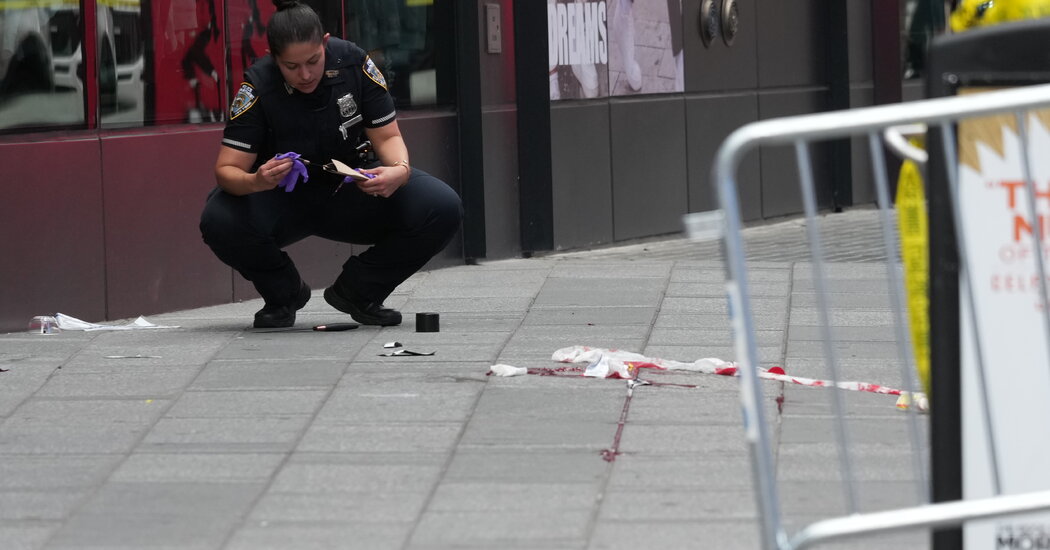
Incident in Times Square Leads to Fatal Stabbing and Police Shooting
NEW YORK CITY – An incident in the heart of Times Square on Monday afternoon resulted in the fatal stabbing of one individual, the injury of another, and the subsequent death of the assailant following a confrontation with law enforcement. Authorities confirmed that a woman, identified as Pamela Cisneros, 49, armed with two knives, stabbed two people before being shot by police after refusing commands to disarm.
The sequence of events unfolded shortly before 4:30 p.m. in one of New York City’s most heavily trafficked tourist destinations. According to Police Commissioner Jessica Tisch, Ms. Cisneros initially approached a 68-year-old man and his wife as they were waiting to cross the street at West 41st Street and Seventh Avenue, moments after exiting a subway station. Ms. Cisneros proceeded to stab the man, who was later reported to be in stable condition at a hospital.
The fatal stabbing occurred mere seconds later. Aliou Dieye, a 62-year-old street vendor selling sunglasses and hats, witnessed the second attack from his nearby stand. Mr. Dieye recounted seeing Ms. Cisneros approach another woman directly in front of his location. “She didn’t say nothing,” Mr. Dieye stated. “She walked up to her. She stabbed her in the stomach.”
The victim of this second attack, a 32-year-old woman whose identity has not yet been released, collapsed to the sidewalk. Both Mr. Dieye and a friend immediately contacted emergency services. Commissioner Tisch later confirmed that the 32-year-old woman was pronounced dead upon arrival at a hospital. The names of both victims have been withheld by authorities pending notification of next of kin.
Following the stabbings, Ms. Cisneros continued northbound along Seventh Avenue. She was subsequently confronted by uniformed officers near a Police Department substation at West 43rd Street. This confrontation was captured in at least two videos that later circulated publicly, offering different perspectives on the incident. One video, shared on platform X, showed Ms. Cisneros holding a knife in each hand, engaged in a tense standoff with a semicircle of police officers. The officers maintained a distance of approximately 10 feet, while pedestrian and vehicular traffic continued to move in the background of the bustling square.
Commissioner Tisch detailed that officers engaged Ms. Cisneros for approximately four minutes, attempting to de-escalate the situation and persuade her to surrender her weapons. During this period, Ms. Cisneros reportedly refused the commands, stating, “I’m not dropping anything. I would rather kill both of you,” according to the Police Commissioner.
After 38 seconds into one of the video recordings of the standoff, an individual could be heard shouting, “Tase her.” Ms. Cisneros then began waving her arms in circular motions. The command to “Tase her” was repeated, and multiple percussive sounds were audible. Wires indicative of Taser darts were visible near Ms. Cisneros, and an officer holding what appeared to be a Taser gun entered the frame. Commissioner Tisch confirmed that two officers deployed Tasers against Ms. Cisneros in an attempt to incapacitate her with less-lethal force.
Despite the Taser deployment, Ms. Cisneros then charged toward the officers. In response, two or three gunshots were heard, and Ms. Cisneros fell to the ground. Another video, provided by a former law enforcement official and filmed from behind the officers, depicted at least seven officers surrounding Ms. Cisneros as she advanced. The surreal backdrop of giant video screens displaying advertisements for a jeweler could be seen in the background as the shots were fired.
A third video, obtained from a food vendor, showed Ms. Cisneros lying on the sidewalk after being shot. Officers were seen immediately rendering aid to her as blood spread across the pavement. Paramedics subsequently transported her on a gurney to a nearby hospital. Ms. Cisneros was later pronounced deceased. Police investigators confirmed the recovery of two kitchen knives at the scene, which are believed to be the weapons used in the stabbings.
In a news conference held in Times Square following the incident, Mayor Zohran Mamdani extended gratitude to the New York City Police Department (NYPD) officers involved. “I want to thank the N.Y.P.D. officers who stepped in and prevented a horrific attack from becoming even worse,” Mayor Mamdani stated. Commissioner Tisch reiterated this sentiment, affirming, “Our officers did exactly what they’re trained to do,” in reference to the use of de-escalation tactics and force protocols.
Authorities also disclosed that Ms. Cisneros resided in Queens and that there was preliminary information suggesting a history of mental illness. This aspect of the incident is likely to be a focus of ongoing investigation and public discussion regarding the interplay between mental health and public safety.
The tragic event occurred approximately one week before the Labor Day holiday weekend, a period when Times Square, a major draw for international and domestic tourists, experiences peak visitor numbers. Such fatal incidents are relatively uncommon in this specific area. According to the most recently available police data, the Midtown South Police Precinct, where the attack took place, recorded two killings between January 1 and August 30 of the current year, mirroring the two killings reported during the same period last year. As of August 23, felony assaults within the precinct had decreased by 6 percent from the previous year, with 356 incidents reported compared to 377.
Despite the overall stability or decrease in certain crime categories, high-profile attacks in prominent public spaces within Midtown have occurred in recent months. In April, a man wielding a machete injured three individuals at the Grand Central subway station. In June, another assailant stabbed seven people within a two-minute span inside Penn Station, the nation’s busiest transit hub. However, none of the victims in these preceding incidents sustained life-threatening injuries, distinguishing them from Monday’s fatal outcome.
The investigation into the Monday afternoon incident in Times Square is ongoing, with authorities examining all available evidence, including witness statements and video footage, to establish a comprehensive understanding of the events and the motivations behind the attack.
Jamie Leventhal contributed reporting.
Why This Matters
The fatal incident in Times Square carries significant implications across several dimensions, extending beyond the immediate tragedy for the victims and their families. It highlights critical ongoing discussions regarding urban public safety, police response protocols, and the intersection of mental health crises with public order.
Firstly, the location of the attack—Times Square, a global icon and a symbol of New York City’s vibrancy—raises immediate concerns about public safety in high-density tourist areas. While crime statistics for the precinct show overall stability or reduction in certain categories, a highly visible and violent incident can disproportionately impact public perception of safety, particularly among the millions of tourists who visit the area annually. This incident could prompt renewed scrutiny of security measures and police presence in major public spaces, especially during peak visitor seasons like the upcoming Labor Day weekend, to reassure both residents and visitors.
Secondly, the detailed account of the police interaction, including a four-minute de-escalation attempt and the deployment of less-lethal Tasers before resorting to lethal force, places a spotlight on police training and use-of-force policies. The officers’ reported efforts to disarm the assailant without deadly force, coupled with the suspect’s alleged explicit threats to kill officers, underscores the complex and often dangerous decisions law enforcement must make under extreme pressure. This sequence of events will be closely analyzed in the context of police accountability and appropriate responses to armed individuals, particularly when mental health concerns are a factor. It serves as a real-world case study on the application of de-escalation techniques and the continuum of force within police procedure.
Thirdly, the preliminary information indicating that the assailant had a suspected history of mental illness brings the issue of mental health support and intervention to the forefront. Public incidents involving individuals experiencing mental health crises underscore systemic challenges in providing adequate support and preventing such situations from escalating into violence. This tragedy reignites conversations about how cities can better identify and assist individuals with mental health needs, prevent them from becoming a danger to themselves or others, and equip first responders with specialized training and resources for mental health-related calls. It also raises questions about the balance between public safety and the humane treatment of individuals in distress, particularly in highly visible urban settings.
Finally, for the victims, their families, and the numerous witnesses, the incident represents a traumatic event. The broader community is reminded of the unpredictable nature of violence, even in spaces generally considered safe. Understanding the full context of such events—from their immediate causes to their societal implications—is crucial for fostering resilience, informing policy, and working towards solutions that enhance both public safety and individual well-being in urban environments.