
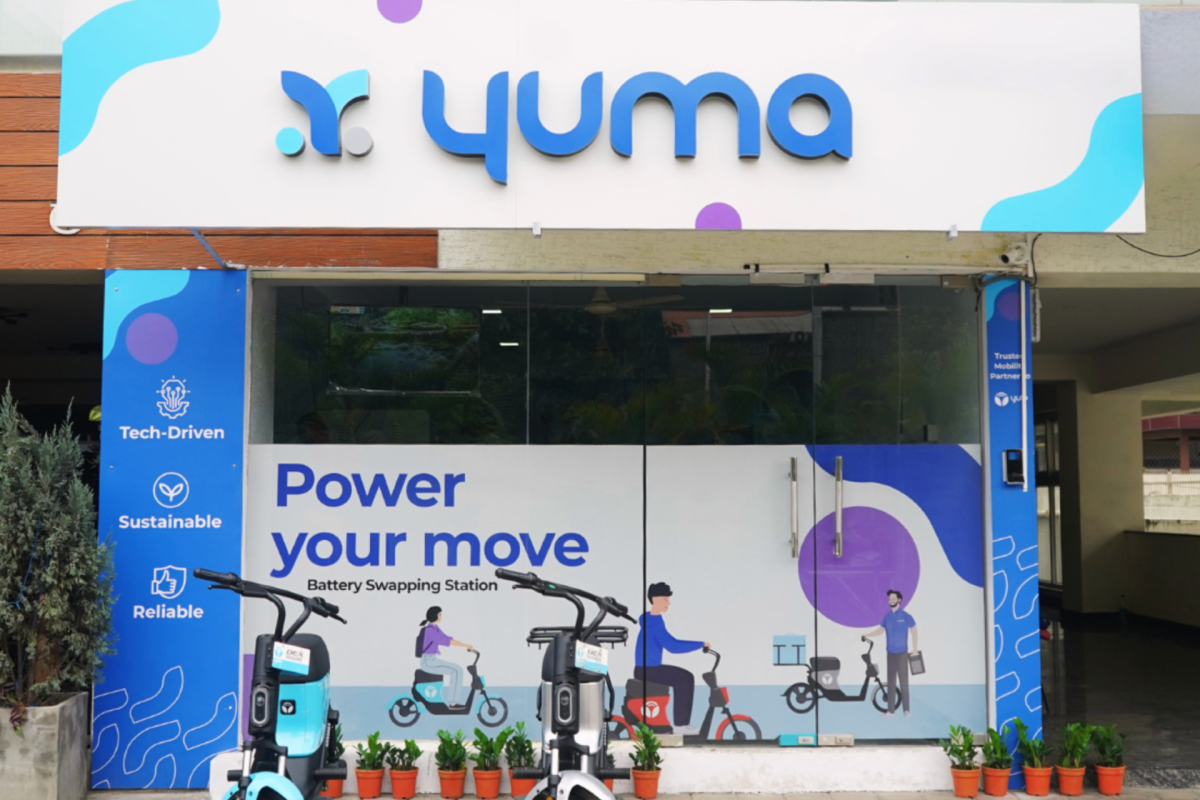
While battery swapping has struggled to take off in much of the world, Canadian auto parts giant Magna International believes the model could work at scale in India, where millions of two- and three-wheelers and a fast-growing delivery economy create a different set of economics.
And it’s placing that bet on Yuma Energy, a Bengaluru-based firm that operates a battery-swapping network for electric two- and three-wheelers. Yuma, which spun out of Indian mobility startup Yulu in early 2023, has completed more than 60 million swaps to date and now has about 100,000 batteries deployed across its network.
Key Takeaways:
- Magna’s Strategic Bet on India:Auto parts giant Magna International has significantly increased its investment in Bengaluru-based Yuma Energy, pouring another $35 million into the battery-swapping firm, underscoring its confidence in India’s unique EV market.
- Powering India’s Gig Economy:Yuma’s model directly addresses the critical need for uptime among high-mileage gig workers using electric two- and three-wheelers, offering rapid battery swaps as a superior alternative to lengthy charging times.
- Path to Profitability and Expansion:Despite being capital-intensive, Yuma is targeting EBITDA break-even within two quarters, fueled by plans to double its battery fleet and expand its network across India, with an eye on future international markets and proprietary battery technology.
Magna Fuels India’s EV Swapping Future with $35M Boost to Yuma Energy
The global electric vehicle (EV) market is booming, yet one persistent challenge has been the practicality of battery charging, especially for high-usage vehicles. While battery swapping has seen limited success in many Western markets, a unique set of circumstances in India — driven by its vast network of two- and three-wheelers and an exploding gig economy — presents a compelling opportunity. Canadian auto parts behemoth Magna International is seizing this opportunity, doubling down on its investment in Bengaluru-based Yuma Energy, a company at the forefront of India’s EV battery-swapping revolution.
Yuma Energy, which emerged as a spin-off from Indian mobility startup Yulu in early 2023, has already established itself as a significant player. Its network has facilitated over 60 million battery swaps to date, with approximately 100,000 batteries currently deployed across its growing infrastructure. This proven operational scale forms the bedrock of Magna’s renewed confidence and strategic commitment.
Deepening the Investment: Magna’s Commitment
In a significant show of faith, Magna is injecting an additional $35 million into Yuma Energy. This latest infusion of capital will further solidify Magna’s position, increasing its stake beyond the initial 51% it acquired when the joint venture was first established. While Yuma managing director Muthu Subramanian refrained from disclosing the precise new ownership split, he confirmed that Yulu’s initial 49% stake would be diluted as a result of this fresh investment.
This latest funding builds upon Magna’s prior strategic commitments in the Indian market. In 2022, the company made a combined investment of $77 million across its Indian ventures, allocating $25 million to Yulu and $52 million to the battery-swapping joint venture, Yuma. These investments remain Magna’s sole ventures in India, highlighting the company’s laser-like focus on the country’s burgeoning EV and mobility sectors through these two interconnected entities.
The Gig Economy: A Catalyst for Swapping Success
Magna’s increased investment is largely predicated on the exponential growth of India’s gig economy. Millions of delivery riders, often operating two- and three-wheelers, rely on constant uptime to maximize their earnings. For these high-mileage individuals, every minute spent off the road translates directly to lost revenue, making traditional EV charging a significant bottleneck.
Subramanian estimates that electric vehicles currently constitute only 10% to 15% of the total fleet used by gig workers in India. This statistic alone points to an enormous untapped market for operators like Yuma, especially as more riders transition from gasoline-powered vehicles to electric alternatives. “With Indian gig workers’ high runtime on a daily basis, an EV makes absolute sense in terms of cost of ownership,” Subramanian told TechCrunch. “Uptime is important.”
Yuma’s value proposition directly addresses this need. Swapping a battery takes under two minutes, a stark contrast to the 20 to 30 minutes required for even a fast charge. Beyond time, fast charging also demands more physical space and power infrastructure to serve multiple vehicles simultaneously, complexities that battery swapping elegantly bypasses for a distributed network model.
Scaling Infrastructure and Achieving Profitability
Building a comprehensive battery-swapping network is inherently a capital-intensive endeavor. Yuma must pre-empt demand by deploying batteries and infrastructure, ensuring readiness even before stations achieve full utilization. “It’s a capital-intensive business, and the unit economics will play out at scale,” Subramanian acknowledged.
Currently, Yuma is not yet profitable as a whole, but encouraging signs are emerging: some of its older, more established swapping stations have already achieved EBITDA-positive status. The firm, which reported approximately ₹1 billion (about $10.5 million) in revenue for the financial year ending March 2026, is aggressively targeting EBITDA break-even within the next two quarters. The bulk of Magna’s latest investment will be strategically deployed to accelerate this goal by expanding Yuma’s swapping infrastructure and doubling its existing fleet of 100,000 batteries over the next 12 to 18 months.
Diversifying Beyond Yulu: Expanding the Customer Base
While Yulu has historically accounted for the vast majority of Yuma’s lifetime swaps, the company is actively working to diversify its customer base. In the latest quarter, non-Yulu customers contributed a significant 15% to 20% of total swaps, a proportion Yuma aims to increase to approximately 25% within the next two years. This expansion is crucial for Yuma’s long-term sustainability and growth.
Beyond its foundational partnership with Yulu, Yuma now serves more than five independent fleets and has successfully integrated its battery technology with over 10 distinct vehicle platforms. This includes prominent models from leading Indian EV manufacturers such as Kinetic Green, Motovolt, BGauss, and Quantum Energy. This broader adoption underscores the versatility and interoperability of Yuma’s system.
The symbiotic relationship with Yulu continues to be vital; Yulu recently raised $93 million to expand its own electric two-wheeler fleet, which will naturally drive increased demand for Yuma’s swapping services. This expansion necessitates Yuma’s continued rapid growth to keep pace with its largest client while simultaneously accommodating its expanding roster of new fleet customers.
Expanding Geographic Reach and Future Horizons
Yuma’s battery-swapping network currently spans 18 Indian cities, including major metropolitan hubs like Bengaluru, Hyderabad, Mumbai, and the Delhi region, as well as rapidly growing centers such as Jaipur, Lucknow, Indore, Coimbatore, Kochi, and Kolkata. With the fresh capital infusion, the firm plans to further deepen its presence in existing cities and strategically enter new markets like Chennai and Pune in the coming quarters.
While India will remain Yuma’s primary focus for at least the next 12 to 18 months, the company has an ambitious longer-term roadmap that includes international expansion. Subramanian highlighted Southeast Asian markets such as Vietnam and Thailand, along with parts of Africa, as particularly attractive due to their large and rapidly electrifying two-wheeler markets. While discussions for overseas entry have not yet commenced, the strategic intent is clear.
A key differentiator for Yuma is its vertical integration. Unlike many operators that simply manage swapping networks, Yuma designs and manufactures its own proprietary battery packs and charging units. The firm operates a dedicated facility in Chennai for battery pack production and another in Bengaluru for charging unit manufacturing. This end-to-end control over both the hardware and the network management system provides Yuma with a significant competitive advantage in terms of quality, cost control, and innovation.
Bottom Line
Magna’s substantial follow-on investment in Yuma Energy is more than just a financial transaction; it’s a powerful endorsement of a business model uniquely suited to India’s dynamic EV landscape. By tackling the critical issue of ‘range anxiety’ and ‘charge time’ for the gig economy, Yuma is not only poised for significant growth but also plays a crucial role in accelerating the electrification of last-mile logistics. As Yuma expands its footprint and refines its vertically integrated approach, it stands to become a pivotal force in driving EV adoption in emerging markets, potentially setting a global precedent for how battery swapping can truly thrive at scale.
When you purchase through links in our articles, we may earn a small commission. This doesn’t affect our editorial independence.
{content}
Source:{feed_title}