
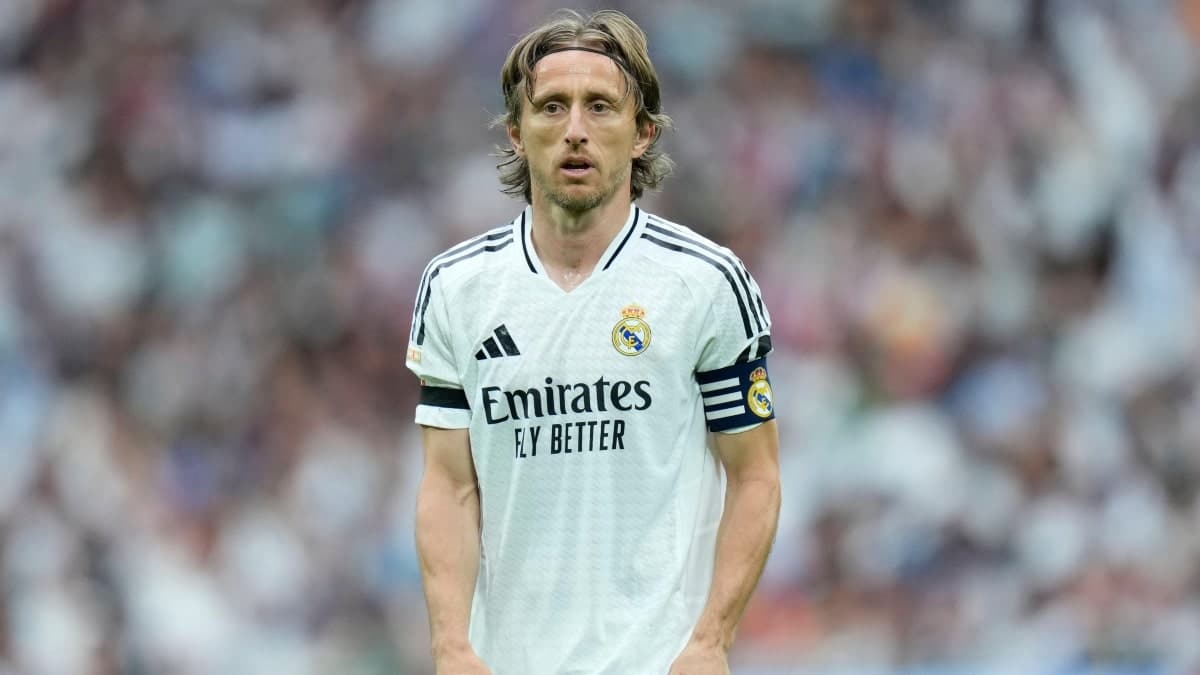
The air crackles with a familiar tension, not just on the pitch, but around the legend whose very name evokes midfield mastery. Luka Modric, the eternal architect, stands at a pivotal crossroads, his future shrouded in a captivating blend of speculation and profound respect. As Croatia gears up for what promises to be an emotionally charged World Cup campaign in North America, the footballing world holds its breath, wondering if this global spectacle will mark the swansong of a generational talent whose relentless pursuit of excellence has defied time itself.
His recent chapter with AC Milan, a bold Italian adventure, ended not with the triumphant crescendo he envisioned, but with a frustrating stumble. The Rossoneri’s Champions League dreams crumbled into dust after a deflating defeat by Cagliari at the iconic San Siro, leaving a bitter taste in the mouths of both players and fans. For Modric, it was an unfamiliar sensation of missing out on the game’s elite club competition, a stark contrast to his storied dominance with Real Madrid.
Despite the bittersweet conclusion, Modric’s debut season in Italy was anything but uneventful. The midfield maestro made 35 appearances across all competitions, a testament to his enduring fitness and crucial role. He notched two goals and laid on three assists, tangible contributions that, for much of the campaign, kept Milan firmly in the hunt for a coveted top-four finish. His arrival injected a new dimension of control and vision into Stefano Pioli’s side, transforming their build-up play and adding a layer of big-game experience that money simply can’t buy.
However, fate, often a cruel mistress, intervened with devastating timing. A fractured cheekbone suffered in a bruising encounter against Juventus last month abruptly sidelined the Croatian general. His absence, felt immediately and acutely, coincided with Milan’s precipitous dip in form. The tactical cohesion unraveled, the midfield lost its orchestrator, and the team’s momentum dissipated, ultimately seeing them slide out of the Champions League berths and into the Europa League. It was a stark, almost painful, illustration of Modric’s invaluable, almost irreplaceable, influence.
Yet, even amidst the disappointing team finish, Luka Modric quickly transcended mere performance statistics. His magnetic personality, coupled with an unwavering commitment to his craft and an exemplary level of professionalism, endeared him almost instantly to the passionate Milan faithful. He became a beacon of resilience, a respected elder statesman who led by example, earning a deep admiration that stretched far beyond the confines of the pitch. He didn’t just play for Milan; he embodied the spirit of a true champion, regardless of the outcome.
In a gesture that perfectly encapsulated his class and humility, the former Real Madrid luminary also donated his prized 2018 Ballon d’Or – a symbol of his individual pinnacle in football – to AC Milan, allowing the club to proudly display the prestigious award in its museum. It was a powerful statement, an acknowledgment of his new club and a gift to its rich history, further cementing his place in the hearts of the Rossoneri supporters.
World Cup: Modric’s Final Bow?
The clock ticks relentlessly for even the greatest. Modric, who will celebrate his 41st birthday in September, has frequently expressed his profound desire to continue representing his beloved Croatia. All indications point to him being a central figure at the upcoming World Cup in North America, kicking off on June 11th. For many, this tournament feels like an inevitable, glorious, and perhaps final, chapter in his international career – a chance for one last dance on football’s grandest stage, a last opportunity to lead his nation to glory, much like he did in 2018.
Beyond the intoxicating spectacle of the World Cup, however, his long-term future remains shrouded in tantalizing uncertainty. The whispers from the Spanish capital suggest a deeply respectful and enduring bond. Real Madrid, the club where he carved an indelible legacy, is reportedly more than open to welcoming him back into the fold in a non-playing capacity whenever he decides to hang up his boots. This isn’t just a job offer; it’s a testament to the immense respect and gratitude the club holds for one of its most decorated sons.
Club president Florentino Perez, a man known for his astute management and deep appreciation for club legends, reportedly assured Modric during his emotional farewell ceremony last year that the doors of the Bernabéu would always remain open. Modric spent an astonishing 13 seasons at Madrid, a period that saw him accumulate an incredible six Champions League titles, etching his name into the very fabric of the club’s illustrious history. He isn’t just a former player; he’s an institution, a symbol of an era of unprecedented success.
He remains a hugely respected figure throughout the Spanish capital, his name spoken with reverence by teammates, staff, and fans alike. The links with potential future roles within the club’s sporting structure – perhaps as a mentor, a scout, or even a pathway into coaching – are not mere speculation but a logical progression for a player whose footballing intelligence is as profound as his on-field artistry. The question isn’t if he’ll return to Madrid, but when, and in what capacity, marking another fascinating chapter in an already legendary career.
Game Highlights: The Maestro’s Influence
While Modric’s Milan tenure ultimately fell short of collective glory, his individual moments of brilliance and leadership were undeniable. He wasn’t just a passenger; he was often the engine, the conductor, the steady hand guiding the Rossoneri through choppy waters. Here are a few illustrative highlights of his impact, demonstrating why his absence was so acutely felt:
- Early Season Orchestration vs. Napoli (3-1 Win):In a crucial early-season clash against a formidable Napoli side, Modric put on a clinic. Operating from deep, he dictated the tempo with surgical precision, his signature outside-of-the-boot passes unlocking spaces that didn’t seem to exist. He provided a sublime assist, a weighted through-ball that split the defense for Rafael Leão to slot home, showcasing his enduring vision and ability to turn defense into attack with a single touch. It was a performance that announced his arrival and set the tone for Milan’s early title aspirations.
- The Crucial Equalizer vs. Atalanta (2-2 Draw):Facing a resilient Atalanta side, Milan found themselves trailing. With time running out, Modric stepped up. Receiving the ball on the edge of the box, he expertly feigned a pass, creating a sliver of space, before unleashing a powerful, curling shot that nestled into the top corner. It was a goal born of pure individual quality and a refusal to yield, earning Milan a vital point and demonstrating that even at 40, he still possessed the magic touch to alter the course of a game.
- Midfield Generalship vs. Juventus (1-0 Loss before Injury):Though the match ended in defeat and his unfortunate injury, Modric’s performance against Juventus was a masterclass in controlled aggression and tactical intelligence. Before the fateful collision, he was the dominant force in midfield, winning crucial duels, breaking up play, and initiating dangerous counter-attacks. He shielded the defense, pressed relentlessly, and provided the steel and composure necessary in such a high-stakes encounter. His early departure fundamentally altered Milan’s ability to compete in the midfield battle, directly contributing to their eventual capitulation.
The Final Verdict: A Prediction
Luka Modric is not just a footballer; he is a force of nature, a testament to enduring passion and unparalleled skill. His age is a mere number, overshadowed by the incandescent flame of his talent. While his AC Milan chapter closed with a whimper rather than a bang, it offered further proof of his undiminished quality and leadership. The World Cup represents an opportunity for a glorious redemption, a chance to etch one final, unforgettable memory into the annals of football history with his beloved Croatia.
Prediction:Modric will undoubtedly lead Croatia with distinction at the World Cup, delivering several vintage performances that defy his age. However, the physical toll of a long season, coupled with the intensity of international football, will likely convince him that the North American tournament is indeed his swansong for the national team. While he may be tempted by one last season as a player, perhaps in a less demanding league, the allure of Real Madrid is simply too strong to resist. I predict that after a dignified international retirement post-World Cup, Luka Modric will accept a non-playing role at Real Madrid by the end of the year, bringing his illustrious playing career to a graceful close and beginning a new chapter at the club he calls home, transitioning his legendary footballing brain into the sporting structure of the Bernabéu. The maestro will take his bow, but the symphony will continue.