
Key Takeaways:
- Massive GPU Expansion:Amazon Web Services (AWS) will integrate an additional 2 million Nvidia GPUs, including next-generation Blackwell Ultra, Rubin, and Rubin Ultra chips, by 2027-2028, significantly expanding its AI compute capacity.
- Beyond Silicon:The partnership extends far beyond just chips, encompassing Nvidia’s networking hardware, open models, CPUs (like Vera), data processing software, and its comprehensive robotics platform, integrating deeply across AWS infrastructure and Amazon’s operations.
- Strategic Paradox:This deepening alliance with Nvidia occurs even as Amazon heavily invests in developing its own custom AI chips (Trainium, Graviton), highlighting Nvidia’s continued market dominance in high-end AI despite AWS’s efforts to diversify its silicon supply.
Amazon and Nvidia Forge Deeper AI Alliance with Multi-Billion Dollar GPU Deal
In a move underscoring the relentless demand for artificial intelligence infrastructure, Amazon and Nvidia announced a dramatic expansion of their partnership on Wednesday. This includes a landmark deal to deploy an additional 2 million Nvidia GPU chips into Amazon’s vast data centers, a commitment estimated to be worth tens of billions of dollars given current unit costs.
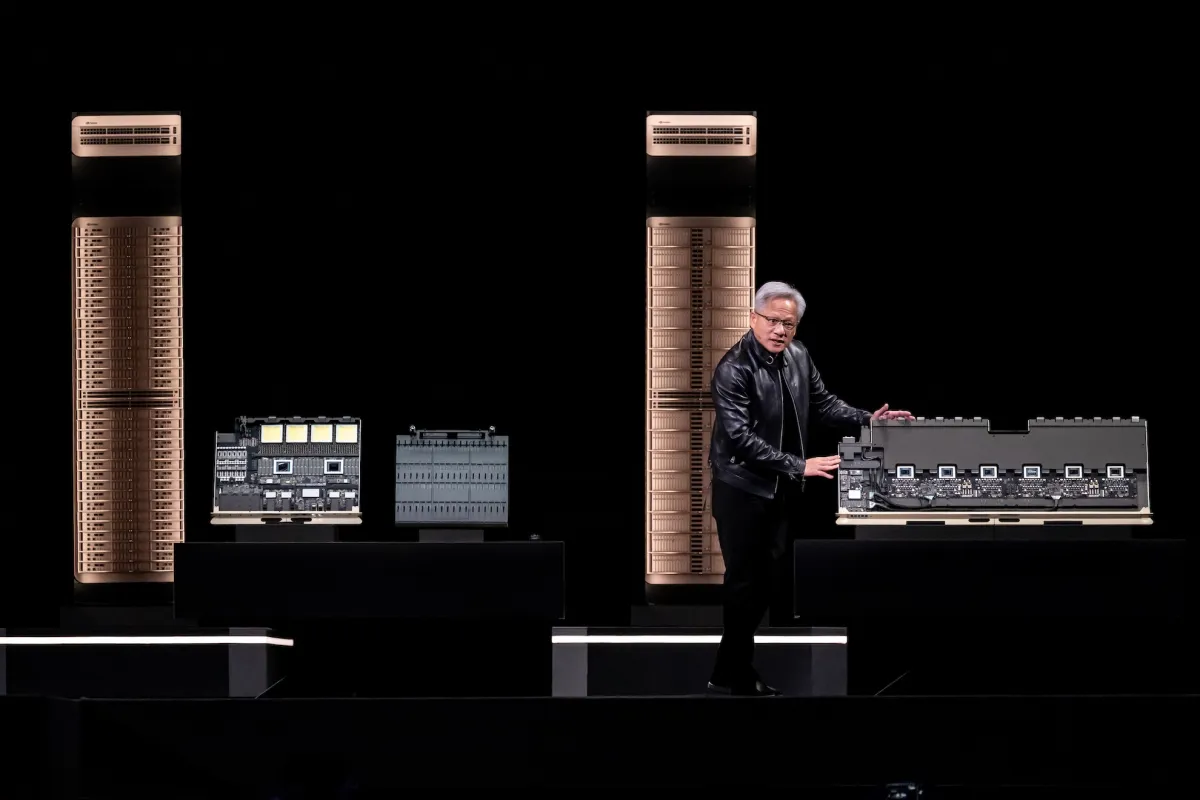
These aren’t just any chips; they are Nvidia’s most advanced GPUs, specifically designed to tackle the immense computational demands of training and running sophisticated AI models. The infusion will include future-generation powerhouses like Nvidia Blackwell Ultra, Rubin, and Rubin Ultra GPUs, slated for integration into Amazon Web Services (AWS) data centers between 2027 and 2028. This announcement, made during Nvidia’s quarterly earnings call, follows closely on the heels of a previous agreement just five months prior, where Amazon committed to deploying over 1 million Nvidia GPUs starting this year. The rapid escalation, according to Nvidia, is a direct response to “demand [that] has exceeded those expectations.”
A Partnership That Transcends Silicon
The significance of this expanded alliance stretches far beyond merely purchasing more chips. Nvidia revealed that its comprehensive technology stack—including the crucial networking hardware that links thousands of GPUs into cohesive, supercomputing systems, as well as its open models, CPUs, data processing software, and its sophisticated robotics platform—will be seamlessly integrated across AWS. This holistic integration points to a strategic deepening of ties, positioning Nvidia not just as a hardware vendor, but as a foundational technology partner for Amazon’s entire AI ecosystem.
Both companies attribute this intensified collaboration to “surging demand” originating from a diverse clientele. Startups pushing the boundaries of AI, large enterprises seeking competitive advantages, cutting-edge AI labs, and even governments are all clamoring for advanced AI compute, driving this unprecedented investment in infrastructure. This demand signals a maturing market where AI is moving from experimental phases to critical, revenue-generating applications.
Amazon’s Dual AI Strategy: Build and Buy
This deepening reliance on Nvidia presents an intriguing dynamic, particularly as Amazon has been aggressively ramping up its own efforts in developing custom AI chips. AWS has made significant strides with its proprietary silicon, including the Arm-based Graviton CPU, which challenges traditional server processors from Intel and AMD, and its Trainium chips. Trainium is a direct competitor to Nvidia’s H100 and forthcoming Blackwell chips, specifically optimized for deep learning workloads.
Amazon’s motivation for investing in its own chips is clear: to reduce dependence on external vendors, gain greater control over its infrastructure, and potentially offer more cost-effective solutions to its cloud customers. Indeed, Amazon’s AI chief Peter DeSantis has openly discussed selling Trainium chips to other companies for data center use. The success of Amazon’s custom chip business is evident, having recently crossed a $25 billion annualized revenue run rate, bolstered by an impressive $225 billion in total commitments from leading AI labs such as Anthropic and OpenAI.
However, despite these formidable internal advancements, the latest Nvidia deal unmistakably reinforces Nvidia’s current status as the undisputed leader in high-performance AI silicon. For the most demanding, cutting-edge AI workloads, Nvidia’s architecture remains the preferred choice, even for a cloud giant with its own chip ambitions.
Nvidia’s Expanding Dominance: The Rise of Vera CPUs
Beyond the 2 million GPUs, the expanded partnership will also see Nvidia sending an unspecified number of its Vera CPUs to AWS. These Vera CPUs, some integrated with Rubin GPUs and others deployed standalone, signify Nvidia’s broader strategy to capture a larger share of the data center market beyond just GPUs. Nvidia CEO Jensen Huang previously boasted about a “brand new $200 billion TAM” (Total Addressable Market) for the company through its Vera CPUs, signaling ambitious plans for this product line.
Nvidia CFO Colette Kress affirmed that Vera is not just for AWS. The company anticipates Vera will be deployed by “every major hyperscaler, neocloud, AI lab, and system OEM,” with shipments already underway to early adopters like Oracle and SpaceXAI. This indicates a concerted effort by Nvidia to establish Vera as a general-purpose processor complementing its GPU dominance, further solidifying its position across the AI computing stack.
AI Beyond the Cloud: Robotics and Enterprise Integration
The collaboration also extends into Amazon’s physical operations and enterprise offerings, highlighting the pervasive influence of AI. Amazon plans to adopt Nvidia’s complete physical AI stack to power its burgeoning fleet of warehouse robots. This includes Omniverse, Nvidia’s platform for simulation and digital twins; Cosmos, its world model platform; Isaac, its robotics development platform; and Jetson, its computing hardware tailored for robots and edge AI. Nvidia recently unveiled a new version of Jetson, designed to make advanced robotics computing more accessible for “entry-level edge AI” applications.
On the enterprise side, AWS will host Nvidia’s Nemotron family of open models on Amazon Bedrock, its managed foundation model platform, and SageMaker, its managed cloud service for machine learning. This integration provides AWS customers with broader access to Nvidia’s AI models, demonstrating a commitment to fostering an open and diverse AI ecosystem within the AWS environment.
Nvidia’s Financial Juggernaut and the “Profitable Tokens” Era
The announcement coincided with Nvidia’s staggering Q2 earnings report, showcasing its financial might in the AI era. The company recorded sales of $96.2 billion for the second quarter, comfortably surpassing analyst estimates. Data center revenue was the primary driver, accounting for $89 billion of total sales—an astounding 117% increase from a year ago. Looking ahead, Nvidia projects revenue to reach $108 billion in the third quarter, with contributions expected from its next-generation Rubin GPUs, which began production shipments this quarter.
To meet the insatiable demand for AI, Nvidia has made colossal commitments to secure supply and manufacturing capacity. Its projected spending for current and future data center projects has swelled to an unprecedented $279 billion, a substantial leap from $119 billion just last quarter. This includes an estimated $92 billion for the remainder of the current fiscal year and an additional $87 billion earmarked for fiscal year 2028.
Nvidia CEO Jensen Huang captured the essence of the current AI boom during the earnings call, stating, “The thing that matters for the industry is that AI is now doing productive and useful work. AI is generating profitable tokens… If we had more compute, we could generate more profitable tokens, which results in more profit for all of the services. This is the exact phase where we’re at, which is the reason why everybody’s leaning in.” This philosophy underscores the industry’s belief that increased compute power directly translates into greater value and profitability, fueling the massive investments seen across the sector.
Bottom Line
The expanded, multi-billion-dollar partnership between Amazon and Nvidia isn’t just a testament to the exploding demand for AI compute; it’s a strategic maneuver that highlights the complex, often paradoxical, nature of the modern tech landscape. While Amazon vigorously builds its own AI chips to diversify and control its infrastructure, it simultaneously makes a colossal bet on Nvidia, solidifying the latter’s indispensable role in delivering cutting-edge AI capabilities today and for the foreseeable future. This alliance signals that even the largest tech giants cannot solely rely on internal innovation to meet the unprecedented demands of the AI revolution, making Nvidia’s full-stack dominance a crucial enabler for the entire industry. The core question now is how neatly this massive investment in compute will translate into the “profitable tokens” Jensen Huang envisions, as companies pour hundreds of billions into an infrastructure race with no clear finish line.
When you purchase through links in our articles, we may earn a small commission. This doesn’t affect our editorial independence.
{content}
Source:{feed_title}