
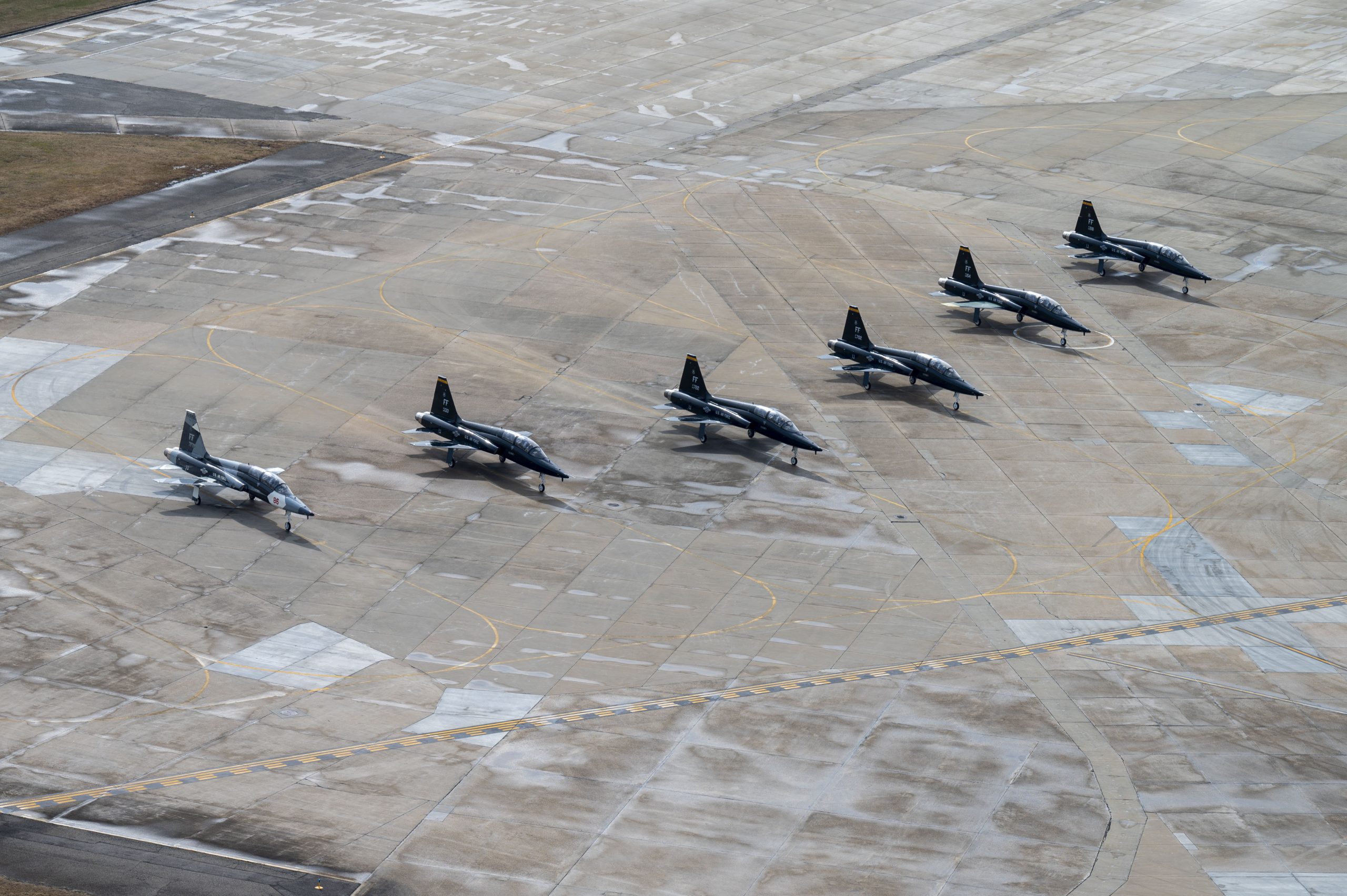
The United States Air Force has initiated the process of returning its T-38 Talon trainer jet fleet to operational service, with the first aircraft anticipated to resume flights within days. This follows a comprehensive, fleet-wide operational pause enacted after a T-38 crash in Alabama on May 12.
The grounding of the entire T-38 fleet was formally announced on May 19. The incident prompting this measure involved a routine training mission, during which both pilots aboard the T-38 successfully ejected and sustained no serious injuries. In the immediate aftermath, the Air Force described the grounding as an “operational pause” implemented “out of an abundance of caution.” This temporary measure aimed to allow for thorough inspections and any necessary maintenance across the fleet before resuming flight operations.
The scope of the operational pause was extensive, impacting T-38 aircraft assigned to various major commands across the Air Force. These included Air Education and Training Command (AETC), which is responsible for pilot training; Air Combat Command (ACC), which deploys combat aircraft; Air Force Materiel Command (AFMC), tasked with development, acquisition, and sustainment; and Air Force Global Strike Command (AFGSC), which oversees the nation’s nuclear deterrent and long-range strike assets. The wide-reaching nature of the grounding underscored the Air Force’s commitment to safety and its methodical approach to mitigating potential systemic risks following an incident.
On May 29, the Air Force released a statement confirming that the operational pause had been officially lifted a day earlier, on May 28. This decision came after engineering and maintenance teams across the service successfully established and implemented a detailed inspection process. This process is designed to ensure a safe and thorough return to flight status for all T-38 aircraft. The statement indicated that the service was making significant progress, with inspected aircraft expected to begin returning to flying status within a matter of days.
During the period of the flight pause, affected commands took proactive steps to minimize negative impacts on critical operations, ongoing training schedules, and overall readiness levels. A key mitigation strategy involved maximizing the use of flight simulators to allow pilots to maintain proficiency and currency requirements. This approach helped to bridge the gap created by the absence of live flight hours, ensuring that essential training pathways continued without complete disruption.
As of the most recent updates, the specific issues or components that the Air Force’s inspection processes are targeting have not been publicly disclosed. The safety inspection board investigating the May 12 crash remains ongoing, and a definitive cause for the incident has yet to be determined. Investigations of this nature are typically complex and thorough, often involving detailed analysis of flight data recorders, aircraft components, maintenance records, and witness accounts.
The Northrop T-38 Talon has served as a cornerstone of U.S. Air Force pilot training for approximately six decades. First introduced in the early 1960s, this two-seat, twin-engine supersonic jet has been instrumental in preparing generations of pilots for various combat aircraft. Currently, around 475 T-38 Talons remain in active service, a testament to its enduring design and utility.
However, the advanced age of the T-38 fleet presents significant challenges. The aircraft is increasingly difficult and costly to maintain, with parts sometimes scarce or requiring custom fabrication. Furthermore, the T-38 was originally designed to train pilots for third-generation fighter jets, many of which are no longer in service. Its capabilities are inherently limited in preparing pilots for the complexities of modern fifth-generation aircraft, such as the F-22 Raptor and F-35 Joint Strike Fighter. These advanced platforms feature highly integrated avionics, sensor fusion, stealth capabilities, and sophisticated weapon systems that the T-38 cannot adequately simulate.
Recognizing these limitations and the escalating costs associated with maintaining an aging fleet, the Air Force has embarked on a crucial modernization effort. It is in the process of acquiring a new fleet of advanced trainer jets: the Boeing-made T-7 Red Hawk. The T-7 is designed to offer a more realistic and comprehensive training environment, better preparing future pilots for the demands of contemporary and future air combat. Its introduction marks a significant step in updating the Air Force’s pilot training pipeline to align with 21st-century warfare requirements.
Why This Matters
The grounding and subsequent return to flight of the T-38 Talon fleet underscore several critical aspects of military operations and national security. Firstly, it highlights the paramount importance of safety within the U.S. Air Force. An “operational pause” is a serious measure, reflecting a commitment to thoroughly investigate incidents and prevent potential widespread issues, even at the cost of temporary operational disruptions. This meticulous approach ensures the well-being of personnel and the integrity of military assets.
Secondly, the incident and the ongoing transition to the T-7 Red Hawk illuminate the broader challenges of maintaining military readiness with aging equipment. The T-38’s six-decade service life, while impressive, showcases the increasing difficulty and expense of sustaining older platforms. As the Air Force faces peer and near-peer adversaries equipped with advanced technology, its pilot training pipeline must evolve to meet these new threats. Delays or inefficiencies in training due to outdated equipment can directly impact the readiness and capabilities of future combat aircrews.
Finally, this situation directly affects the U.S. Air Force’s ability to produce highly skilled pilots, a cornerstone of its air superiority doctrine. Any disruption, even temporary, in the training pipeline can have long-term consequences for pilot recruitment, retention, and the overall strength of the force. The successful and timely integration of the T-7 Red Hawk is therefore not merely an acquisition program but a strategic imperative, vital for ensuring the U.S. maintains its qualitative edge in air power and continues to deter potential adversaries effectively. The smooth resumption of T-38 flights, even as investigations continue, is a critical step in mitigating immediate impacts while the larger modernization effort proceeds.