
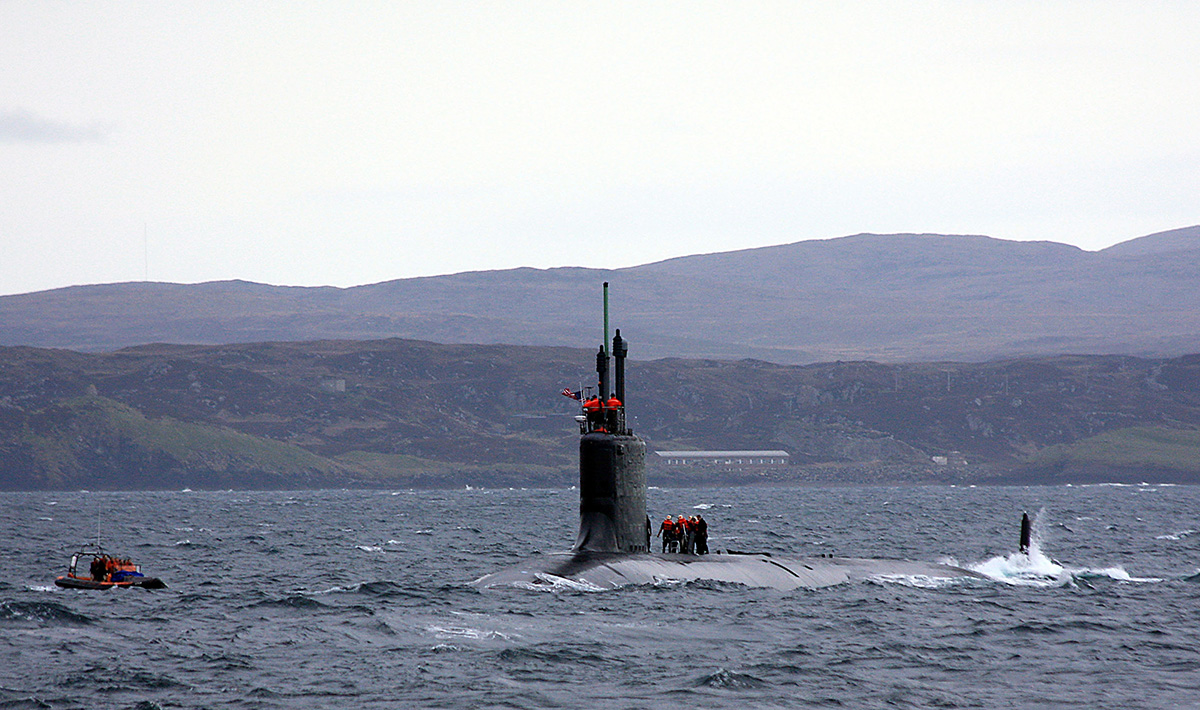
AUKUS Partners Streamline Australia’s Virginia-Class Submarine Acquisition Plan
The AUKUS security pact partners have announced a significant streamlining of Australia’s planned acquisition of US-built Virginia-class submarines under Pillar 1 of the agreement. Australia is now set to receive three in-service Virginia-class submarines (VCS) from the United States, rather than the previously envisaged mixture of new and existing variants, according to information understood by the UK Defence Journal.
This pivotal change was officially confirmed in a joint statement issued on May 30, following a high-level meeting in Singapore. The statement came from Australian Deputy Prime Minister Richard Marles, US Secretary of War Pete Hegseth, and UK Defence Secretary John Healey, who convened at the US Embassy in the city-state to discuss the ongoing implementation of the AUKUS agreement.
In their joint declaration, the ministers expressed their approval for this revised approach, highlighting its potential to simplify various critical aspects of the submarine program. They noted that the updated plan would streamline supply chain management, reduce complexities in operational and maintenance requirements, and maximize overall cost efficiencies for the Royal Australian Navy (RAN). The statement explicitly confirmed that “this approach would enable Australia to acquire three in-service VCS in lieu of a mixture of new and in-service VCS variants.” This shift represents a move towards greater standardization in Australia’s initial nuclear-powered submarine fleet.
The original framework for Pillar 1, formally agreed upon in March 2023, outlined a plan for the United States to sell Australia an initial three Virginia-class submarines starting in the early 2030s, with an option for an additional two boats if required. Under that earlier plan, the initial transfers were expected to comprise a blend of existing US Navy boats and newly produced submarines from US shipyards. The recent Singapore statement effectively removes this mixed-variant element, establishing a more uniform arrangement that exclusively utilizes submarines already in active service with the US Navy. This strategic adjustment is primarily intended to reduce the operational and logistical complexity for the Royal Australian Navy as it embarks on the unprecedented task of establishing its sovereign nuclear-powered submarine capability. Furthermore, it is expected to alleviate some of the significant pressure currently faced by US shipyards, which have been grappling with challenges in meeting existing Virginia-class production rates amidst growing demand.
Beyond the immediate submarine acquisition, the ministers also confirmed the finalization of crucial arrangements for the establishment of Submarine Rotational Force-West (SRF-West) at HMAS Stirling in Western Australia. This forward operating base is slated to become operational in 2027. In support of this initiative, the United States has officially authorized the establishment of US Navy support elements for SRF-West and is preparing to begin rotating the first US Navy personnel to HMAS Stirling later this year, marking a tangible step in the operationalization of the pact. The United Kingdom, for its part, reaffirmed its steadfast commitment to a rotational presence in the region and specifically highlighted the successful Submarine Maintenance Period recently conducted earlier this year by HMS Anson, a Royal Navy Astute-class submarine, demonstrating practical interoperability and support capabilities.
Addressing the longer-term vision of the AUKUS program, the joint statement indicated significant progress in the design and delivery of SSN-AUKUS, the next-generation attack submarine that will be jointly operated by both the United Kingdom and Australia. The development and eventual delivery of these advanced submarines are underpinned by substantial financial commitments from both nations, including a significant £6 billion committed by the UK by 2025. Current projections anticipate that the first UK-built SSN-AUKUS boats will enter service in the late 2030s, with the first Australian-built boats following approximately a decade later, in the early 2040s, underscoring the long-term, multi-generational nature of the defence partnership.
The ministers also acknowledged Australia’s substantial planned investments aimed at bolstering its naval infrastructure. These include an allocation of up to A$8 billion specifically for SRF-West, earmarked for essential infrastructure development and logistics support at HMAS Stirling. Additionally, initial down payments have been made for a new Submarine Construction Yard in South Australia, totaling A$3.9 billion, which will be crucial for domestic submarine production. A further A$12 billion is designated for the Henderson Defence Precinct, intended to support contingency docking and provide essential depot-level maintenance capabilities, thereby enhancing Australia’s self-sufficiency in submarine sustainment.
In the realm of industrial collaboration and technology sharing, the statement confirmed support for the expansion of the AUKUS licence-free environment among the three partners. This expansion will involve taking expeditious and practical steps to narrow the list of excluded technologies, facilitating smoother and faster technology transfer and cooperation. The ministers also reaffirmed the recognized value and importance of the Advanced Capabilities Industry Forum, a platform designed to foster greater collaboration and innovation across the defence industrial bases of the three nations.
This latest announcement from Singapore marks the most substantive operational refinement of Pillar 1 since the Trump administration completed a comprehensive review of the AUKUS program in late 2025, publicly affirming its strong support for the initiative. The continuous adaptation and refinement of the AUKUS agreement demonstrate the partners’ commitment to its long-term success and strategic objectives.
Why This Matters
The AUKUS agreement, and specifically these recent refinements, represent a significant geopolitical and strategic development with far-reaching implications. For Australia, the acquisition of nuclear-powered submarines marks a profound shift in its defence capabilities. These submarines offer unparalleled stealth, endurance, and strike capabilities compared to conventional submarines, fundamentally altering Australia’s naval power projection in the Indo-Pacific region. Receiving three in-service Virginia-class submarines simplifies the initial standing up of this capability, reducing the immediate technical, training, and logistical hurdles associated with operating a mixed fleet or waiting for brand-new, potentially delayed boats. This accelerates Australia’s path to becoming a nuclear-powered submarine operator, enhancing its deterrence posture sooner.
For the United States, the streamlined transfer of in-service submarines helps manage the immense strain on its own shipbuilding industry, which is already struggling to meet domestic demand for new vessels and maintenance backlogs. By providing existing assets, the US can fulfill its AUKUS commitments without further exacerbating its industrial capacity challenges, while still strengthening a key ally. This move underscores the US commitment to burden-sharing and alliance reinforcement in a critical strategic theatre.
The United Kingdom’s continued commitment to rotational presence and joint development of the SSN-AUKUS highlights its enduring engagement in the Indo-Pacific, demonstrating a broader global security perspective beyond its traditional European focus. The collaborative design and future production of the SSN-AUKUS represent an unprecedented level of technological and industrial integration among the three nations, fostering a shared defence industrial base and ensuring interoperability for decades to come.
Economically, the vast investments planned by Australia—up to A$8 billion for SRF-West, A$3.9 billion for a new submarine construction yard, and A$12 billion for the Henderson Defence Precinct—underscore the long-term commitment and the scale of the industrial transformation required. These investments are set to create thousands of jobs, develop advanced manufacturing capabilities, and foster a highly skilled workforce in Australia, positioning the nation as a key player in advanced defence technology. The expansion of a “licence-free environment” and the Advanced Capabilities Industry Forum further facilitate technology transfer and industrial collaboration, fostering innovation and resilience across the defence sectors of all three partners.
Strategically, AUKUS is widely viewed as a crucial response to the evolving security landscape in the Indo-Pacific, particularly concerning the rise of China’s military power. By enhancing Australia’s naval capabilities and strengthening interoperability among these key allies, the pact aims to contribute to regional stability and maintain a balance of power. The adaptability shown through these operational refinements indicates the partners’ commitment to making AUKUS a flexible and effective long-term security framework, capable of responding to future challenges and ensuring a robust collective defence posture.