
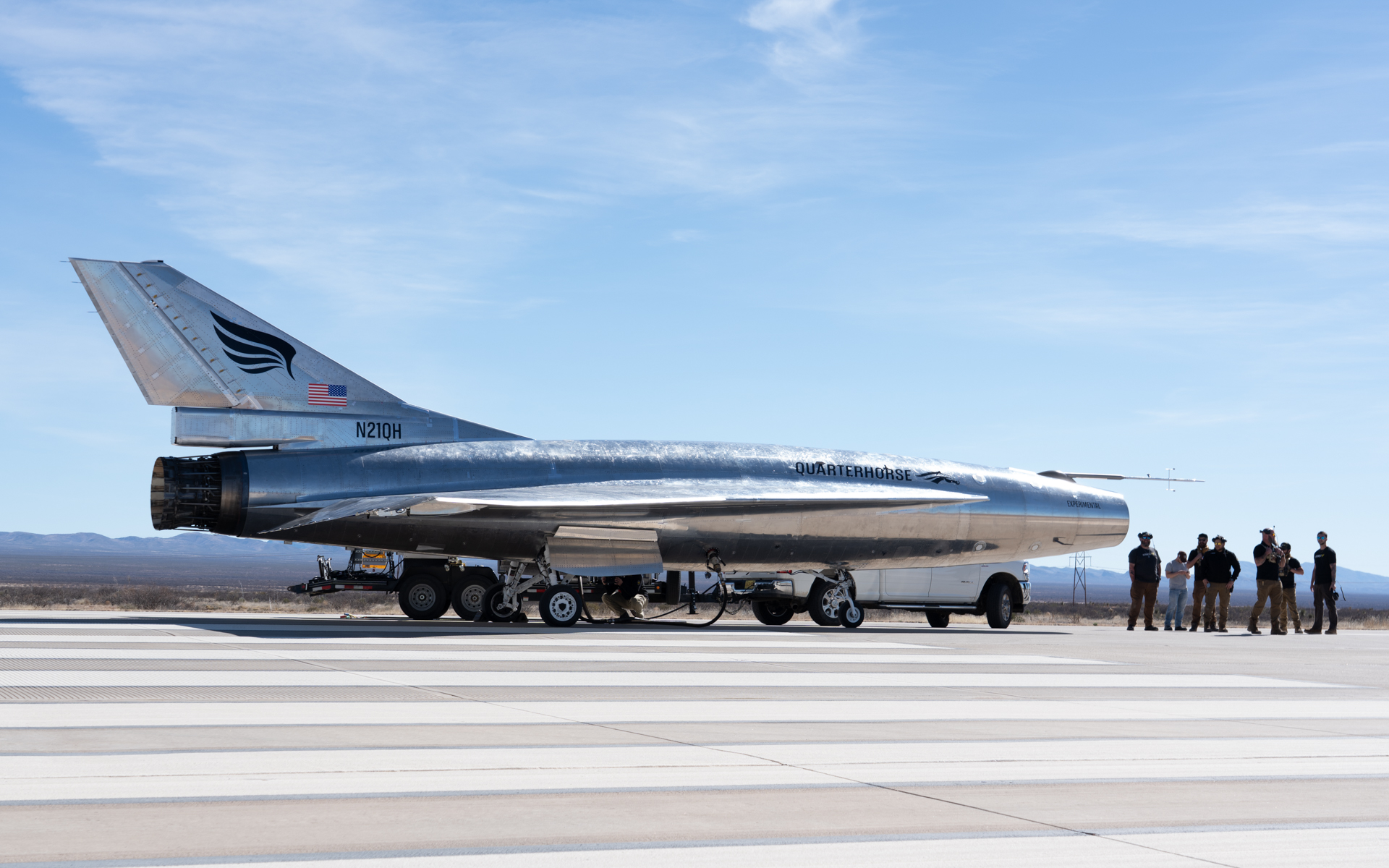
Hermeus, a venture capital-backed aerospace startup, announced on May 28 that its Quarterhorse unmanned aircraft will undertake a series of flight tests in collaboration with the Defense Innovation Unit (DIU) over the next few years. This initiative, backed by a $159 million contract, aims to gather crucial flight data from the Quarterhorse’s upcoming operations, which will then be shared with the DIU, the U.S. Air Force, and the U.S. Navy. The data is intended to inform and shape future designs and operational concepts for high-speed military aircraft.
The announcement follows a significant milestone achieved earlier this month, when the Quarterhorse Mk 2.1 prototype reached a top speed of Mach 1.21. Hermeus President and incoming CEO Zachary Shore indicated that the company is actively working to expand the aircraft’s flight envelope, with an ambitious target of achieving Mach 3 speeds by 2027.
“This truly launches us into the envelope expansion phase for these three vehicles, allowing us to reach higher-speed conditions and demonstrate stable, reusable, high-Mach unmanned aircraft,” Shore explained to Air & Space Forces Magazine. He emphasized the strategic importance of these technical milestones, stating that successfully demonstrating the platform’s viability will unlock its potential as a strategically impactful technology for the DIU team and the broader defense community.
Hermeus was established in 2018 with a clear strategy: to develop hypersonic aircraft for both military and commercial applications. The company employs a rapid, iterative prototyping approach to accelerate its research and development. The first Quarterhorse prototype, designated Mk 1, made its debut in 2025 with a flight at Edwards Air Force Base in California. Its successor, the Mk 2.1, performed its inaugural flight in March of this year. Later that same month, the Mk 2.1 achieved a notable first, becoming the first privately funded unmanned aircraft to attain supersonic speeds, reaching Mach 1.21 during a flight over White Sands Missile Range in New Mexico.
For clarity, supersonic refers to any speed exceeding the speed of sound, which is Mach 1. Hypersonic, a distinct and more challenging category, describes speeds at Mach 5 and above.
The U.S. Department of Defense (DOD) has provided foundational funding to support Hermeus’s hypersonic ambitions. In 2020, AFWERX, the Air Force’s innovation arm, awarded Hermeus a $1.5 million contract to explore options for a future hypersonic Presidential Airlift Fleet. This was followed by a substantial $60 million follow-on contract from AFWERX in 2021, underscoring the Air Force’s continued interest in Hermeus’s capabilities.
Further demonstrating government confidence, in 2023, the DIU selected Quarterhorse for its Hypersonic and High-Cadence Airborne Testing Capabilities (HyCAT) program. The HyCAT program aims to integrate commercial technology into the challenging domain of hypersonic testing. Under this selection, Hermeus received $23 million to demonstrate key propulsion systems, advanced thermal management, power generation, and mission system capabilities. These technologies could potentially be integrated into future Pentagon programs or utilized to test existing efforts.
Shore acknowledged that it took Hermeus seven years to achieve its first aircraft flight, but he expressed optimism that recent test successes have positioned the company for rapid future progress. During the current phase of the HyCAT work, Hermeus plans to conduct a series of flights throughout this year and next, involving two additional prototypes. Shore anticipates that the next vehicle, Mk 2.2, will reach Mach 1.6 this summer, and the subsequent Mk 2.3 is projected to achieve Mach 3 in 2027.
While hypersonic flight remains the company’s long-term objective, Shore indicated that Hermeus is already engaged in preliminary discussions with the Air Force and Navy regarding potential applications for a supersonic Quarterhorse. Hermeus intends to offer this supersonic variant as a standalone product. Shore expressed hope that firm contracts could materialize once the Mach 3 milestone is reached, demonstrating the aircraft’s advanced capabilities.
The Quarterhorse is designed to be roughly the size of an unmanned F-16 fighter jet. It boasts 30,000 pounds of thrust, a payload capacity of up to 20,000 pounds, and 20 kilowatts of power. Shore suggested that these specifications make it suitable for a diverse range of missions. He highlighted its potential suitability for programs such as the Air Force’s Collaborative Combat Aircraft (CCA) initiative, or as an independent platform for strike or electronic attack operations. While refraining from specifying a precise cost, Shore affirmed that Quarterhorse is competitively priced and that its final cost could be adjusted based on its specific configuration and mission requirements.
Maj. Gen. Joseph Kunkel, the DIU’s military deputy and former deputy chief of staff for Air Force Futures, stated that a platform like Quarterhorse has the potential to address several critical challenges the Department of Defense anticipates facing in the future, particularly concerning factors like time and distance in military operations.
“If we can mass produce this, then it becomes a game-changing warfighting capability, where we use it as a weapon instead of a test platform,” Kunkel remarked in a statement. “And I think we found a significant number of use cases where it can be used as a weapon.”
Hermeus is also in discussions with various combatant commands about opportunities for the Quarterhorse to support DOD exercises and experimentation campaigns. Currently, the company faces some limitations in vehicle availability due to existing test commitments, but Shore expects to have a sufficient number of aircraft on hand by the end of next year to support these additional engagements.
The Pentagon has consistently identified the development of high-speed weapons and air vehicles as a major priority. Last year, “scaled hypersonics” was designated as one of its six critical technology imperatives. In addition to investing in large-scale weapons development programs, such as the Air Force’s Air-Launched Rapid Response Weapon (ARRW) and the Hypersonic Attack Cruise Missile (HACM), the department has also strategically invested in startups like Hermeus. These investments aim to mature key technologies that could either be leveraged for future defense programs or used to facilitate the testing of existing capabilities.
Despite years of targeted investment and significant focus, the DOD has yet to successfully field a operational hypersonic platform. This lack of progress has drawn concern from lawmakers, most recently articulated in the House Armed Services Committee’s draft of the fiscal year 2027 defense policy legislation.
“The committee notes that the Department of Defense has not yet completed transition of hypersonic weapon technologies from science and technology, prototyping, and middle-tier acquisition efforts into major acquisition capabilities,” the bill states. It further calls for the department to develop a comprehensive plan to transition hypersonic technologies into major acquisition programs and to deliver this strategy by March 2027. The Hermeus Quarterhorse program, therefore, represents a part of the broader effort to bridge this gap between advanced technological development and operational deployment.
Why This Matters
The Hermeus Quarterhorse program and its partnership with the Defense Innovation Unit are significant for several reasons, touching upon national security, technological innovation, economic impact, and the future of warfare.
Accelerating Defense Capabilities: The development of high-speed aircraft, particularly those capable of supersonic and eventually hypersonic flight, is a critical national security imperative for the United States. Such platforms offer unmatched advantages in areas like rapid global reach, surveillance, reconnaissance, strike capabilities, and contested environment access. In a strategic landscape where peer competitors are also investing heavily in similar technologies, maintaining a technological edge is paramount. The Quarterhorse, if successful, could provide the U.S. military with unprecedented speed and responsiveness, fundamentally altering strategic calculations.
Leveraging Private Sector Innovation: This program exemplifies the Pentagon’s strategy of tapping into private sector agility and innovation. Traditional defense acquisition often faces lengthy timelines and high costs. By investing in startups like Hermeus, which utilize rapid, iterative prototyping approaches, the DOD aims to accelerate the development and fielding of critical technologies. This model allows for faster experimentation and reduces the risk associated with committing to large-scale, long-term programs too early. It demonstrates a commitment to diversifying the defense industrial base and fostering a more dynamic ecosystem for technological advancement.
Bridging the Hypersonic Gap: Despite significant investment, the U.S. has struggled to transition hypersonic technologies from research and development into operational systems. Congressional concern over this “hypersonic gap” underscores the urgency. The Quarterhorse program, focused on demonstrating core propulsion, thermal management, and mission systems, is a direct effort to address this challenge. Even if Quarterhorse itself does not become a front-line weapon, its flight data and demonstrated capabilities could prove invaluable in informing and de-risking larger, more complex hypersonic programs, helping to bridge the gap between prototypes and fielded assets.
Dual-Use Technology Potential: Hermeus’s stated goal of developing hypersonic aircraft for both military and commercial customers highlights the potential for dual-use technology. Advancements in high-speed flight could revolutionize global travel, drastically reducing transit times for passengers and cargo. Military investments in this area could therefore have significant spillover benefits for the commercial aerospace sector, fostering economic growth and creating new industries. This dual-use potential makes the program attractive for broader public and private investment.
The Future of Warfare: Should the Quarterhorse or similar platforms become widely available and mass-producible, as Maj. Gen. Kunkel suggests, it could fundamentally reshape military strategy and operations. High-speed unmanned aircraft could serve as versatile assets for persistent surveillance, electronic warfare, or precision strike, operating in environments too dangerous for manned aircraft. Their speed could complicate adversary defense systems, offer quick reaction capabilities in rapidly evolving situations, and enable new concepts of networked, collaborative combat, such as those envisioned in the Collaborative Combat Aircraft (CCA) initiative. This program is therefore a forward-looking investment in the capabilities that will define future conflicts.