
Recent exchanges of attacks between the United States and Iran have raised concerns regarding the stability of a temporary halt to fighting, agreed upon earlier this month, which had aimed to de-escalate a broader regional conflict. These developments challenge hopes for a sustained period of peace or a swift return to pre-conflict conditions in the Middle East.
U.S. forces conducted airstrikes on Iranian targets overnight between Saturday and Sunday. The U.S. military stated these actions were taken in retaliation for Iran’s alleged firing upon commercial vessels traversing the Strait of Hormuz in the preceding days.
Hours following the U.S. strikes, the governments of Bahrain and Kuwait reported intercepting multiple incoming ballistic missiles and drones, which they attributed to Iran. Initial reports indicated no significant damage or casualties from these attacks.
The rapid succession of these hostile actions underscores the precariousness of the understandings that underpin the current cease-fire agreement between the United States and Iran, highlighting ambiguities and a lack of consensus on its terms.
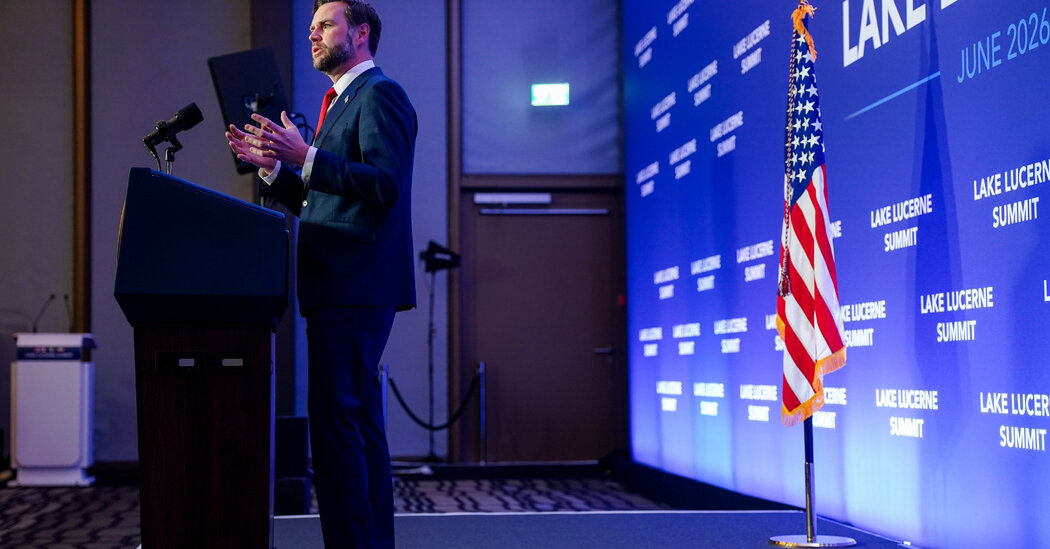
Concurrently, negotiations aimed at finalizing a comprehensive agreement to address Iran’s nuclear program remain at an impasse. A recent round of talks in Switzerland earlier this month, involving U.S. Vice President JD Vance and Iranian leaders, concluded without discernible progress.
Recent Escalations Between the U.S. and Iran
President Trump previously characterized the truce signed with Iran approximately two weeks ago as a pathway to peace and security across the region. This agreement, a memorandum of understanding (MOU) signed on June 15, was intended to impose a 60-day halt to fighting between the United States and Iran within the broader regional conflict that commenced in late February. Its provisions deferred resolution of complex issues, such as Iran’s nuclear activities, to subsequent negotiations planned over a two-month period.
The primary objective of the June 15 agreement was to establish the cease-fire itself. Furthermore, the Trump administration expressed an expectation that the agreement would lead to the cessation of Iran’s disruption of maritime traffic in the Strait of Hormuz, a critical international waterway for oil and gas shipments.
Iran had initiated a blockade of the Strait of Hormuz following joint airstrikes by the United States and Israel against Iranian targets in late February, marking the start of the current conflict.
On Thursday, Iran reportedly fired upon the commercial container ship *Ever Lovely* while it was transiting the Strait of Hormuz, near the Omani coastline. This incident occurred hours after Iran issued warnings to ships, advising them that passage was permitted solely through Iranian territorial waters within the Strait; many vessels had previously utilized an alternative route through Omani waters.
American forces responded with a series of retaliatory strikes on Friday. Subsequently, on Saturday, a Panamanian-flagged vessel, the *Kiku*, was reportedly struck by drones, as were targets in Bahrain, a U.S. ally. Multiple sources and analysts attributed these attacks to Iran.
Iranian officials have neither confirmed nor denied responsibility for the attacks on either commercial vessel. During the preceding phase of the conflict, Iran frequently launched attacks targeting Gulf Arab nations, asserting that these actions were directed at U.S. military installations or other American assets located within their territories.
Sunday witnessed a further escalation of hostilities. U.S. forces carried out additional airstrikes against Iranian military installations, citing the attack on the *Kiku* as justification. Later that day, Iran announced it had fired upon U.S. military bases situated in Kuwait and Bahrain. Reports from these incidents indicated no major casualties or significant damage.
The Status of the Strait of Hormuz
A key objective for the Trump administration in negotiating the June 15 agreement with Iran was the reopening of the Strait of Hormuz to unrestricted commercial traffic, with the aim of mitigating surging energy prices caused by the conflict. In the days immediately preceding the most recent wave of attacks, the strait had experienced a noticeable increase in maritime activity, including the transit of numerous vessels carrying Iranian oil.
However, the memorandum of understanding signed by the Trump administration and Iran did not definitively resolve the long-term status or administration of the strait, leaving its future open to further negotiation.
According to the terms of the MOU, Iran committed to providing “safe passage of commercial vessels with no charge for 60 days only.” Beyond this initial period, the agreement stipulated that Iran would “conduct dialogue” with Oman concerning “future administration and maritime services” within the strait.
President Trump has publicly stated his assertion that the strait would become “permanently toll-free.” In contrast, Iranian authorities have indicated that they are considering the imposition of transit fees on ships, emphasizing what they describe as their “sovereign rights over their territorial waters in the Strait of Hormuz.”
The implementation of transit fees would represent a potential revenue source for the Iranian government and a significant departure from the pre-conflict status quo, under which vessels generally enjoyed free passage through the waterway.
From Iran’s perspective, control or influence over the Strait of Hormuz has also served as a significant point of leverage in ongoing negotiations with the United States.
Ali Bahreini, Iran’s ambassador to the United Nations in Geneva, previously stated that his country was prepared to close the Strait of Hormuz if necessary to achieve an agreement on the future of its nuclear program.
Ambassador Bahreini remarked, “We have all realized the world economy can’t tolerate the impact of the closure of the Straits of Hormuz.”
Prospects for the Cease-Fire
In recent days, both the United States and Iran have intensified their public statements, with each side accusing the other of violating the terms of the temporary cease-fire. Despite both nations appearing to test boundaries and issue threats, analysts suggest that neither party exhibits a desire for a return to full-scale warfare.
For President Trump, a resumption of widespread conflict carries clear political disadvantages, including potential domestic unpopularity, division within his Republican political base, and the risk of further increases in fuel prices during an election year.
Iran, similarly, may perceive limited strategic benefit in re-engaging in an extensive military conflict.
According to expert assessments, Iranian leaders may view the initial phase of the conflict as a success, having compelled the United States to abandon President Trump’s earlier demands for the collapse of the Iranian regime and its “unconditional surrender.”
Nevertheless, a mutual disinclination for full-blown war does not guarantee that the two countries will successfully conclude a final agreement on Iran’s nuclear program, as envisioned by the current cease-fire arrangement. While Vice President Vance met with Iran’s chief negotiator, Mohammad Bagher Ghalibaf, in Switzerland earlier this month for discussions, there has been no public announcement regarding any progress achieved between the two delegations since those meetings.
Timeline of Key Events
Below is a summary of significant events since the commencement of the conflict involving the United States, Israel, and Iran:
Feb. 28:The United States and Israel launch joint airstrikes on Iran. President Trump states these actions would reshape the Middle East and eliminate the threat from what he termed a “wicked, radical dictatorship.”
March 1:Hezbollah, a Lebanese militant group supported by Iran, enters the conflict by launching rockets toward Israel. This action is stated as retaliation for the killing of Iran’s supreme leader.
Early March:Iran’s missile and drone attacks on oil facilities and tankers effectively close the Strait of Hormuz to commercial traffic.
April 7:The United States and Iran jointly announce a temporary two-week cease-fire.
April 12:Talks between the U.S. and Iran conclude without an agreement, as both sides fail to reconcile major disagreements, including the status of Iran’s enriched uranium stockpile and the reopening of the Strait of Hormuz.
April 13:The United States imposes a naval blockade on Iranian ports.
April 16:Israel and Hezbollah agree to a 10-day cease-fire in Lebanon, which is subsequently extended.
June 7:Israel conducts an airstrike on a neighborhood on the outskirts of Beirut, an area long associated with Hezbollah. Iran retaliates with its first ballistic missile attacks targeting Israel since the earlier cease-fire.
June 15:The United States and Iran sign a memorandum of understanding intended to halt fighting for a period of 60 days.
June 21:The initial round of talks between U.S. and Iranian negotiators begins in Switzerland.
Reporting was contributed by Jenny Gross, Erika Solomon, Neil MacFarquhar, Jim Tankersley, Lara Jakes, David M. Halbfinger and Natan Odenheimer.
Why This Matters
The renewed exchanges of fire between the United States and Iran, following a recent cease-fire agreement, carry significant implications for regional and global stability. The Strait of Hormuz, a critical chokepoint for approximately one-fifth of the world’s oil and a quarter of its liquefied natural gas (LNG), remains central to these tensions. Any sustained disruption or the imposition of transit fees by Iran would directly impact global energy markets, potentially leading to increased energy prices and supply chain vulnerabilities worldwide. This economic fallout could affect consumers and industries far beyond the Middle East, influencing inflation and economic growth in major importing nations.
Furthermore, the fragility of the U.S.-Iran cease-fire threatens the broader security architecture of the Middle East. The conflict has already drawn in regional actors like Israel and Iran-backed groups such as Hezbollah, increasing the risk of wider escalation. Persistent hostilities undermine the confidence of international investors and businesses in the region, deterring essential economic development and exacerbating existing humanitarian challenges. The inability to maintain a truce, even a temporary one, diminishes prospects for long-term peace and stability, creating an environment of perpetual uncertainty.
The stalled nuclear negotiations are another critical component. Without a comprehensive agreement to rein in Iran’s nuclear program, concerns about nuclear proliferation in a volatile region will intensify. This not only poses a direct security threat but also challenges the global non-proliferation framework. The international community has a vested interest in a diplomatic resolution to prevent further regional arms races and ensure adherence to international nuclear safeguards.
Finally, the unfolding events test the credibility of international diplomacy and the effectiveness of agreements brokered by major powers. A failure to uphold cease-fires or advance diplomatic solutions can erode trust in international mechanisms for conflict resolution, potentially encouraging future belligerents to disregard negotiated settlements. The perceived strength and reliability of U.S. foreign policy and its alliances in the Gulf region are also under scrutiny, as regional partners closely monitor how the United States manages this ongoing challenge with Iran.