
FIFA Reverses World Cup Suspension for U.S. Striker Folarin Balogun Amid Controversy and Allegations of Political Influence
Zurich, Switzerland – FIFA, the international governing body of soccer, has controversially reversed the suspension of United States striker Folarin Balogun, making him eligible to play in an upcoming World Cup match against Belgium. This decision, announced on Sunday, follows a reported phone call between U.S. President Donald Trump and FIFA President Gianni Infantino on Wednesday, according to three individuals familiar with the conversation. The reversal has drawn strong condemnation from the Belgian Football Federation and has raised significant questions about political interference and the integrity of FIFA’s disciplinary processes.
Mr. Balogun had initially been issued a red card during the United States’ World Cup match against Bosnia and Herzegovina, held in Santa Clara, California. The incident occurred midway through the second half of the match, shortly after Balogun had scored the opening goal for the U.S. team. Following a tussle with a Bosnian opponent, Mr. Balogun’s foot came down on his opponent’s ankle, causing it to twist. After a video review by match officials, he was sent off the field. A red card in the World Cup typically carries an automatic one-game suspension for the subsequent match, which in this case would have been Monday’s crucial fixture against Belgium.
However, on Sunday, FIFA issued a statement declaring Mr. Balogun eligible to play. The statement cited Article 27 of the FIFA Disciplinary Code, explaining that “the implementation of the match suspension is suspended for a probationary period of one year.” It further stipulated that “if Folarin Balogun commits another infringement of a similar nature and gravity during the probationary period, the suspension shall be revoked and the sanction enforced without prejudice to any additional sanction imposed for the new infringement.” Notably, FIFA’s statement did not provide a specific explanation for why Mr. Balogun’s case warranted this exceptional application of Article 27, nor why he did not receive the automatic ban that has historically been applied to other players sent off in the tournament.
The reversal is highly unusual within the context of World Cup history. Records indicate that this marks the first instance since 1962 that FIFA has permitted a player to participate in a match after having been suspended due to a red card during the tournament. The rarity of such a decision has intensified scrutiny, particularly given the reported intervention from a head of state, which is not typically part of standard sporting disciplinary procedures.
Reactions and Allegations of Undue Influence
The Belgian Football Federation swiftly condemned FIFA’s decision, expressing profound “astonishment” in a public statement. The federation highlighted that FIFA’s action appeared to be in direct contravention of its own established regulations, as well as specific briefings provided to competing teams at a pre-World Cup meeting and in a letter sent to national federations in May. The Belgian statement concluded by indicating that the federation was “investigating all potential options” in response to the ruling, signaling a possible challenge or protest against the decision.
In Washington, the White House referenced a post by President Trump on his social media platform, Truth Social. In the post, the President expressed gratitude, stating, “Thank you to FIFA for doing what was right and reversing a great injustice.” While celebrating the outcome, Mr. Trump’s post did not explicitly mention his reported phone call to Mr. Infantino, nor did he claim direct credit for FIFA’s decision to reverse the suspension.
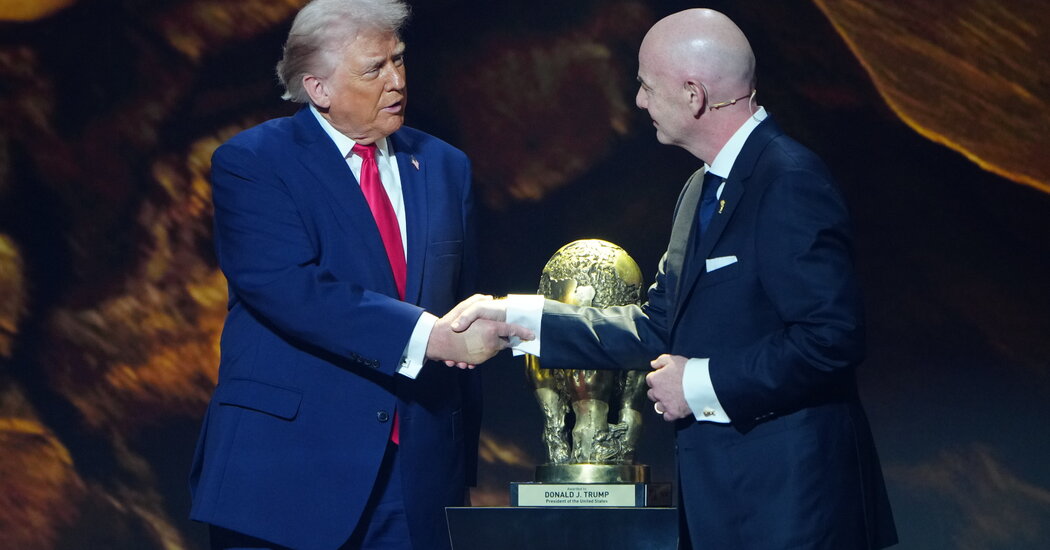
The unusual clemency granted to Mr. Balogun has brought renewed focus on the long-standing relationship between FIFA President Gianni Infantino and President Trump. Mr. Infantino has cultivated a notable rapport with Mr. Trump, including creating and awarding him the “FIFA Peace Prize” last year. This prize was presented amidst President Trump’s public, albeit unsuccessful, campaign to win the Nobel Peace Prize. Mr. Infantino has publicly described himself as a friend of the American president and has, on several occasions, offered praise and gifts to Mr. Trump, a practice that observers note is distinctive within FIFA’s 122-year history. This perceived close relationship has already led to an ethics complaint against Mr. Infantino, filed by the president of Norway’s football federation, alleging breaches of FIFA’s statutes on political neutrality.
The current incident marks the first time that the relationship between Mr. Trump and Mr. Infantino appears to have had a direct consequence on the field of play in a major tournament. This stands in contrast to other controversial decisions, such as FIFA’s handling of Iran during the tournament, where Iranian players were reportedly required to stay in Mexico and faced limitations on their time spent in the United States due to ongoing geopolitical tensions between the two countries.
Historical Context and Wider Implications
The decision benefits the United States team significantly, as Folarin Balogun is considered their primary goal-scoring threat. The U.S. is striving to advance to the World Cup quarterfinals for the first time in 24 years, and Balogun’s presence is seen as crucial to these aspirations. Privately, some senior soccer officials have reportedly expressed incredulity regarding the handling of this case, openly debating whether a precedent has now been established that could allow other teams to demand similar reinstatements for their suspended players in future tournaments.
This is not the first instance where FIFA has faced scrutiny for altering or interpreting rules in ways that appear to favor specific teams or high-profile players. Earlier in this year’s World Cup, Portuguese superstar Cristiano Ronaldo was cleared to play at the tournament’s outset despite having received a red card prior to the competition. Under standard regulations, this card should have resulted in him missing the first two games. Such decisions contribute to ongoing discussions about consistency and equitable application of rules within global football.
The situation also draws parallels to a notable incident in the 1962 World Cup. Brazil’s star attacker, Garrincha, was allowed to participate in that year’s final only after direct intervention from the Brazilian government. Garrincha had been sent off in the semifinal, prompting officials, including then-Prime Minister Tancredo Neves, to petition FIFA for his reinstatement. This historical precedent underscores the rare but impactful instances where external political pressure has influenced major sporting outcomes.
Why This Matters
This incident carries significant implications for the world of international football and global governance. Firstly, it raises fundamental questions about theintegrity and impartiality of FIFA’s disciplinary processes. The reversal of a standard red card suspension, especially one that is historically rare and follows a reported direct appeal from a head of state, challenges the perception that rules are applied consistently and fairly to all teams and players, regardless of their political connections or national influence.
Secondly, the episode highlights concerns about thepotential for undue political influence in sports. The reported involvement of President Trump, coupled with the long-standing, unusually close relationship between him and FIFA President Gianni Infantino, fuels suspicions that decisions can be swayed by factors external to the game itself. This undermines the principle of sporting neutrality, which is crucial for maintaining public trust in global competitions like the World Cup.
Thirdly, the decision has the potential to set aproblematic precedent. If disciplinary actions can be reversed through high-level interventions, it opens the door for other nations or powerful figures to exert similar pressure in future tournaments. This could lead to a less predictable and more politically charged environment for adjudicating on-field infringements, eroding the foundation of fair play and equal competition. The strong reaction from the Belgian federation and the private concerns of other soccer officials underscore this point.
Finally, the controversy impactsFIFA’s credibility and ethical governance. The organization has a history of facing scrutiny over transparency and decision-making. Incidents like these, particularly when FIFA provides limited explanation for exceptional rulings, further erode public and stakeholder confidence in its leadership and commitment to its own ethical codes. For fans, players, and national federations, the perception of fairness is paramount for the legitimacy of the sport’s highest governing body.