
Unlock the White House Watch newsletter for free
Your guide to what Trump’s second term means for Washington, business and the world
**Key Takeaways**
* **Geopolitical Risk Premium Resurfaces:** Israeli Prime Minister Benjamin Netanyahu’s outright rejection of a U.S.-backed Gaza peace plan immediately heightens regional geopolitical tensions, likely impacting investor sentiment, crude oil futures, and the Shekel.
* **Political Instability Weighs on Israeli Assets:** Netanyahu’s strong stance, driven by internal coalition pressures and upcoming elections, signals prolonged political uncertainty, which could depress Israeli bond yields, equity valuations, and foreign direct investment in key tech and innovation sectors.
* **Stalled Reconstruction & Humanitarian Crisis:** The breakdown in diplomatic efforts postpones any comprehensive reconstruction initiatives for Gaza, keeping pressure on global humanitarian aid budgets, commodity prices for essential goods, and dampening prospects for regional economic recovery and trade.
The volatile political landscape in the Middle East has once again sent ripples through global markets, as Israeli Prime Minister Benjamin Netanyahu publicly rejected a US-backed plan for Gaza under which Hamas would disarm in exchange for a phased Israeli withdrawal from the Palestinian enclave. This decisive disavowal signals a significant setback for diplomatic efforts and immediately translates into a renewed risk premium for regional assets and global commodities, particularly crude oil.
Netanyahu’s announcement follows fierce criticism of the 15-point plan from far-right members of his coalition — even though US officials have insisted it was in line with a previous US plan that Israel had accepted. The internal political pressures underscore the deep divisions within Israeli leadership, creating an environment of heightened policy uncertainty that is typically viewed unfavorably by international investors. The Israeli Shekel (ILS) has shown sensitivity to such developments, and Israeli government bond yields may experience upward pressure as investors demand higher compensation for the increased political risk.
Speaking ahead of a cabinet meeting on Sunday, Netanyahu said Israel “does not accept the 15-point document”, and insisted that the Israeli military would not withdraw from Gaza at all “until Hamas is disarmed”. This uncompromising stance suggests a prolonged military presence and potentially continued conflict, delaying any prospects for a stable economic environment necessary for significant foreign direct investment or infrastructure development in the region. “And when I say the disarming of Hamas, it means heavy weaponry, lighter weaponry, all weaponry. And we are talking about genuine disarmament, not fictitious disarmament,” Netanyahu added. This detailed rejection of the disarmament mechanism complicates future negotiation prospects, further pushing out the timeline for any comprehensive peace settlement.
“Right now, we are talking with the Americans about this issue. They have ideas, some of which are acceptable to us and some of which are unacceptable, and we know how to stand firm against these things,” Netanyahu affirmed. This comment highlights the ongoing diplomatic friction between two key allies. While Israel remains a critical recipient of US military and economic aid, prolonged disagreements on core regional strategies could, in the long term, lead to reassessments of aid packages or even impact defense industry contracts, although such scenarios remain speculative.
US President Donald Trump announced the 15-point plan last month, saying it would lead to the “complete disarmament of Hamas and all other armed groups in Gaza”, and that Israeli forces would withdraw from the Palestinian enclave “as disarmament is completed”. Trump hailed the plan as a major breakthrough and claimed at the time that it would be a “critical step towards Gaza finally being governed by a new Palestinian government”. The initial optimism surrounding the plan had briefly offered a glimmer of hope for stability, potentially fostering positive, albeit muted, sentiment in regional equity markets. Netanyahu’s subsequent rejection, however, has swiftly deflated that optimism, leading to a reversal of any nascent positive sentiment.
However, it quickly came under fire from Netanyahu’s allies, with officials insisting any Israeli withdrawal from the Palestinian enclave should begin only after Hamas’s disarmament was complete, and not take place in parallel. This internal political dynamic, where the Israeli Prime Minister’s political survival is linked to appeasing hardline factions, introduces a significant domestic political risk premium for investors. Companies with exposure to the Israeli economy, particularly in sectors sensitive to regional stability such as tourism, real estate, and energy infrastructure, must now factor in an elevated level of uncertainty due to the ongoing political gridlock.
Meanwhile, Hamas officials said any progress on the new roadmap was contingent on Israel first fulfilling its prior obligations, including increasing humanitarian aid flows into the shattered Palestinian territory and withdrawing to the positions it held when a truce took effect last year. The humanitarian crisis in Gaza continues to be a major concern, attracting global attention and international funding. The inability to move forward on a peace plan means that the substantial reconstruction market for Gaza remains on hold, impacting industries from construction materials to logistics and international aid organizations, all of whom are watching for a stable environment to operate.
Sunday’s comments by Netanyahu — whose coalition is trailing opposition parties in polls ahead of parliamentary elections due to be held in October — underscored the political obstacles to the deal’s implementation. With elections on the horizon, Netanyahu’s calculus is clearly influenced by domestic political considerations, including his own electoral standing. This pre-election posturing adds another layer of instability, as policy decisions may be prioritized for political gain rather than long-term economic stability, creating a “wait-and-see” approach for many foreign investors considering opportunities in Israel.
A person briefed on the discussions said Israel had various concerns about the plan, including the idea that Hamas would hand over its weapons to a newly formed Palestinian police force. This indicates a profound distrust that complicates the security architecture envisioned for a post-conflict Gaza. Israel was also concerned about the potential influence Qatar and Turkey would have in Gaza, the person added. The involvement and influence of regional powers like Qatar and Turkey introduces another layer of geopolitical complexity, which could affect regional trade routes, energy deals, and diplomatic relations with other Gulf states, impacting broader market sentiment across the Middle East and North Africa (MENA) region.
The plan — published last month by Trump’s Board of Peace — also contained other conditions analysts said would be difficult for Netanyahu to accept, including a commitment to halt military strikes in Hamas-controlled areas of Gaza and the creation of a pathway to Palestinian statehood. The rejection of a clear pathway to Palestinian statehood is a critical point, as it fundamentally undermines the long-term vision for regional stability and economic integration. For international investors, the absence of a political horizon suggests ongoing conflict and uncertainty, dampening prospects for significant regional development projects, cross-border trade, and stable tourism revenues.
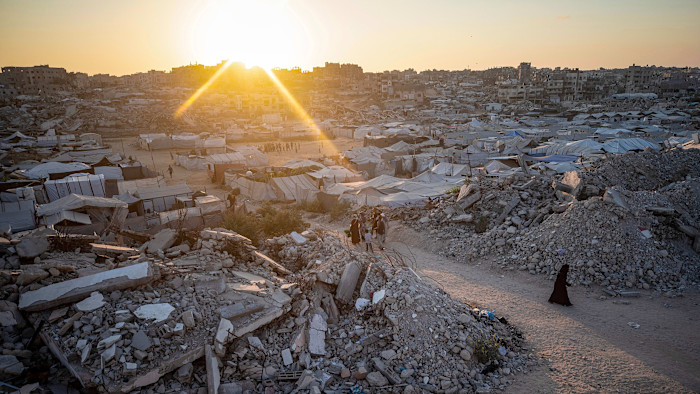
Although Israel has not carried out strikes in Gaza in the past few days, it has launched hundreds in the Palestinian enclave since the US-backed ceasefire took effect last October and halted the worst of the fighting. According to Palestinian health authorities, the strikes since the truce have killed more than 1,200 people in Gaza, much of which has been reduced to rubble by Israel’s two-year offensive. The sheer scale of destruction and human cost highlights the massive investment required for reconstruction, which remains unattainable without a credible peace framework. This ongoing state of conflict also impacts shipping routes, insurance premiums for vessels operating in the Eastern Mediterranean, and the overall supply chain resilience for the wider region.
Market Impact
Netanyahu’s definitive rejection of the US-backed peace plan will likely cause an immediate, albeit perhaps temporary, uptick in crude oil prices as geopolitical tensions in the Middle East escalate. The Israeli Shekel could face depreciation pressure against major currencies, reflecting increased political and security risks. Israeli equity markets, particularly those with significant foreign investor participation or exposure to infrastructure and tourism, are expected to trade cautiously, with a potential for a risk-off sentiment pushing down valuations. Defense sector stocks globally might see a marginal boost from the prospect of prolonged regional instability. Furthermore, the delay in any peace process ensures that the multi-billion dollar reconstruction market for Gaza remains hypothetical, affecting companies in construction, logistics, and humanitarian aid. Investors will closely monitor upcoming Israeli elections and further diplomatic overtures for any signs of a shift in policy, as the current stance points to sustained regional uncertainty.