
**Key Takeaways**
* **Heightened Market Volatility:** The escalating political feud between Brazil’s President Lula and US Secretary of State Rubio, coupled with the upcoming Brazilian election, injects significant uncertainty into the market, likely driving increased volatility in the Brazilian Real (BRL) and sovereign debt as investors price in geopolitical risk.
* **Trade Policy and Sectoral Impact:** Bilateral trade tensions, particularly surrounding tariffs and allegations of US interference, directly threaten key Brazilian export sectors like agriculture and commodities. The ongoing dispute underscores the market’s vulnerability to protectionist policies and the critical importance of stable trade relations.
* **Shifting Geopolitical Alignment and Investment Flows:** Brazil’s strategic pivot towards diversified trade partners, notably China, lessens its economic dependence on the US but introduces complexities regarding its alignment in global power dynamics. This shift influences foreign direct investment (FDI) decisions and the perceived long-term stability of the Brazilian market.
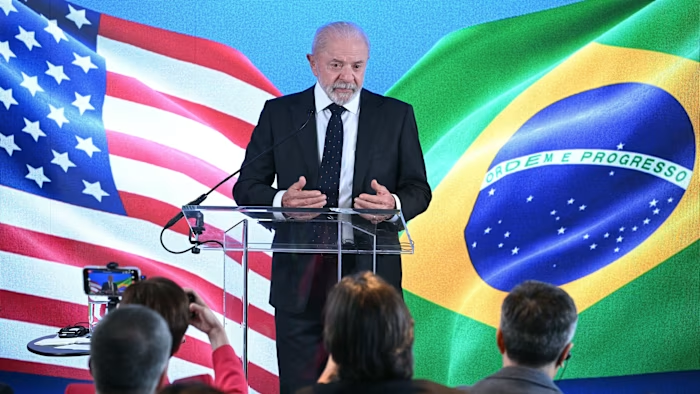
The political dynamic between President Luiz Inácio Lula da Silva of Brazil and US Secretary of State Marco Rubio has intensified into a high-stakes diplomatic confrontation, injecting a new layer of uncertainty into Latin America’s largest economy. This feud, far from being a mere political spat, carries significant implications for investor confidence, trade relations, and the valuation of Brazilian assets, particularly as the nation approaches a closely contested presidential election in October. Lula’s surprising outreach to former President Donald Trump, rather than his administration, underscores a transactional approach to international relations that could either stabilize or further destabilize market perceptions.
Rubio’s sharp criticism, accusing Lula of prioritizing “his own ego” over his people, and Lula’s retort labeling Rubio a “frustrated Latin American” who “hates Brazil,” are more than just rhetoric. For financial markets, such public spats between major economic partners often signal potential disruptions to trade, investment, and diplomatic cooperation. The immediate concern for investors is the unpredictability these exchanges generate, which can lead to capital flight, currency depreciation, and a rise in risk premiums for Brazilian sovereign bonds.
Lula’s strategy to engage Trump directly, leveraging what he perceives as a more pragmatic and less ideologically driven American leadership, reflects a calculation of economic self-interest. His statement last week about calling Trump to complain about election interference — and the subsequent “friendly and cordial” call emphasizing “the importance of maintaining strong commercial ties” — speaks volumes. From a market perspective, this highlights the fragility of traditional diplomatic channels and the growing influence of personal relationships at the highest levels of power. Investors keen on Brazil will be closely watching for any signs that this direct line to Trump might bypass or mitigate the more confrontational stance of the State Department, potentially safeguarding crucial trade agreements and foreign direct investment.
Some analysts in Washington suggest Lula is deliberately manufacturing this confrontation with Rubio, believing a surge of nationalist sentiment against perceived US interference could bolster his standing against his rival, Flávio Bolsonaro, the eldest son of the far-right former president. While politically astute, such tactics introduce an element of calculated risk for markets. A nationalist backlash, if it translates into protectionist economic policies or increased friction with international bodies, could deter foreign investment and disrupt global supply chains reliant on Brazilian exports. For equity markets, this could mean increased volatility for companies with significant international exposure or those reliant on foreign capital.
Conversely, the Brazilian government views the dispute as evidence of the US State Department’s increasingly ideological posture under Trump’s second term, which they believe places undue emphasis on supporting right-wing allies in Latin America. A senior Brazilian official’s assertion of “an agenda of the Brazilian far right which is co-ordinated with the far right in the [US] state department” points to a deeper ideological chasm that transcends mere political posturing. This perception of ideological bias from a major trading partner complicates economic forecasting and risk assessment, as policy decisions may be seen as driven by political alignment rather than pure economic rationality. This can particularly affect sectors like energy, infrastructure, and technology, where foreign partnerships and investment are crucial.
Lula’s view that “Trump is the best of all of them [in the US government], he is the one who talks most seriously with me” suggests a preference for a more transactional and less ideologically charged relationship. For global markets, leaders who prioritize deal-making over ideological battles can sometimes offer more predictable (though not necessarily less volatile) outcomes, especially concerning trade tariffs and market access. However, relying on the personal rapport between leaders in their eighties to navigate complex diplomatic and economic issues inherently introduces key person risk for market participants.
As South America’s biggest economy and a significant player in global trade, the stakes in Brazil’s election are undeniably high. The prior imposition of 50 percent tariffs on Brazilian imports by the Trump administration, making Brazil one of the most affected nations, served as a stark reminder of the economic leverage the US holds. While these tariffs were later scaled back after significant lobbying efforts — notably by Joesley Batista of JBS, whose US subsidiary Pilgrim’s Pride was a major donor to Trump’s inaugural committee — the episode highlighted the direct link between political influence, corporate lobbying, and market outcomes. The scaling back of tariffs provided relief to Brazilian agricultural exporters and meatpackers, whose stock valuations and export revenues were directly threatened. This incident vividly illustrates how political machinations can directly impact the profitability and market capitalization of major listed companies.
Brazilian diplomats claim that the political tide shifted with the onset of the Iran war, which distracted the White House and allowed the State Department greater autonomy. This perception is critical for markets, as it suggests that US foreign policy, and by extension its trade policy, might be subject to internal power struggles and shifts in focus, rather than a consistent, predictable strategy. The subsequent alleged attempts by the State Department to favor the Bolsonaro family, including the revocation of a visa for Darren Beattie after he planned to meet former President Jair Bolsonaro (who is under house arrest for coup plotting), and the denial of entry to two other officials for allegedly casting doubt on Brazil’s electronic voting system, further fuel market apprehension. Such actions, regardless of their truth, contribute to a perception of external interference that can destabilize internal political processes, making Brazil a riskier proposition for long-term foreign investment.
The new round of 25 percent tariffs imposed in July, coupled with Rubio’s statement that Lula’s policies are “bad for Americans and bad for Brazilians,” directly impacts trade balances and corporate earnings. Industries affected by these tariffs face higher input costs or reduced market access, potentially dampening their performance and, by extension, the broader equity market. The US official’s insistence that the administration is not trying to interfere, but rather engaging in “perfectly routine conversations,” contrasts sharply with Brazil’s “bizarre” reaction. This clash of narratives itself creates market uncertainty, as investors struggle to discern the true extent of geopolitical risk.
Rubio’s categorisation of Brazil alongside authoritarian regimes like Cuba, Nicaragua, and Venezuela as an exception to a “coalition of friendly countries” is a powerful signal to international investors. This diplomatic isolation, if persistent, could impact Brazil’s access to international credit, its attractiveness for multinational corporations, and its standing in global economic forums. The US official’s rationale that Lula has “consistently taken radical leftwing positions that are opposed to the interests of the US” encapsulates the ideological divide that now heavily influences economic relations.
Matias Spektor, a foreign policy expert, rightly points out that Brazil’s reduced dependence on the US economy – with about a third of its exports now going to China compared to 11 percent to the US – means the two countries are “bound to bump into each other.” This diversification of trade partners offers Brazil some insulation from US pressure but also aligns it more closely with competing global powers, adding a layer of geopolitical complexity for investors. While Spektor believes cooperation on security and other issues might not be impacted post-election, he acknowledges that the US administration would prefer Bolsonaro. This preference, combined with the ongoing turbulence, ensures that Brazilian assets will continue to trade with a significant geopolitical risk premium until the election dust settles.
**Market Impact**
The ongoing political friction between Brazil and the US, exacerbated by the upcoming presidential election, is having a tangible impact on financial markets. We anticipate continued volatility in the Brazilian Real (BRL) as investor sentiment remains susceptible to headlines regarding diplomatic spats, trade threats, and election polls. Foreign direct investment (FDI) inflows may slow as companies adopt a wait-and-see approach, leading to potential delays in growth projects and job creation. Key Brazilian export sectors, particularly agriculture, mining, and manufacturing, face heightened uncertainty due to the potential for new tariffs or disruptions to existing trade agreements, which could depress earnings for publicly traded companies in these areas. Furthermore, the perceived ideological rift and alleged US interference could elevate Brazil’s sovereign risk premium, making it more costly for the government and state-owned enterprises to borrow on international markets. Overall, the market will price in a significant “turbulence premium” for Brazilian assets until there is greater clarity on both the election outcome and the future trajectory of US-Brazil relations.