
Unlock the White House Watch newsletter for free
Your guide to what Trump’s second term means for Washington, business and the world
Key Takeaways:
- Escalating maritime hostilities in the Gulf of Oman and Strait of Hormuz are intensifying geopolitical risk, directly threatening global energy supply chains and driving up commodity prices.
- The recent US military strike, coupled with Iran’s increased attacks on commercial shipping, signals a dangerous new phase in regional tensions, significantly elevating war risk insurance premiums and operational costs for global shipping.
- President Donald Trump’s explicit linkage of military action to US midterm elections introduces a layer of political uncertainty, suggesting that immediate de-escalation may be influenced by domestic political calculations rather than purely strategic or economic imperatives.
The geopolitical risk premium on global energy markets ratcheted higher this weekend as the US military initiated its first strike in over a month near Iranian ports, targeting a commercial vessel in the Gulf of Oman. This aggressive action, aimed at enforcing a naval blockade against Iranian trade, underscores the rapidly deteriorating security landscape in a region vital for global commerce and crude oil transit.
The Pentagon’s move comes amidst a surge in regional instability, with a deadly missile strike at Riyadh’s airport claiming 12 lives and injuring 300, days after Iran-backed Houthi rebels targeted the same Saudi hub. Concurrently, Tehran has demonstrably escalated its own campaign against commercial shipping, creating increasingly perilous conditions for vessels attempting to navigate the critical Strait of Hormuz. These developments combine to inject significant volatility into commodity markets, particularly crude oil, and amplify the already substantial challenges facing global supply chains.
Of particular note for investors and market analysts was the timing of Washington’s strike, occurring just two days after President Donald Trump publicly declared that American forces would refrain from attacking Iran prior to the upcoming US midterm elections, now less than a month away. This apparent contradiction between rhetoric and action raises questions about the administration’s strategic coherence and introduces an additional layer of political calculus into an already combustible geopolitical equation.
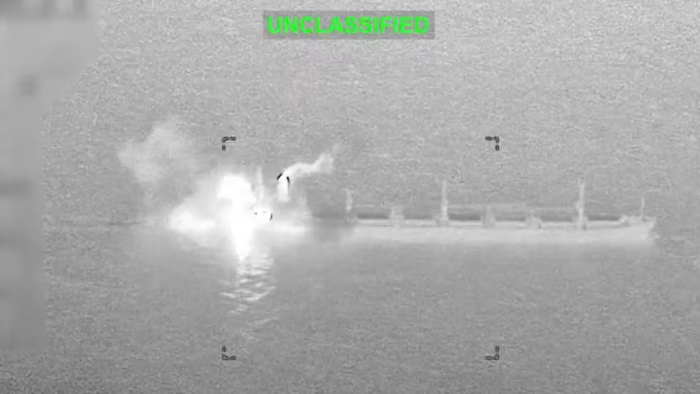
According to US Central Command (Centcom), which oversees military operations in the Middle East, an American fighter jet successfully disabled the Panama-flagged M/V Ocean Molica with a precision munition on Saturday. Centcom stated the large cargo vessel was attempting to transit regional waters after having departed an Iranian port and was struck only after its crew disregarded repeated warnings. A video released by Centcom showed an explosion at the rear of the Ocean Molica, also known as the Arika Sun, with the crew reported unharmed. This incident directly impacts the cost of doing business in the region, as insurance providers immediately reassess risk profiles and associated premiums.
The latest strike marks a significant re-engagement after the Pentagon last acknowledged operations against Iranian targets in early September. That earlier action involved striking five crude oil tankers identified as belonging to the Islamic Revolutionary Guard Corps (IRGC), in retaliation for the regime’s forces targeting a US Navy ship. Such sustained military pressure, whether direct or indirect, translates into sustained upward pressure on energy prices and heightened concerns over the stability of supply.
From an economic standpoint, President Trump’s “war on Iran” has been widely cited as a major contributor to the current global energy crisis, sparking an inflation shock that has severely impacted American consumers’ purchasing power. His Truth Social post on Thursday – stating, “We will not be attacking Iran at any time prior to the Midterm Elections to be held in the United States on November 3rd” – was a thinly veiled acknowledgment of the political liability posed by further military escalation. The implication for markets is clear: geopolitical decisions are not solely driven by foreign policy objectives but are increasingly intertwined with domestic electoral considerations, potentially leading to unpredictable shifts in strategy.
Meanwhile, Iran has demonstrably expanded its maritime aggression beyond the Strait of Hormuz in recent days, creating some of the most dangerous operating conditions for tanker operators since the conflict began. Tehran and Washington’s forces are locked in a tense struggle for control over this vital waterway, through which an estimated one-fifth of the world’s crude oil passes daily. The direct targeting of commercial vessels not only disrupts immediate shipping schedules but also dramatically inflates war risk insurance premiums, making transit prohibitively expensive for some carriers and forcing others to seek longer, more costly alternative routes.
The IRGC claimed on Saturday that a crude oil supertanker attempting to exit the strait “suffered a powerful explosion after striking a naval mine in the high-risk route” not authorised by Iran. The elite force stated the unidentified vessel had switched off its navigation and positioning systems, with the resulting blaze intense enough to be visible from the coast. The following day, the IRGC reported another supertanker carrying crude oil struck a naval mine in the southern area of the strait, igniting an explosion and fire in its engine room. This vessel, too, had reportedly switched off its navigation systems while “travelling along an unauthorised route.”
These incidents are not isolated; they represent a deliberate strategy to disrupt maritime traffic. The IRGC has issued a stark warning, declaring that all vessels in the strait that switch off their navigation and identification systems will be classified as “hostile and dealt with firmly and decisively.” This policy directly targets the transparency and safety protocols essential for international shipping, further exacerbating the operational risks and pushing up the cost basis for any company operating in the region.
Iran’s actions appear to be a concerted effort to stem Gulf oil exports, particularly after a period of recovery. Commodities platform Kpler reported on Friday that flows had rebounded to pre-war levels in September, but cautioned that “intensified attacks on tankers” had subsequently driven exports “sharply lower” this week. This direct impact on supply volumes, coupled with the increased cost and risk of transport, contributes significantly to the geopolitical risk premium currently embedded in global energy prices.
Market Impact:
The escalating tensions in the Gulf of Oman and Strait of Hormuz are immediately reflected in global commodity markets, particularly crude oil. Futures contracts for both Brent and WTI benchmarks are likely to see sustained upward pressure as the geopolitical risk premium widens, driven by fears of supply disruptions from a region responsible for a substantial portion of global oil supply. Shipping stocks, especially those with significant exposure to tanker operations, may experience increased volatility due to rising war risk insurance premiums and potential rerouting costs, impacting their profitability. Conversely, defense contractors could see a boost in investor sentiment. Broader equity markets are likely to trade with increased caution, with a potential flight to safe-haven assets such as gold and US Treasury bonds. The inflationary impulse from higher energy costs will also weigh on central bank policy, potentially reinforcing a hawkish stance and adding pressure to interest rate expectations. The uncertainty introduced by the interplay of military action and US domestic politics further complicates forecasting and investor sentiment, making stability elusive for the foreseeable future.