
American Supercarrier USS George H.W. Bush Conducts Operations in Pacific Following Middle East Deployment
The American supercarrier USS George H.W. Bush (CVN 77) has commenced flight operations with its embarked F/A-18E Super Hornet fighter aircraft in the Pacific Ocean. This deployment follows the completion of a scheduled port visit to Phuket, Thailand, and marks a significant shift in the carrier strike group’s operational area after six months supporting U.S. interests in the Middle East, as confirmed by the U.S. Navy.
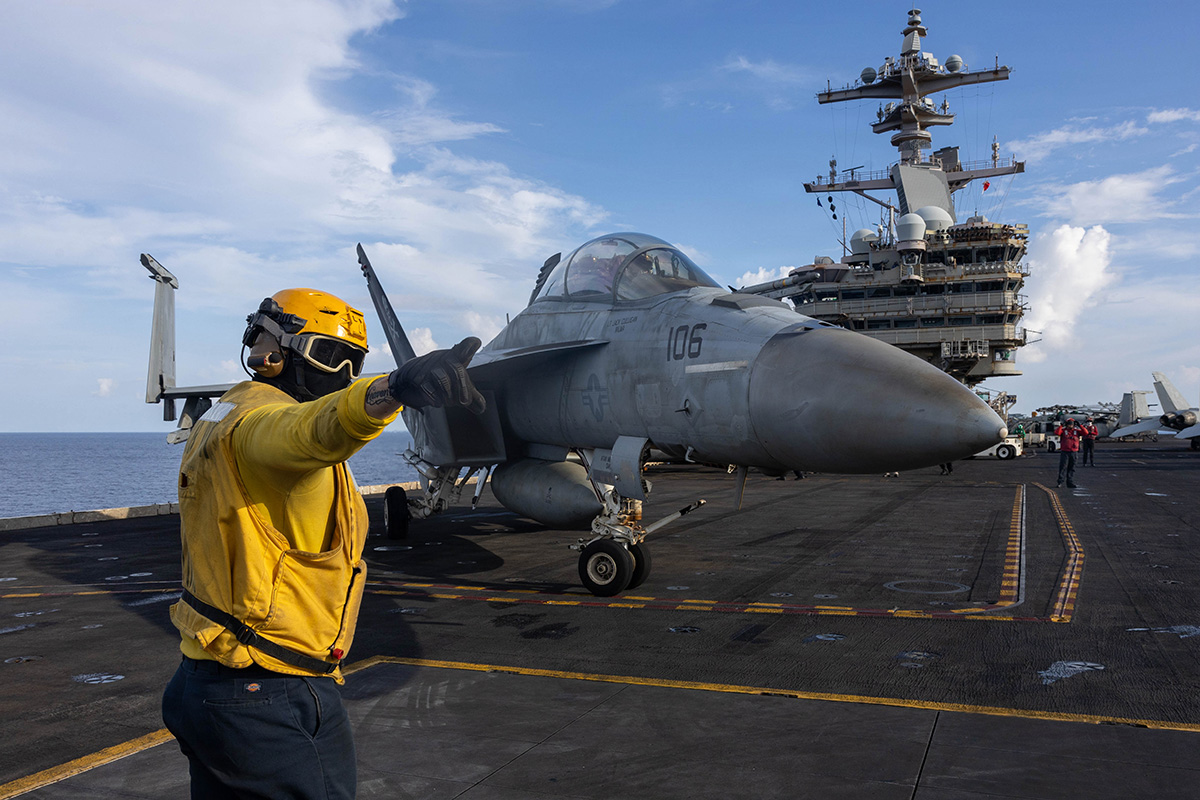
On October 11, the U.S. Navy released imagery depicting a sailor on the carrier’s flight deck directing an F/A-18E Super Hornet. The aircraft belongs to Strike Fighter Squadron 105, known as the “Gunslingers,” and the operations took place at sea the previous day. Such imagery offers a glimpse into the continuous, high-intensity activities inherent to carrier aviation, underscoring the readiness and operational tempo of the naval asset.
The USS George H.W. Bush is now operating within the vast expanse of the U.S. 7th Fleet’s area of responsibility. This strategic move follows an extensive six-month period during which the carrier strike group was deployed to the Middle East, falling under the purview of U.S. Central Command (CENTCOM) and the U.S. 5th Fleet. In this region, the strike group played a pivotal role in supporting American security operations, which typically encompass maritime security, counter-terrorism efforts, and regional stability initiatives.
Prior to its return to sea and the resumption of flight operations, the nuclear-powered aircraft carrier made a five-day port call in Phuket, Thailand, from October 4 to October 9. Port visits serve multiple critical functions, including providing essential rest and recreation for the crew, enabling logistical resupply, and fostering diplomatic relations with host nations. Following its departure from Thailand, the U.S. Navy issued an update accompanying the released imagery, stating: “George H.W. Bush is underway conducting routine operations in the U.S. 7th Fleet area of operations.”
Further elaborating on the nature of these operations, the U.S. Navy highlighted the strategic importance of its presence in the region: “U.S. 7th Fleet, the Navy’s largest forward-deployed numbered fleet, routinely interacts and operates with allies and partners in preserving a free and open Indo-Pacific.” This statement underscores a core tenet of U.S. foreign and defense policy, emphasizing international cooperation and adherence to international law in critical global waterways.
The USS George H.W. Bush, designated CVN 77, holds the distinction of being the tenth and final vessel of the venerable Nimitz-class aircraft carrier fleet. As the centerpiece of Carrier Strike Group 10, its combat capabilities are significantly augmented by accompanying vessels. The strike group has been operating with several Arleigh Burke-class guided-missile destroyers, including the USS Delbert D. Black, USS Mason, USS Ross, and USS Donald Cook. These destroyers provide multi-faceted support, ranging from close escort and sophisticated air defense capabilities to anti-submarine warfare and additional precision strike options, forming a formidable and integrated naval combat unit.
The recent imagery specifically showcased an F/A-18E Super Hornet being maneuvered on the flight deck, an integral part of routine carrier aviation. The controlled chaos of a flight deck necessitates a highly trained crew, utilizing precise hand signals to direct aircraft. This is essential due to the immense noise generated by jet engines and the inherently confined and dynamic operating environment aboard an aircraft carrier. Strike Fighter Squadron 105 operates the single-seat F/A-18E Super Hornet, a versatile, multi-role combat aircraft that forms a primary component of the U.S. Navy’s carrier air wings, executing missions ranging from air-to-air combat and ground attack to reconnaissance and electronic warfare.
Nimitz-class carriers, such as the USS George H.W. Bush, are engineering marvels, displacing in excess of 100,000 tonnes when fully loaded. Their propulsion system, powered by two nuclear reactors, grants them unparalleled endurance, allowing for extended deployments without the need for frequent refueling that conventional propulsion systems demand. The carrier’s core combat power resides in its embarked air wing, a formidable collection of diverse aircraft. This typically includes a mix of F/A-18E and F/A-18F Super Hornets for strike and air superiority, EA-18G Growler electronic attack aircraft designed to jam enemy radars and communications, E-2D Advanced Hawkeye aircraft providing airborne early warning and command and control capabilities, and various helicopters for anti-submarine warfare, search and rescue, and logistics support.
The USS George H.W. Bush entered service with the U.S. Navy in 2009 and is homeported at Naval Station Norfolk in Virginia. The ship bears the name of George H.W. Bush, the 41st President of the United States, who himself served with distinction as a U.S. Navy aviator during the Second World War. This naming tradition honors individuals who have made significant contributions to the nation, often reflecting their military service or leadership.
Why This Matters
The operational movements and activities of the USS George H.W. Bush Carrier Strike Group are of significant geopolitical importance, reflecting key aspects of U.S. foreign policy and military strategy. Its transit from the Middle East to the Indo-Pacific region underscores the flexible and global reach of U.S. naval power, demonstrating the capacity to project influence and respond to crises across diverse theaters.
Firstly, the presence of a U.S. supercarrier in the Indo-Pacific directly supports the U.S. commitment to a “free and open Indo-Pacific.” This strategic vision, shared with numerous allies and partners, aims to ensure freedom of navigation, uphold international law, and promote regional stability in a critically important economic and geostrategic area. The Indo-Pacific encompasses vital international shipping lanes, and maintaining security in these waters is crucial for global trade and economic prosperity. The carrier’s presence signals a dedication to deterring potential aggression and reassuring allies.
Secondly, port visits, such as the one in Thailand, are integral to U.S. diplomacy and alliance-building efforts. These visits facilitate direct engagement with partner nations, foster goodwill, and strengthen interoperability between respective militaries. They are a tangible demonstration of commitment to regional security partnerships and provide opportunities for cultural exchange and economic benefits to the host ports.
Thirdly, the carrier strike group itself represents an unparalleled instrument of power projection. As a self-contained airbase capable of deploying advanced aircraft anywhere in the world, it provides a rapid response capability for humanitarian aid, disaster relief, or combat operations. Its sophisticated array of aircraft and accompanying destroyers, with their advanced defensive and offensive capabilities, collectively offer significant strategic leverage, serving as a powerful deterrent and a flexible tool for crisis management.
Finally, the long-duration deployments of nuclear-powered carriers highlight the technological superiority and sustained operational capacity of the U.S. Navy. The ability of these vessels to operate for extended periods without needing to refuel demonstrates a unique strategic advantage, allowing for continuous presence in critical regions without logistical dependency on land-based support, thereby contributing significantly to global security and stability.