
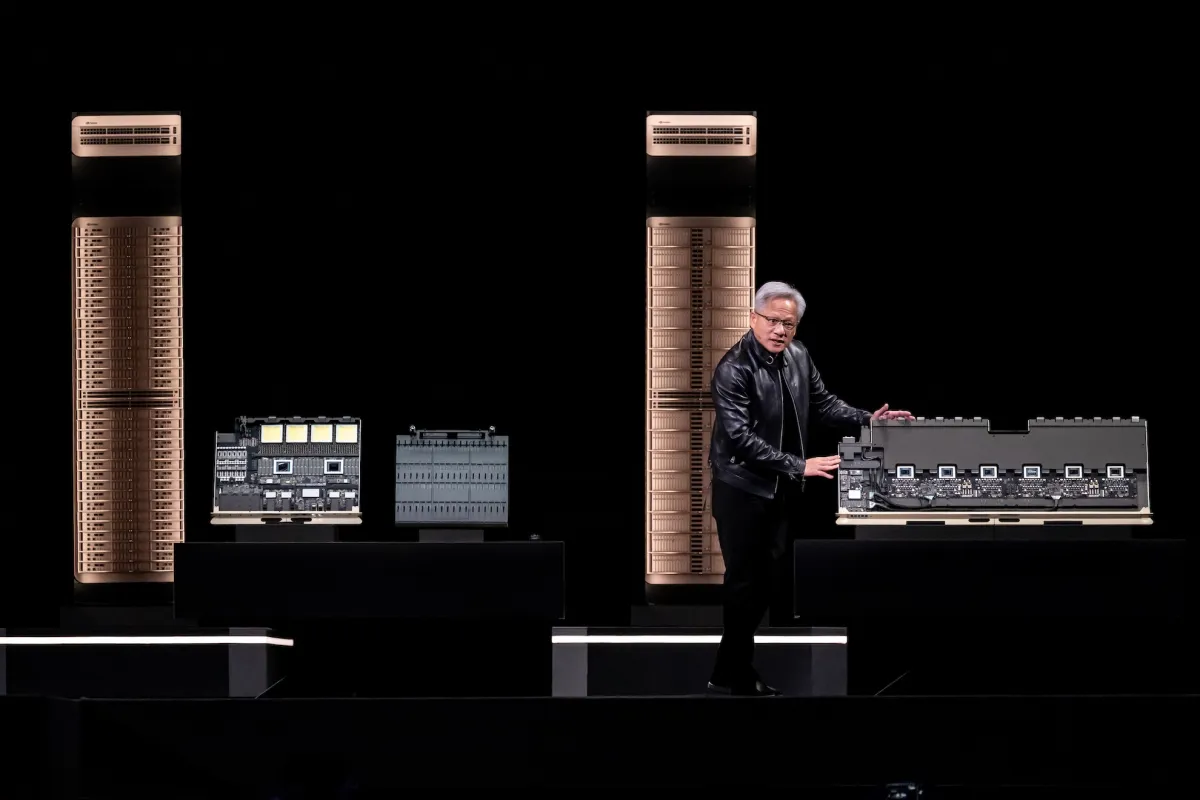
Nvidia, long synonymous with high-performance GPUs, is redefining its competitive advantage. While concerns about increasing GPU competition from hyperscalers have moderated its stock trajectory, recent insights post-earnings reveal a profound shift: Nvidia’s dominance is extending far beyond the GPU itself, into the critical realm of AI infrastructure orchestration. As AI compute scales to unprecedented levels—reaching gigawatts of power consumption—the challenge of efficiently managing vast, complex data flows and interconnected hardware has become paramount. Nvidia’s proactive development of specialized hardware for this orchestration, such as its Vera CPU, positions it with a significant lead in ensuring the entire AI system operates at peak efficiency, creating a new, formidable moat around its core business.
Key Takeaways
- Beyond the GPU: Orchestration is Nvidia’s New Moat:While GPU competition from hyperscalers grows, Nvidia’s strategic focus has shifted to system-level orchestration hardware and software, essential for managing the immense complexity and data flow within megascale AI data centers.
- Data Flow Efficiency is the Next Frontier:As AI compute demands reach gigawatt scales, the primary bottleneck is no longer just raw processing power but the efficient movement and management of data between memory, storage, and GPUs. Specialized solutions like Nvidia’s Vera CPU are crucial for unlocking full system potential.
- A New Layer of Competition Emerges:The battle for AI infrastructure dominance is evolving. Success hinges on making entire systems work seamlessly, rather than just building faster individual components. Nvidia, with its integrated approach, appears to have an early and commanding lead in this critical new layer of innovation.
The Shifting Sands of AI Compute
For years, the narrative surrounding Nvidia was a straightforward one: the company reigned supreme as the sole provider of cutting-edge GPUs, riding the crest of the AI boom to astronomical profitability. Its market capitalization soared tenfold between early 2023 and mid-2025, a testament to its indispensable role in the burgeoning artificial intelligence industry. However, a different story began to take hold in the past year, as industry giants like Amazon and Google, increasingly reliant on massive AI infrastructure, started developing their own custom silicon. This development sparked legitimate investor concerns about the long-term durability of Nvidia’s competitive edge, leading to a more modest trajectory for its shares.
Yet, a profound new narrative has emerged in the wake of the company’s recent earnings report. Investors are beginning to grasp that Nvidia’s strategic advantage extends far beyond its silicon prowess. As AI’s computational demands escalate to a staggering gigawatt scale – powering vast data centers with energy equivalent to small cities – the task of orchestrating these colossal systems has become incredibly complex. Nvidia, with characteristic foresight, has been meticulously building much of the state-of-the-art hardware and software necessary to manage this intricate dance. This comprehensive approach grants the company a colossal advantage in the entire ecosystem surrounding the GPU, even as direct competition on the GPU chip intensifies. The notion of compute as a commoditized utility, while appealing in theory, dramatically understates the immense difficulty and specialized engineering required to operate a megascale data center at peak efficiency – a challenge that only grows more formidable with each advancement in AI.
Beyond the GPU: Nvidia’s Orchestration Advantage
A closer look at Nvidia’s product offerings reveals the depth of this new strategy. The company is currently rolling out its groundbreaking Vera Rubin architecture, an integrated system designed to deliver not just raw processing power, but unparalleled efficiency. This architecture pairs the powerful Rubin GPU with a suite of complementary units, including the Vera CPU, the Groq 3 LPX inference accelerator, and specialized racks for high-speed storage and networking. This isn’t just a collection of chips; it’s a meticulously engineered, full-stack solution.
In recent conversations with Nvidia insiders, the true sophistication of these systems became strikingly clear. Like the Rubin GPU itself, these accompanying components are highly specialized. However, their purpose isn’t to churn through AI tokens directly. Instead, they are dedicated to ensuring that every other element within the AI infrastructure functions with maximal efficiency and perfect synchronization. To use an apt analogy, if the GPU serves as the high-performance engine of an AI system, then these surrounding components – the Vera CPU, networking, and storage solutions – represent the sophisticated chassis, transmission, and control systems that enable the engine to perform optimally. They are the unseen heroes making sure the entire vehicle runs smoothly and at peak performance.
The Critical Role of Data Flow
The Vera CPU, in particular, is engineered to tackle the formidable challenge of data orchestration. “Vera is important because there’s only so much memory that you can put in a single server or any sort of compute platform,” explained Jason Hardy, Nvidia’s VP of storage technology. This limitation highlights a fundamental hurdle in scaling AI: while processing power has surged, effectively feeding that power with data remains a complex bottleneck.
As data centers have massively scaled their computing power, memory capacity has indeed grown in parallel, enriching companies like Micron in this second wave of the infrastructure boom. However, the sheer volume and velocity of data required by modern AI models make getting that data to the GPU at precisely the right moment an incredibly complex task. As companies relentlessly pursue lower “tokens-per-watt” – a critical metric for efficiency and cost-effectiveness – they are increasingly recognizing the paramount importance of intelligent data traffic direction. Bottlenecks in data transfer can render even the most powerful GPUs underutilized, leading to wasted energy and compute cycles.
Hardy elaborated on the tangible benefits of Nvidia’s approach: “We saw upwards of 3x improvement in these operations, where the Vera CPU is allowing for acceleration. So now we can use our flash to its fullest potential, because we can get all that performance out of it without bottlenecking.” This significant performance boost underscores how specialized orchestration hardware can unlock the full potential of existing memory and storage, directly translating into higher AI throughput and lower operational costs.
Alternative Approaches, Shared Goals
Versions of this data orchestration challenge can be observed across the industry. When OpenAI developed its proprietary Jalapeño chip, a major design imperative was to circumvent these very data movement challenges by minimizing the amount of data that needs to be shuttled around the system in the first place.
As OpenAI articulated in a recent blog post, “We designed Jalapeño to minimize data movement and communication delays. Its large domain allows the entire workload to remain within one connected system, minimizing data movement and helping the complete request stay fast and efficient from beginning to end.” This represents a distinct approach: rather than optimizing external data flow like Nvidia, OpenAI seeks to avoid it entirely by consolidating a workload within a single, highly integrated chip. Yet, the underlying logic is identical: both strategies aim to significantly increase efficiency through smarter traffic control and optimized data handling, rather than simply relying on ever-more processor cycles. This shared objective, pursued through different architectural philosophies, reveals an entirely new layer of infrastructure where companies can compete and innovate.
A New Battleground Emerges
This intensified focus on data orchestration and system-level efficiency doesn’t automatically guarantee Nvidia an unchallenged victory. The company will undoubtedly face robust competition from rival chipmakers, specialized networking vendors, and hyperscalers, all vying for dominance in this burgeoning layer of AI infrastructure. However, the nature of the competition has fundamentally shifted. The emphasis is no longer solely on who can build the fastest GPU, but rather on who can engineer an entire system that operates with unparalleled efficiency and seamless integration. In this new paradigm, the ability to make the entire AI deployment work cohesively and optimally becomes the ultimate differentiator.
And in these nascent stages of this critical new competition layer, Nvidia appears to have established a formidable and commanding lead. Their integrated hardware and software stack, honed over years of designing for maximum performance and efficiency, positions them uniquely to capitalize on the increasing demands for orchestration in the age of gigawatt-scale AI.
The Bottom Line
Nvidia’s strategic pivot from being merely a GPU provider to an orchestrator of entire AI data center ecosystems marks a crucial evolution in its business model. As AI compute scales dramatically, the core challenge has shifted from raw processing power to the intricate dance of data movement and system-wide efficiency. By developing specialized hardware like the Vera CPU and integrating a full-stack solution, Nvidia is not just selling components; it’s selling unparalleled performance optimization for the most demanding AI workloads. This foresight creates a powerful new competitive moat, ensuring that even as the GPU market becomes more crowded, Nvidia remains indispensable at the heart of the AI revolution, orchestrating the future of intelligent infrastructure.
When you purchase through links in our articles, we may earn a small commission. This doesn’t affect our editorial independence.
{content}
Source:{feed_title}