
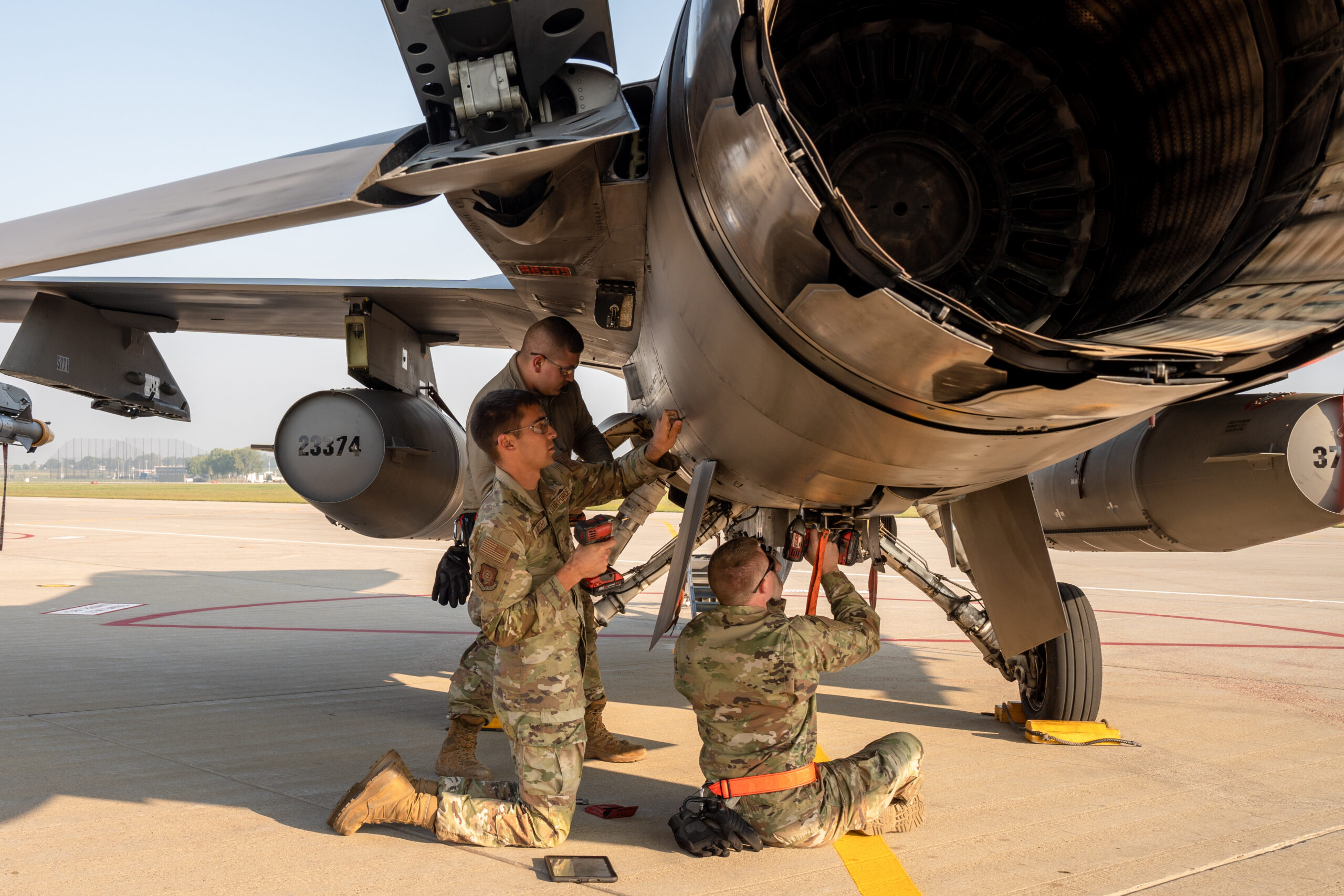
The U.S. Air Force Life Cycle Management Center (AFLCMC) is advancing a significant program aimed at upgrading the core computing system for a substantial portion of its F-16 Fighting Falcon fighter jet fleet. This initiative targets the replacement of a quarter-century-old system to enhance the aircraft’s operational capabilities.
Details of the program, officially titled the F-16 Next-Generation Mission Compute program, were first publicly released in a notice seeking potential industry sources in May. The AFLCMC further engaged with interested vendors during a dedicated Industry Day event held on October 20-21 at Wright-Patterson Air Force Base in Ohio.
The primary objective of this project is to equip older F-16 variants with a modern open systems architecture. This architectural shift is crucial for processing the vast volumes of data generated by contemporary radar systems, facilitating advanced electronic warfare operations, and enabling seamless networking with cutting-edge fifth-generation fighters such as the F-22 Raptor and F-35 Lightning II.
An AFLCMC spokesperson, communicating via email, emphasized the center’s interest in “mature, open-system, modular solutions that can integrate efficiently into the existing aircraft while providing substantial growth capacity at speed.” The spokesperson also noted the robust industry response, confirming “a highly capable industrial base with significant technical expertise is ready to deliver” on these requirements.
The overarching goal, as articulated by the center, is to “maintain and strengthen the F-16’s operational relevance and dominance in an increasingly data-intensive combat environment.” This upgrade is seen as pivotal for ensuring the F-16’s continued ability to execute critical combat missions for the Air Force.
Retired Major Heather Penney, a former F-16 pilot and current director of studies and research at the Mitchell Institute for Aerospace Studies, underscored the upgrade’s importance. Penney described the mission compute system as “the heart of the F-16’s ability to manage, integrate and present information to the pilot,” explaining that it brings together all mission systems on the aircraft. She highlighted that the existing system’s capabilities are fundamentally limited by the technology available at its last update, drawing an analogy to attempting to run a modern graphics-intensive application on a 1990s-era computer processor.
Beyond merely boosting processing power, the mission compute upgrade is designed to enable future technicians and F-16 maintenance teams to rapidly integrate new software capabilities and swap out components. This flexibility is a direct benefit of adopting an open mission systems approach, which promotes modularity and ease of modification.
The upgrade program is not universal across the entire F-16 fleet. It specifically targets the Block 40/42 and 50/52 variants, often referred to as “post-block” aircraft. Older Block 30/32 types are not included in this particular modernization effort.
The Block 40/42/50/52 aircraft previously received the Common Configuration Implementation Program (CCIP) software, which incorporated the Modular Mission Computer (MMC) between 2000 and 2010. The Raytheon-built MMC served as a unified processing hub, consolidating and replacing multiple legacy subsystems. Over its operational lifespan, the MMC underwent three hardware generations, with its processing chips evolving from 32-bit architecture with 4MB of memory to 64-bit architecture with 10MB of memory.
The AFLCMC spokesperson further elaborated that the new upgrade “will combine the latest in open systems architecture, processing performance, reliability, and opportunities for growth to support rapid modernization while retaining compatibility with the F-16’s existing infrastructure.” This ensures a balance between cutting-edge technology and seamless integration.
The F-16 jets slated for this upgrade have been in service for periods ranging from 21 to 38 years. The Air Force intends to extend their operational lifespan into the 2040s through a comprehensive modernization initiative known as the Post Block Integration Team (PoBIT). A 2022 AFLCMC release characterized PoBIT as “one of the largest modernization efforts in Air Force history,” encompassing 22 distinct modifications to these decades-old aircraft, in addition to the mission compute upgrade.
Maj. Penney emphasized the necessity of such programs, stating that “you need to refresh your fleet when it’s out of life,” acknowledging the rigorous operational demands placed on the F-16s.
Modernizing Computational Capabilities
Maj. Penney likened the transition from the F-16’s current closed computing system to an open compute system to the broader technological shift from hardware-defined radios to software-defined radios. She explained that the new open compute system will utilize a graphics processing unit (GPU) as its core, enabling significantly enhanced data processing capabilities.
She further elaborated on the current limitations, noting that F-16 pilots today lack the necessary speed, RAM, and processing power to fully integrate with the advanced battlespace networks that their fifth-generation counterparts utilize. Modern air combat environments are increasingly reliant on intensive data processing and network integration.
Therefore, according to Penney, “We need to have the new mission compute in order to make the most of the combat assets we have,” ensuring the F-16s can effectively operate within the contemporary battlespace.

Strategic Fleet Management
While the Air Force’s newer fourth-generation jet, the F-15EX Eagle II, possesses many of the advanced capabilities that the upgraded F-16s will gain, the F-15EX fleet is significantly smaller than the Fighting Falcon fleet. The U.S. Air Force currently has 120 F-15EXs under contract with a total of approximately 267 planned, whereas it operates more than 600 post-block F-16s. This numerical disparity underscores the critical role of the F-16 modernization.
The Air Force’s long-term plan allocates a total of $6.3 billion for PoBIT F-16 fleet upgrades. This comprehensive package includes integration of active electronically scanned array (AESA) radar, Link 16 data link enhancements, electronic warfare (EW) system upgrades, structural improvements, and the new mission compute system.
In addition to modernizing existing aircraft, there is also the potential for the Air Force to acquire new F-16s, based on Block 70/72 technology. Such an acquisition would aim to expand the combat fleet’s capacity and provide a robust complement to the F-22, F-35, and the future sixth-generation F-47 platforms.
Maj. Penney stressed that while new advanced fighters are essential, the upgrade of existing F-16s is equally imperative for the service. She warned that without this new mission computer, the Air Force risks creating “two tiers of your force, you’ve got the A team and the B team.” This scenario, she concluded, would effectively mean “leaving the bulk of your fighter force behind,” thereby limiting combatant commanders in their operational planning and execution.
Why This Matters
The F-16 Next-Generation Mission Compute program is more than a technical upgrade; it represents a critical strategic investment for the United States Air Force and its global defense posture. This modernization effort addresses several key areas:
- Sustaining Air Superiority:By integrating an open systems architecture and significantly enhancing processing power, the F-16s will be better equipped to handle the complex, data-intensive combat environments of the future. This ensures that a foundational element of the Air Force’s fighter fleet can maintain a technological edge against evolving threats.
- Enhanced Interoperability:The upgrade specifically aims to improve the F-16’s ability to network and share data with fifth-generation aircraft like the F-22 and F-35. This seamless integration is vital for modern joint operations, enabling a more cohesive and effective combat force where different generations of aircraft can operate as a unified system, leveraging each other’s strengths.
- Cost-Effective Force Projection:With over 600 post-block F-16s, the fleet remains a cornerstone of U.S. air power. Modernizing these existing assets to extend their service life into the 2040s is significantly more cost-effective than exclusively relying on the procurement of new, more expensive aircraft. This strategy allows the Air Force to maintain a large, capable fighter presence without incurring the full cost of a complete fleet replacement in the short term.
- Adaptability and Future Growth:The shift to an open mission systems architecture provides a pathway for rapid future upgrades and integration of new technologies. This modular approach allows the F-16 to adapt more quickly to emerging threats and technological advancements, reducing the time and cost associated with future modifications. It fosters innovation within the defense industrial base, encouraging solutions that are flexible and scalable.
- Maintaining a Unified Combat Force:As highlighted by experts, failing to upgrade the F-16s could create a “two-tier” force, where older aircraft are significantly less capable than newer platforms. This program ensures that the majority of the fighter fleet remains relevant and capable across a wide spectrum of missions, providing combatant commanders with a versatile and robust air power option without operational limitations based on aircraft generation. It prevents the marginalization of a significant portion of the Air Force’s fighter inventory, ensuring maximum utility from all assets.
In essence, this program is about ensuring the F-16, a workhorse of the U.S. Air Force for decades, remains a formidable and relevant asset in an increasingly complex and technologically advanced global security landscape.