
Ministry of Defence Declines to Publish Risk Assessment for Private Sector Role at RAF Fylingdales Radar
The United Kingdom’s Ministry of Defence (MoD) has refused a recent parliamentary request to publish a comprehensive risk assessment concerning the private sector’s ongoing involvement in the operation and maintenance of the critical Solid State Phased Array Radar at RAF Fylingdales. The ministry has justified its decision by stating that the recent contractual activities represent a continuation of longstanding support arrangements rather than a new initiative to outsource the capability, according to an official answer provided in Parliament.
The inquiry was put forth by Mark Pritchard, the Conservative Member of Parliament for The Wrekin constituency. Mr. Pritchard specifically asked whether a risk assessment pertaining to the outsourcing of the radar’s operation and maintenance would be made publicly available. His question reflects broader parliamentary interest in the transparency and accountability surrounding the management of critical national defence infrastructure, particularly when private entities are contracted to provide essential support functions for such sensitive military assets.
In response to the parliamentary question, Louise Sandher-Jones, the Parliamentary Under-Secretary and Minister for the Armed Forces, outlined the Ministry of Defence’s position. She clarified the historical context, stating, “Private-sector support to the Solid State Phased Array Radar at RAF Fylingdales is longstanding. The recent contract activity represents the continuation and re-let of existing support arrangements, rather than a new decision to outsource the capability.” This statement underscores the MoD’s assertion that private involvement is not a novel development but a well-established practice, with current contracts being renewals of existing agreements.
Minister Sandher-Jones further assured Parliament that all “contractual re-lets were subject to the Ministry of Defence’s established investment, commercial, security, safety and risk-assurance processes.” This indicates that while a public risk assessment is not being released, the MoD maintains that robust internal protocols and scrutiny were applied during the contracting process. Crucially for national security oversight, she also emphasized that “Operational command of, and accountability for, the radar remain with the Ministry of Defence. Contractor personnel provide defined operational, maintenance and sustainment support within established contractual, security and technical governance arrangements.” This aims to clearly delineate responsibilities, asserting that while private contractors handle specific support functions, ultimate control and strategic responsibility for the radar’s vital mission reside firmly with the MoD.
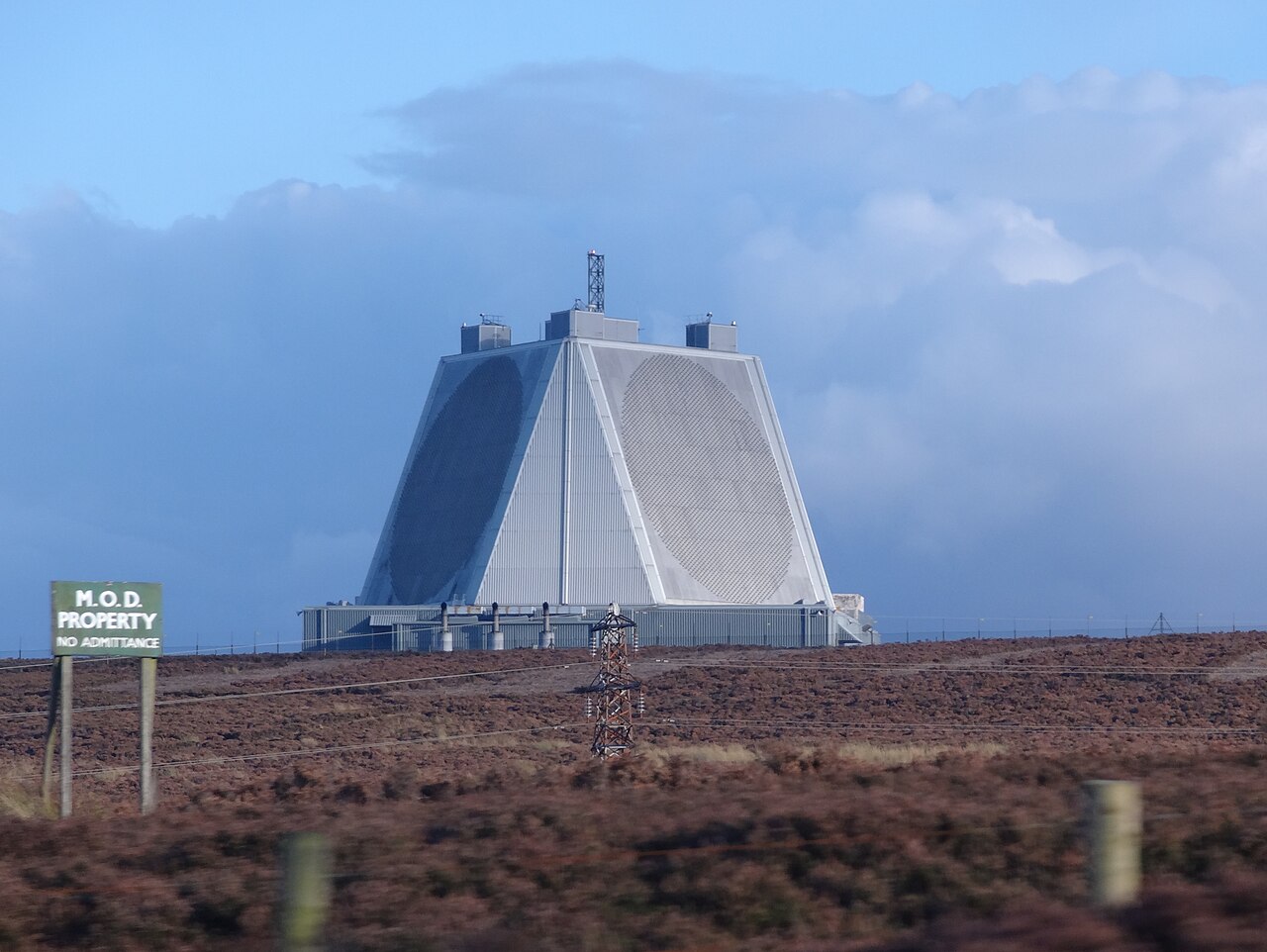
RAF Fylingdales, strategically positioned on the North York Moors, holds a pivotal role in both UK and international defence architecture. Since its establishment in 1963, it has been a cornerstone of ballistic missile early warning capabilities. The station was initially distinctive for its three large, spherical radomes, which colloquially earned it the nickname “the golf balls.” A significant technological upgrade occurred in 1992, replacing these iconic structures with the current Solid State Phased Array Radar. This advanced system is an imposing truncated pyramid, featuring three faces, each designed to provide 120 degrees of coverage. This innovative design allows for continuous, 360-degree surveillance without any moving parts, employing electronic beam steering to scan vast areas of sky.
The radar’s primary and most critical mission is to detect and track incoming ballistic missiles, providing vital early warning information to allied nations. This data is indispensable for the United States Ballistic Missile Early Warning System (BMEWS), contributing a crucial layer of defence against potential strategic threats. Beyond missile detection, RAF Fylingdales also plays a significant role in global space surveillance. This involves diligently tracking a wide array of objects in Earth’s orbit, ranging from active satellites to hazardous space debris. By doing so, it enhances overall space situational awareness, which is essential for ensuring the safety of space operations and protecting valuable orbital assets worldwide.
The broader context of private sector involvement in defence operations is a subject of ongoing discussion and policy debate across many nations, including the United Kingdom. Governments frequently engage private companies for a range of support services, including maintenance, logistics, and specialized operational roles. This approach is often driven by objectives such as achieving greater cost efficiency, accessing niche technical expertise, and enhancing operational flexibility. However, such arrangements commonly spark debates concerning transparency, public accountability, the potential implications for national security, and the long-term impact on sovereign capabilities, especially when they involve highly sensitive and mission-critical assets like an early warning radar system. Concerns can encompass the thoroughness of security clearances for contractor personnel, the potential for erosion of in-house military expertise, and the integrity of supply chains. The MoD’s reliance on existing, established internal processes for its contractual re-lets aligns with a common governmental approach to managing such risks, even if these internal evaluations are not publicly disseminated.
Why This Matters
The Ministry of Defence’s decision not to publish a risk assessment for private sector involvement at RAF Fylingdales carries significant implications across several critical domains, from national security to public accountability:
Transparency and Public Accountability:At its core, the parliamentary question from Mark Pritchard MP sought greater transparency regarding the management of one of the UK’s most sensitive defence assets. While the MoD asserts that robust internal “risk-assurance processes” were followed, the refusal to make these assessments public limits external scrutiny by Parliament, the media, and the wider public. In a democratic society, transparency is often considered vital for ensuring that public funds are managed responsibly and that national security decisions, particularly those involving private contractors in critical infrastructure, are robust, well-vetted, and command public confidence.
National Security Implications:RAF Fylingdales is not merely another military installation; it is a foundational element of both UK and international ballistic missile early warning and space surveillance capabilities. Its primary function is to provide advanced notice of potential strategic attacks, a mission of paramount importance. While the MoD firmly states it retains operational command, private contractor personnel are responsible for “defined operational, maintenance and sustainment support.” This raises pertinent questions about the scope of their access to sensitive systems and data, the stringency of security vetting processes for non-military personnel in such a high-stakes environment, potential vulnerabilities arising from supply chain dependencies, and the safeguarding of institutional knowledge if too much expertise becomes concentrated within external contractors. A publicly available, high-level risk assessment could offer vital reassurance that these complex security considerations have been thoroughly evaluated and adequately mitigated.
Parliamentary Oversight and Democratic Scrutiny:A fundamental role of Members of Parliament is to hold the government to account for its decisions and expenditures, especially in areas as critical as national defence. When information deemed crucial for effective oversight, such as risk assessments for key defence contracts, is withheld, it can potentially impede Parliament’s ability to perform its constitutional duty to scrutinize government actions effectively. This particular instance highlights the ongoing tension between a government’s assertions of national security confidentiality and parliamentary demands for greater openness and detailed accountability.
Precedent for Future Outsourcing:The MoD’s stance regarding Fylingdales could establish a significant precedent for how similar outsourcing arrangements are managed and reported across the broader defence estate and other critical national infrastructure. As militaries globally increasingly rely on private sector support for specialized functions, the principles governing transparency, risk management, and public disclosure in such partnerships become increasingly crucial. This case provides insight into the UK government’s approach to balancing operational efficiency and perceived cost-effectiveness with public accountability in the context of highly sensitive defence contracts.
Public Trust and Confidence:Maintaining public trust and confidence in the government’s ability to protect national interests is paramount. Assurance that critical defence systems, which are essential for national security, are managed with the utmost care, security, and integrity is fundamental. While the MoD’s internal processes are described as robust, a degree of public disclosure regarding a high-level risk assessment could further solidify public trust by demonstrating a clear commitment to openness concerning the security and operational resilience of vital defence assets.